
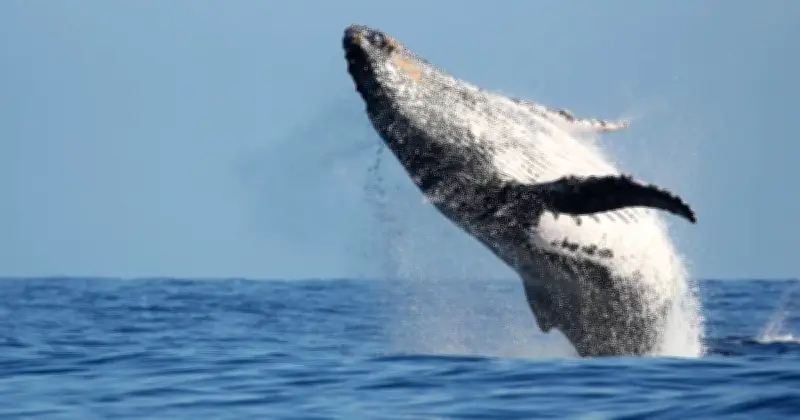
Genetic analysis has revealed that the Arabian Sea humpback whale may represent a fourth subspecies of humpback whale, according to a study published in Frontiers in Marine Science.
Researchers examined genetic material from Arabian Sea humpback whales alongside populations from oceans worldwide, analysing mitochondrial DNA from 2,285 humpback whales sampled throughout the species' range.
Decades of research in Oman
The discovery follows 25 years of whale studies in Oman conducted by the Wildlife Conservation Society working closely with the Environment Society of Oman (ESO).
Lead researcher Dr Rita Amaral said: "Arabian Sea humpback whales have long been an enigma to the scientific community. Their ecology is unlike that of any other known humpback whale population, and this new genetic work represents an important milestone in understanding how that uniqueness developed."
"The results clearly indicate the Arabian humpback whales have followed their own evolutionary trajectory for tens of thousands of years and support their recognition as a distinct subspecies."
Distinct genetics and behaviour
Researchers discovered that the Arabian Sea humpback whale population exhibited markedly different genetics compared to North Atlantic, North Pacific and Southern Hemisphere populations. The Arabian Sea group demonstrated the most limited genetic variation amongst all ocean regions studied.
The research findings lend credence to the potential designation of the Arabian Sea population as Megaptera novaeangliae indica.
The Arabian Sea humpbacks exhibit markedly different behaviour patterns, notably avoiding the lengthy seasonal migrations between feeding territories and tropical breeding locations. These whales remain within sub-tropical waters throughout the year, adhere to a Northern Hemisphere breeding pattern, and produce a distinctive song unique to the Arabian Sea region.
Ancient lineage confirmed
Genetic analysis indicated that Arabian Sea whale lineages separated tens of thousands of years previously, with various groups displaying estimated divergence periods spanning approximately 43,000 to 113,000 years ago.
Scientists examined ancient DNA extracted from the type specimen designated as Megaptera indica in 1883—a whale obtained near Basra, Iraq, whose remains are housed at the Muséum National d'Histoire naturelle in Paris. The scientific evidence confirmed this was a humpback whale specimen with close genetic ties to present-day Arabian Sea humpback whales.
Conservation concerns
Suaad Al Harthi, Executive Director of the Environment Society of Oman and a co-author of the study, said: "These findings are built on more than 25 years of dedicated research in Oman."
"What began with small-boat surveys to photograph individual whales and collect tiny tissue samples has developed into a much broader programme using satellite tracking, acoustic monitoring, health assessments, and other techniques. It is enormously rewarding to see samples collected during those early years now contributing to findings of such international scientific importance."
The research reveals that the population's limited size renders it particularly susceptible, as Arabian Sea humpback whales contend with numerous dangers including entanglement in fishing gear, vessel strikes, underwater noise, and pollution, alongside natural threats such as disease.
Climate change poses a further risk to the species, with monsoon patterns and ocean upwelling disrupting the availability of prey such as sardines. With such a small population, extinction remains a very real possibility without urgent intervention.
Aida Al Jabri from the Environment Authority of Oman commented: "The growing body of research on Arabian Sea humpback whales has given Oman an increasingly clear understanding of both the importance of this population and the pressures it faces."
"This evidence is now helping us move from scientific understanding towards practical conservation action, including regional cooperation through the International Whaling Commission and Oman's work to explore greater protection for important marine habitats through international mechanisms such as the International Maritime Organisation's special protection provided by Particularly Sensitive Sea Areas."
The International Whaling Commission recognises Arabian Sea humpback whales as their own distinct species and has recommended the introduction of a Conservation Management Plan. The study concludes that coordinated conservation efforts and dedicated resources are urgently required to safeguard these whales.
As the only known humpback whale population in which the entire group both feeds and breeds within the same geographical area, Arabian Sea humpback whales are genetically, demographically, ecologically, and culturally unique.
The Arabian humpback is classified as an endangered species, and their extinction would result in the irreversible loss of a distinctive collection of traits that could offer valuable insights into how baleen whale populations adapt to environmental shifts.
Dr Howard C. Rosenbaum, Executive Director of the WCS New York Bight Program, said: "Our collaborative efforts through the years, and especially with this most recent publication, further highlights how Arabian Sea humpback whales are genetically distinct from other humpback whales around the world."
"Generating the robust science about its unique evolutionary history, isolated nature, and small population size strengthens the case for protecting these humpback whales throughout their range."




