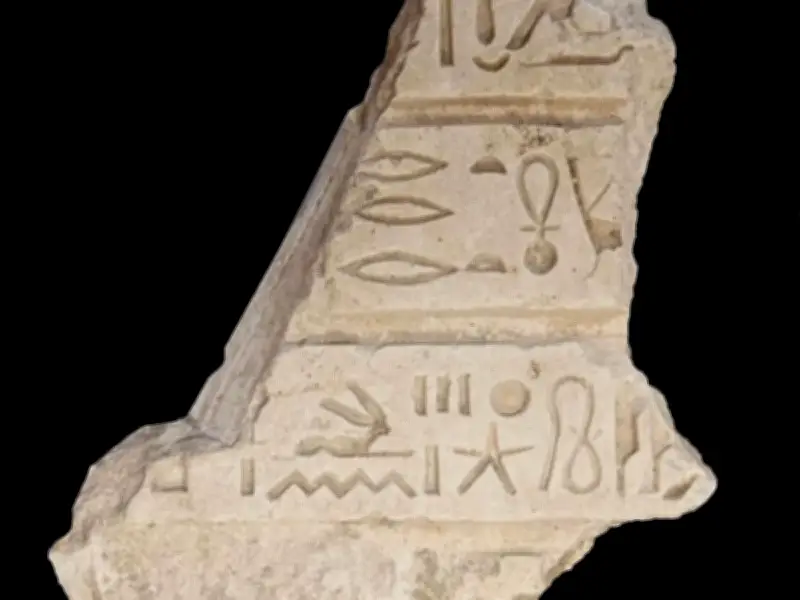
Archaeologists have uncovered a 3,000-year-old stone beam bearing the name of King Ramses II at Tell Abu Seifi, around 90 miles northeast of Cairo in northern Sinai. The discovery strengthens the site's ties to the long-lost ancient city of Mesen and may offer fresh clues about the world described in the Bible's story of Moses.
Discovery of the Inscribed Stone Beam
The stone beam, also called a lintel, was found broken into two pieces and has hieroglyphic inscriptions carved into three sides. It bears the titles of Ramses II and refers to restoration work carried out on a statue of Horus, described as "Lord of the City of Mesen."
Egyptian officials said the newly found inscriptions "present a strong archaeological and historical hypothesis linking the site to the ancient Egyptian city of Mesen." They vowed to continue "excavation and scientific study" in the hope of putting Mesen on the map.

Connections to the Book of Exodus
While Mesen is not mentioned in the Bible, its surrounding ancient infrastructure was. In the Bible's second book, Exodus, Raamses is referenced as one of the cities built by the enslaved Israelites. Historically, that city was built by Ramses II circa the 13th century BCE.
Another Mesen connection to Exodus comes from its location along the Military Road, which linked Egypt with the Sinai Peninsula and Canaan. However, the Bible states that the Israelites were intentionally led away from the Horus Military Road because God feared they would turn back to Egypt if they encountered war.
Additional Finds at the Site
Also uncovered at the site were the remains of a fortified temple complex surrounded by a mudbrick wall and gates. Storage rooms and two stone roads leading into the temple were found alongside fragments of falcon statues and other sculptures.
The team also recovered the torso of a royal figure carved from basalt, a Late Period statue missing its head and feet, and pieces of limestone and basalt falcon sculptures. Supreme Council of Antiquities head of Egyptian Antiquities Mohamed Abdel Badie said: "The archaeological evidence shows that the site underwent several phases of development." Director General of Sinai Antiquities Mahmoud Galal, who led the excavation, said the objects reflected both the military and administrative activity that once took place at the site.