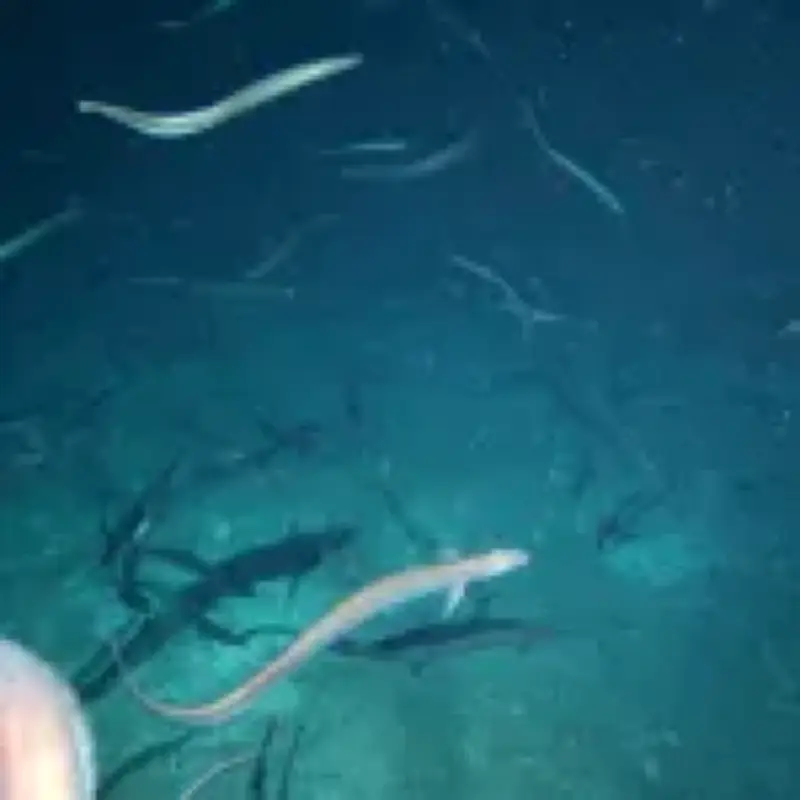
Millions of basketwork eels, weighing nearly 3.5 million kilograms, gather at a deep-sea mountain south of Tasmania each year to mate, according to a new study led by Australia's scientific research agency CSIRO. The research, published in Royal Society Open Science, counted the eels for the first time.
Eel aggregation at Patience Seamount
The 2.8 million eels, known to scientists as Diastobranchus capensis, cram into Patience Seamount just south of Tasmania. These slimy scavengers, which look like purple-ish woven noodles, are usually found across the southern coasts of Australia and Africa but have been slithering to a specific ridge at Patience Seamount since the 1980s, peaking from March to May before dispersing in October.
Study lead author Ben Scoulding told the Australian Broadcasting Corporation his team carried out surveys between 2023 and 2025 to count how many eels make up the blob. They used a hydro-acoustic survey, which Scoulding described as a 'really expensive scientific fish finder', to ping sound waves down below. The sound would bounce off anything it knocked into, allowing the researchers to see all the wriggling eels.
Spawning and feeding behaviour
Dr Scoulding said the ball was about 1,000 metres deep and covered an area about two by three kilometres wide. 'One of the interesting things is the persistence of the aggregation,' he said, adding: 'It is there for the majority of the year.'
CSIRO caught a few eels and found they all had empty stomachs, with most of the females close to laying eggs, called spawning. This suggests they may stop eating as they prepare to join the writhing eel ball.
Population concerns
The study's count is far higher than an estimation made in 2015, which was tens of thousands of eels in April that year. Previous catches have similarly found both males and females in peak spawning condition, suggesting they came for a reproductive reason.
Dr Scoulding says his team's findings don't reveal why the eels have chosen Patience Seamount for their gathering. Populations of the eel on the slopes in New Zealand have declined 85% in the past 40 years, though it's unclear if drops at Patience Seamount have happened before. Basketwork eels are vulnerable to becoming endangered, according to the International Union for Conservation of Nature's Red List. Fisheries are accidentally catching the eels, causing the eel population to slowly but 'significantly' decrease, the global scientific authority says.