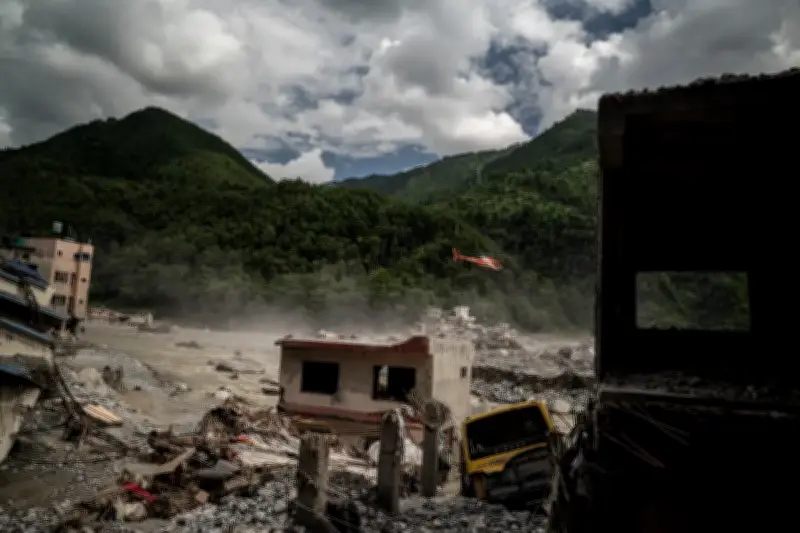
More than 5,000 people are reported missing in Nepal and a further 546 in China-controlled Tibet after flash floods devastated communities, with survivors using their bare hands to search for loved ones in the mud. In Betrawati, Dil Bahadur Shrestha, 70, has been picking through the ruins of his house, lamenting that he doesn't even have a shovel left, as he searches for his wife of 50 years, Jamuna.
Jamuna was last seen going back into her house to usher her chickens to safety as deadly flash floods coursed down Nepal's Bhotekoshi and Trishuli rivers. The floods left more than 1,200 people dead in Nepal and Tibet. Dil Bahadur Shrestha, who was tending to his rice fields on the opposite bank, saw a black wave hundreds of metres high coming down the valley and ran to safety in the forest, but not before watching two bridges get swept clean away.
Rescue efforts hampered
Rescue workers have still not reached Dil Bahadur Shrestha's home, so he returned to try to retrieve his wife's body himself. The couple had already rebuilt their home once after an earthquake in 2015 that killed about 9,000 people. As he spoke, his frail body collapsed to the ground on the barren, muddy terrain where his neighbour's house once stood.

The scale of the tragedy in Betrawati is unfathomable. At 8.37am, a melting glacier high up in the Himalayas on the border between Nepal and Tibet crashed into the valley below, setting off deadly flash floods. By 8.50am, with only a few minutes warning, the settlement of Betrawati was engulfed.
Villages wiped away
Further up the river, in the district of Rasuwa, many villages were swept away entirely and are only accessible by army helicopter. Some are still so cut-off that the fate of hundreds of local people remains unknown. On Tuesday, police search and rescue teams confirmed they had finally been able to begin ground operations in the border village of Timure, recovering 90 bodies so far.
The mountain village of Syabru Besi was among those wiped clean away, with even the road to the village gone. According to local government officials, at least 500 people there are missing, a quarter of the population. The village now resembles nothing more than a muddy riverbed, just one building left standing.
Aid and hope amid tragedy
With the highways washed away, the only road from Kathmandu to Rasuwa is a perilous unpaved track of mud and stones, weaving through tiny mountain villages. The treacherous conditions have made it difficult for aid to reach the worst-hit areas and hindered the rescue and relief operations. Many aid trucks are now stuck in Dhunche, unable to drive any further north.
At a small relief camp on the road between Betrawati and Dhunche set up by Nepal's Dhulikhel hospital, doctors said dozens of the children here had lost their parents in the floods. More than 200 local children from the local Nilakantha school, most between the ages of five and 11, are also missing, believed to have been washed away as they walked to morning classes. Amid the tragedy, there were also small stories of hope. Ram Krishna Neupane, 69, and his wife, Muiya Neupane, 66, said their only son had been rescued by the army after two days of silence, calling from a hospital in Kathmandu, which his wife called "a miracle".