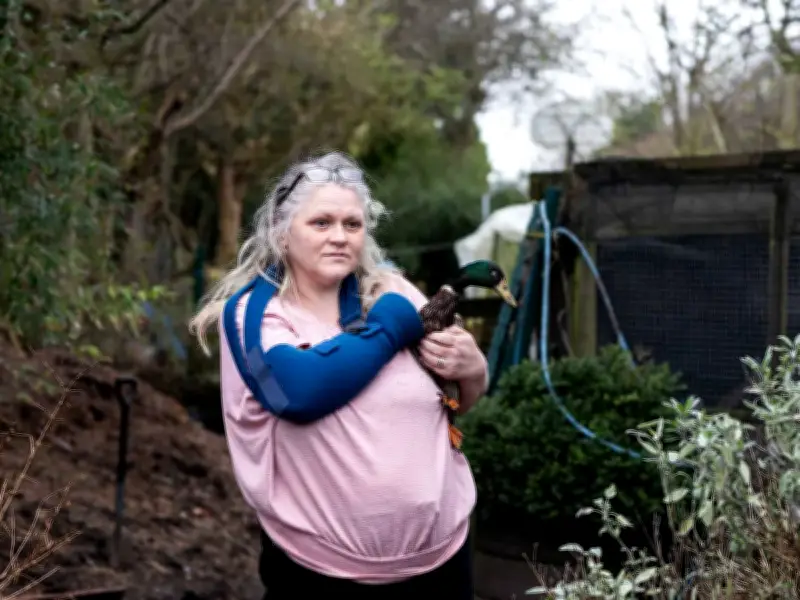
A mother living in a village blighted by forever chemicals has spoken of her horror at the thought she poisoned her children by feeding them fruit and vegetables from her garden.
Sam Linacre-Hammond, 48, spoke out as it emerged that blood tests of villagers in Thornton Cleveleys, Lancashire, showed two thirds had elevated levels of cancer-causing toxins.
Mum-of-four Sam regularly cultivated fruit and vegetables including potatoes, tomatoes, and strawberries, at an allotment beside her home in Thornton Cleveleys, Lancashire. She also kept hens and ducks that laid eggs, which her family consumed.
Home beside former ICI plant
Her property sits just a stone's throw from the former ICI plant, which manufactured PFOA, part of the PFAS (Per- and Poly-Fluorinated Substances) family, also known as forever chemicals. PFOA is known to build up in blood and can trigger cancer, immune system disorders, as well as high, bad cholesterol.
Earlier tests have shown that the chemical - frequently used to coat non-stick pans - was discovered in the soil of 71 properties surrounding the plant.
Environmental law firm Leigh Day subsequently commissioned blood tests for 49 residents to determine if their blood contained elevated levels of the toxic substance.
Shocking blood results
Sam has since disclosed her blood contained 25 nanograms per millilitre (ng/ml) of blood which, according to Leigh Day, puts her in the high-risk category. Though blood samples taken from her son Lazarus Hammond, 20, revealed extremely elevated levels of 111 nanograms per millilitre (ng/ml) of blood, something which Sam has "no explanation" for.
The mum said: "It makes me angry and guilty for poisoning my children for all of these years. The results are shocking, I am so overwhelmed by it all.
"The only thing I can think of for why my children's levels are so high is that I breastfed them. They only tested Lazarus because he is over 18, I dread to think what my other children's levels are.
"We would eat two eggs a day each, which we would have in sandwiches or use while baking and the veggies were used in most dinners. I used the area a lot with my children, now it is abandoned, we don't dare go on it anymore."
Sam also experienced a cryptogenic - or unexplained - stroke in 2020, which she attributes to consuming contaminated food.
"I was fit, healthy, and a low risk for something like this to happen. The only thing doctors said that could have caused it was high cholesterol. I have never suffered from high cholesterol ever and now I'm on two medications to keep it down. There are a lot of unanswered questions but I think it is the poison."
Council advice and investigation
Testing conducted by Leigh Day discovered that nearly 70% of participants had raised levels of PFOA which put them at a greater risk of developing health complications linked to the chemical, such as high cholesterol and certain cancers. A multi-agency investigation, involving the council and the Environment Agency (EA), into contamination by PFOA (Perfluorooctanoic Acid) from the ICI site in the Hillhouse Technology Enterprise Zone was launched in 2024.
Soil testing uncovered elevated levels of PFOA in samples collected from residents' properties and nearby allotments. The council has since advised residents to avoid eating fruit, vegetables or eggs grown in the surrounding area, while two allotments have been formally shut down.
Law firm Leigh Day has also been looking into PFAS contamination in the area, collaborating with experts led by Dr Dave Megson at Manchester Metropolitan University (MMU) in association with Watershed Investigations. As part of these investigations, blood tests were arranged for residents who were selected based on their proximity to the chemical factory, the length of time they had lived in the area, and whether they consumed locally grown produce.
The blood testing took place over summer 2026, carried out by a specialist team from MMU, with results communicated to participants on 23 September 2026. The findings revealed levels of PFOA above 20 nanograms per millilitre (ng/ml) in 69.4% of participants, placing them in the high-risk category, with the overall average recorded at 26 ng/ml. Not a single participant returned results in the low-risk category of below two ng/ml.
Higher than average PFOA levels were recorded amongst participants residing within a kilometre of the industrial site. Notably, 75% of participants who consumed home-grown fruit and vegetables were found to fall into the high-risk category.
Andrew Molloy, 46, whose back garden borders the southwestern fence line of the factory, had been growing strawberries and herbs which he regularly consumed. He says the "first thing" he is going to do is take it to his GP and at least get it on his record.
Comparisons and response
Experts examining the site say the findings are comparable to those of residents in Ohio living near a DuPont factory, in the case adapted into the film Dark Waters, where an average of 32.9 ng/ml was recorded.
Leigh Day partner Sarah Moore, who heads the firm's investigations, said: "The results of our testing project in Thornton Cleveleys are hugely concerning. They are a reminder that PFAS contamination has a human impact, not just an environmental one.
"The available evidence suggests that PFAS exposure can lead to serious health impacts, including cancers, when it reaches elevated levels. Those levels have already been exceeded in Thornton Cleveleys and it is now the community that are paying the price of that exposure in terms of potential health effects, restrictions on what they can grow and eat locally, and the value of their properties.
"The Government has promised increased engagement and regulation of PFAS contamination, but as yet nothing has been done. The situation in Thornton Cleveleys is a reminder that action should be taken now."
A spokesperson for AGC Chemicals Europe, Ltd., which currently owns the site, said: "We would emphasise that the UK Government's position is clear: PFAS blood testing does not predict future health problems and can sometimes create unnecessary concern. For these reasons PFAS biomonitoring is not currently recommended through the NHS or private blood tests.
"The Hillhouse site and surrounding area has been dedicated to industrial chemical manufacturing for well over a century – long before AGC Chemicals Europe, Ltd. was established - and a wide variety of historical users have operated on the site. Since the wider multi-agency investigation is still ongoing and no formal determination of land contamination has been made under Part 2A of the Environmental Protection Act, we cannot speculate on future outcomes or next steps.
"AGC Chemicals Europe, Ltd. has been part of the Thornton Cleveleys' community since 1999. The health, wellbeing and safety of our employees and the local community remain our priority."