Internal Syngenta records revealed through US litigation show the company did not share certain paraquat health and safety data with the Environmental Protection Agency (EPA), even as the US remains one of the world's last large markets for the weedkiller. The chemical is banned in more than 70 countries.
Global bans contrast with US market growth
Sweden called for a ban on paraquat in 2004, and dozens of other countries followed as evidence of health risks mounted. The Chinese government, which owns Syngenta, halted domestic use of the pesticide a decade ago after its own studies found troubling results. In the US, Vermont and California have recently banned paraquat, and California regulators announced in August that paraquat makers voluntarily agreed to stop selling the chemical after the state identified health concerns. Several federal lawmakers have pushed for a nationwide ban.
Despite this, the EPA continues to allow paraquat use on millions of acres and has downplayed scientific findings linking it to Parkinson's disease, an incurable brain condition. The agency said in June it would hold a round table over the summer to re-examine the safety challenges, but no such event has yet been held or scheduled.
Data not shared with regulators
The newly released files, totaling roughly 3,700 pages, were submitted to a Pennsylvania state court where people with Parkinson's have filed cases alleging they developed the disease from exposure to paraquat products. The records show that as paraquat markets around the world crumbled, Syngenta fought to hold onto the US market, where use of paraquat nearly tripled between 2000 and 2018.
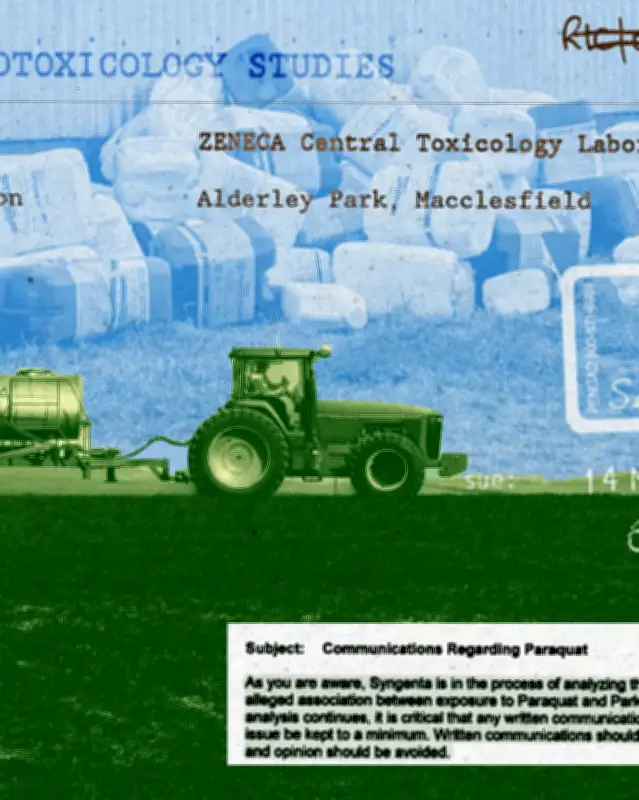
Internal corporate records and depositions show that Syngenta did not share certain internal data with the EPA regarding paraquat health effects and risks, despite federal legal requirements to report information about unreasonable adverse effects. Among the data not shared were analyses of how quickly the chemical could permeate untreated clothing, how fast it could absorb into an applicator's skin and bloodstream, and some information about how mixing paraquat with surfactants increases absorption. Certain information demonstrating risks to the brain from exposure was also not shared.
Syngenta said it has never knowingly failed to provide regulators with any relevant and required information. The company has long maintained there is no actual link between paraquat and Parkinson's disease, and that its decision to stop global production of paraquat, announced earlier this year, was based purely on market factors. The settlements include no admission of liability.
Examples of undisclosed information
Court documents and internal files show multiple examples of information Syngenta developed or accessed but did not give to the EPA. At least since the 1970s, the company had information that paraquat could become more toxic when mixed with surfactants, which farm workers mix into weedkillers to help absorption on plants. Company files show worries about increased toxicity and studies showing potential for increased absorption, including through skin and nasal membranes. Syngenta denied in court filings that surfactants will normally increase the absorption of paraquat and hence increase its toxicity.
Data showed that Syngenta's Gramoxone paraquat product almost immediately penetrated cotton and other clothing materials, including Tyvek materials used in protective apparel. Though the study was done in 1985, Gramoxone labels have stated for years that users can wear a long-sleeved shirt and long pants. An analysis in 2007 of paraquat in the urine of workers spraying the chemical brought bad news, with two sprayers showing levels vastly exceeding acceptable operator exposure levels. A Syngenta scientist wrote in an internal email in June 2007: "This is bad news whichever way you look at it."
The EPA said in a statement that it cannot speculate on how this additional information would impact its assessment, but noted it has based its paraquat assessments on an extensive database of information. The agency said companies must submit information regarding any unexpected or unreasonable adverse effects resulting from their product's use to EPA, and failure to comply is a direct violation of federal law.
Scientific concerns and bans
Numerous scientific studies have found that paraquat damages cells in the brain in ways that can lead to Parkinson's. In one email attached to the court filing, a Syngenta scientist wrote to a colleague: "what we want to do is brush aside 10 years of research by others and replace it with our own." The company would employ the best people to help and would need impeccable data as well as a lot of luck.
Brazil banned paraquat, citing the risk of Parkinson's and concerns that the chemical may be mutagenic. China started a phase-out of paraquat in 2012 and ultimately banned it domestically in 2016 after finding extreme toxicity risks. The World Health Organization in a 2022 report called for banning certain pesticides, including paraquat.
In its 2021 decision, the EPA said there was insufficient evidence of links between paraquat and Parkinson's and a range of other health problems, and considered the human health database for paraquat complete. The EPA administrator, Lee Zeldin, said in January this year that the agency was making a decision to freshly reassess the safety of paraquat as part of an effort to recognize the Make America healthy again movement, but an EPA spokesperson contradicted Zeldin, saying he had been referring to volatilization data.