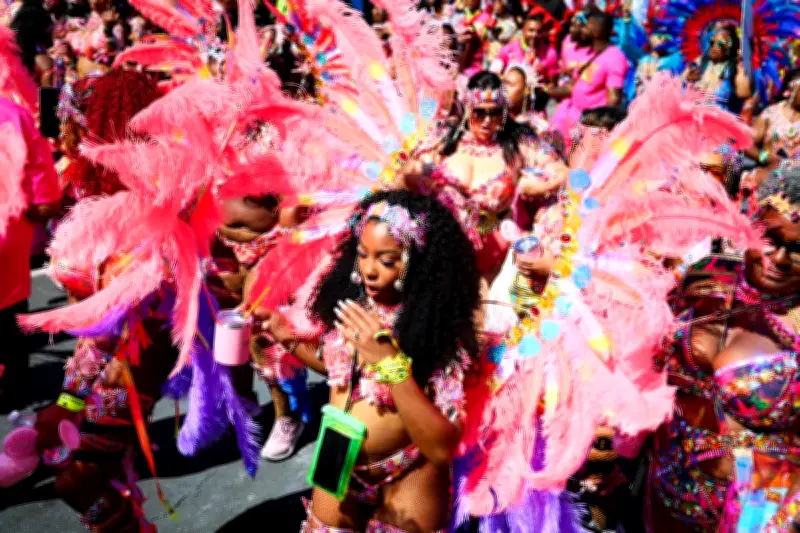
The Notting Hill Carnival almost didn't happen in 2025. Months of costume design, float construction, and rehearsals nearly collapsed after the carnival struggled to secure adequate funding following an independent safety review reporting “critical public safety concerns.” London's City Hall and the local councils of Kensington & Chelsea and Westminster were forced to step in with an emergency £1million bailout to save the Carnival in July last year, signalling the escalating battle over Europe's largest street festival.
Just eight months later, Sir Sadiq Khan wrote another cheque totaling £4.66 million ahead of this year's carnival, which marks the world-famous event's sixtieth anniversary. The festival finds itself at a crossroads as it battles rising costs, safety concerns, and an onslaught of negative publicity.
Rising Costs and Funding Challenges
Born out of British-Caribbean resilience and resistance to racism, CEO of Notting Hill Carnival Ltd Matthew Phillip argues the event is still “the biggest celebration and example of diversity” in Britain. Yet as the event attracts more than two million attendees each year, it is now facing scrutiny over its operational budget, policing requirements, and public safety record.

The total cost for the three-day event has surged from approximately £6million in the early 2000s to a staggering £21million in 2025. These costs cover stewarding, policing, clean-up, and security, including additional costs for third-party contractors. At a time when council budgets are already stretched, opponents of the Carnival have pushed for City Hall and the London councils to tighten the purse strings on funding the festivities.
Councillor Susan Hall, leader of the Conservatives in the London Assembly, has made no secret of her blunt verdict on Carnival's financial future. “It's absolutely eye-watering the amount it costs,” she says. “It costs us an absolute fortune. Why should we have to pay for this?”
Economic and Social Impact
But for carnival organisers like Mr Phillip, it is an “investment” rather than a “burden” or a “drain”. According to research commissioned by the Voice Newspaper in 2024, JN Bank economist James Williams found that “total direct or net economic impact of Europe's largest street festival is over £396 million annually”, as well as bringing in some 160,000 tourists and supporting 3,000 full-time jobs.
“It's an investment in what it brings back to society,” Mr Phillip adds, explaining that carnival began “as a reaction” to marginalisation and deprivation, but created a way “to bring people together to celebrate things we have in common.” “It's a feeling of pride and a feeling of belonging,” he says. “No matter what our skin colour or religion, we're all human beings.”
Leroy Logan, a former police superintendent and founding member of the Black Police Association, says carnival contributes a great deal into “empowering young people to know about their identity”, giving them a sense of “hope and aspiration”. “There is that opportunity to pass on a positive legacy from generation to generation,” he says.
Policing and Safety Concerns
It is not just the cost of Notting Hill Carnival that is rising; costs across London events have been on the rise. City Hall's funding package for Pride in London rose from an initial £500,000 five-year contract in 2013 to a £625,000 five-year contract in 2023, while the budget for the annual New Year's Eve fireworks display increased to approximately £4million in 2024 - even after the introduction of ticketing a decade earlier.
The rocketing costs faced by Carnival include policing, paid for by the Met Police each year. In 2025, the force spent £15.7million on the event - up from £11.7million in 2024. The expenses include accommodation, catering, and officer overtime. In contrast, the Met Police spent just over £10 million on policing the 133 Premier League football matches hosted in London across the entire 2024-2025 season.
Tensions at carnival truly came to a head in 2024 when Cher Maximen was stabbed in front of her three-year-old child with a zombie knife - a story which shook London. But also a story which provided the vitriol for many to brand Notting Hill Carnival as a “violent” and unsafe event in desperate need of resolution.

“There is violence every single year at this particular event,” says Cllr Hall, pointing out that since 2016, more than 75 people have been stabbed. Last year, 528 people were arrested, four people were stabbed and 18 people were arrested for sexual assault. But the reality is more, with the Met Police reporting a decline in serious violence in recent years - aided by facial recognition technology - and the majority of arrests stemming from drug offences rather than possession of offensive weapons.
Mr Phillip insists that knife crime is a problem across the capital and not just at carnival. “Any crime is not tolerable or acceptable in our view,” he says. “Carnival doesn't cause crime. We are victim[s] of crime like everyone else.”
Some of Carnival's mas band leaders have claimed that official figures are inflated by nearby, unrelated incidents - such as the 2024 murder of Mussie Imentu in Queensway, which took place outside the Carnival's footprint. Others have added that it is seldom the parade participants who are involved in the violence, rather the participants. Colin Julien, owner of Caribbean Sessions mas band, explains as a participant of the parade, he has never seen the violence portrayed in the headlines. Pauline, band leader of Funatik Mas, agrees that she always feels safe at carnival as part of the band.
A Met Police spokesperson said: “We already distinguish between arrests at the event and arrests made on the approaches to it. For example, last year there were 528 arrests overall and we explained in our public statements that 135 were on the approaches to Carnival while the majority (393) were inside the event footprint. Arrests on the approaches are still very relevant, as a key part of the policing operation involves doing all we can to keep people safe by identifying and intercepting people intent on committing crime before they get into the busy crowds at the event.”
Strain on Police and Calls for Reform
Beyond the monetary expense, the event can also place heavy strain on police services, forcing officers from surrounding counties and constabularies to work across bank holiday weekend. “The police have got to go. Their holidays are stopped. They are obliged to go,” says Cllr Hall. “I don't like the way police are treated during it. They're kicked at, they're spat at, they've broken arms over time.”
According to Met Police figures, seventy-eight officers were injured while policing Notting Hill Carnival last year, while 100 were injured or assaulted in 2024. A report by the Metropolitan Police Federation, representing 30,000 rank and file officers, recorded that 88.66% of officers said they felt unsafe while working at carnival. In one section of the report, an officer described the carnival as a “war zone” where “officers are treated as lambs to slaughter.”
But Mr Logan has warned against framing the event as a “them vs us” narrative. “Carnival has been viewed in a prism of crime and violence,” Mr Logan said, adding that the black community is frequently labelled as “violent and troublemakers,” with several organisers expressing frustration at the carnival's negative perception in the press.
Mr Logan called on the Met Police to issue outcomes following arrests, including whether the suspects were charged or cautioned to provide context to the raw statistics. He also condemned the Met's use of tactics such as kettling, instead advocating for pre-emptive arrests and interventions to manage potential fallout at Carnival. “I did that as a superintendent in Hackney. I'd go to certain areas where I built good relations, speak to [suspects], speak to youth workers, or even elders in the neighbourhood,” he said.
Responding to claims about a “them vs us” narrative, a spokesperson for the Met said: “We don't recognise this characterisation of the present-day policing of Carnival. We've been very clear that the vast majority of people attending are there for all the right reasons – to have fun and enjoy a celebration. Our aim is to ensure they can do so safely by relentlessly targeting the small minority who are there to be violent, to put women at girls at risk or to commit other offences.”
Future of the Carnival
The festival has grown exponentially since its beginnings in the 1960s. From 500 residents in 1966 to more than 2 million expected in 2026. For many, the route, which has never expanded since its inception, is no longer fit for purpose and has led to criticism about overcrowding and “pinchpoints.”
“It's a disaster waiting to happen with the crushing. It is absolutely rife for a crush” says Cllr Hall. “You'll end up with a Hillsborough situation.” “The joys of ticketing is you'd know how many people were there. You could arrange policing and all sorts of things in a better way. Secondly, it would start to pay for itself,” she said.
Organisers have been resolute in their plans to keep Notting Hill Carnival on the streets of W1, pointing out that Hyde Park's largest licensed event, British Summer Time, caps daily capacity at 69,999 - a fraction of the attendance at Carnival. Mr Phillip argues that carnival must be “maintained as a free event which doesn't have any barriers to participation, honouring the event's founding principles as a place of inclusivity and community.
But organisers do have an alternative plan as they plot to “approach the Arts Council in the future so that Notting Hill Carnival can become a National Portfolio Organisation,” meaning the company could secure additional grant packages. Without it, the carnival's future does hang in the balance, with organisers agreeing that a more permanent solution must be found.
Dr Debbie Weekes-Bernard, London's Deputy Mayor for Communities and Social Justice, said in a statement that the mayor was “proud” to step in to ensure this “fantastic celebration of Caribbean culture” took place in its 60th year. But it remains unclear whether City Hall will continue to provide Notting Hill Carnival with the funding it needs.
A Kensington and Chelsea Council spokesperson said: “Our priority is to support the organisers in putting on a safe, successful and memorable Carnival for everyone.” The statement added that the council would support traders and sound systems, providing more than 1,000 toilet facilities and teams would be deployed to clear around 300 tonnes of waste from the streets.
Besides the financial returns that Carnival brings to the capital annually, “it would be virtually impossible to measure the social impact [that Notting Hill Carnival] has in the kinds of well-being, self-pride, feeling of belonging,” says Mr Phillip. “You can't put a price on that,” he says.
And band leaders, sound systems, and steel pan bands all agree. From memories of playing mas for the first time, to honouring those who lost their lives at Grenfell, Notting Hill Carnival has brought together communities and has served as a vital tool for empowerment, especially amongst young people. The event is one of only occasions in the London calendar which sees multiple generations celebrating together, one band leader tells the Standard. Another adds that carnival “puts the unity in community.”
Crucially, the organisers want to invest more of the funding into the people “at the heart of the event”, including the sound systems, mas bands, Brazilian bands, and steel bands. By bolstering the cultural relevance of the event, organisers believe they can protect the carnival to ensure it is treated as a piece of heritage, and not just a giant street party.
“Those communities are the artistic and cultural lifeblood of the event,” says Mr Phillip. He adds that recognising Carnival as “the force of good” that it is will be the first step in ensuring it lives on to see another 60 years and more. Amid a backdrop of racial tensions and hostility, carnival organisers continue to see the event as a symbol of diversity and a cause for celebration. “It's a big message to those people that seek to find division and rift in our communities. Everyone that comes to carnival is not here for that. This is us coming together to show solidarity.”