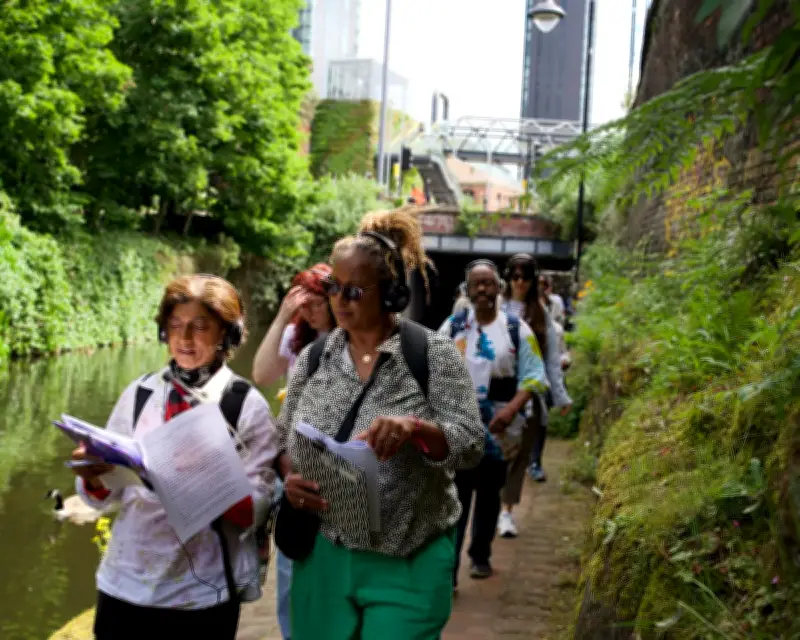
New walking tours in Manchester are bringing to light chapters of the city's Black history that have been largely ignored by official commemoration. The Heritage in Action trail, guided walks exploring the lives of people whose labour shaped the city and its direct relationship with transatlantic slavery, will run on 7 October, World Cotton Day. The events have been produced by the Guardian's Legacies of Enslavement programme and the charity Greater Manchester Moving.
Hidden histories and overlooked landmarks
From the "great crowd" of Black Georgians who gathered at the city's collegiate church to campaign for abolition in 1787, to Pan-Africanist politicians, writers and economists who led postwar independence struggles after meeting in Manchester, the city has a rich history of Black activism. Artists including Nina Simone and Miriam Makeba gave Manchester concerts that galvanised and inspired.
Despite being home to one of the UK's largest postwar Black communities, and the city's evolution depending on cotton produced by enslaved Africans, there are few commemorations of Black history in Manchester's public realm. The Len Johnson Memorial Campaign is hoping to rectify that by bringing a bronze statue of the British boxer, civil rights activist and trade unionist to the city. While sculptures of the Black peace campaigner Erinma Bell and Yomi Mambu, the city's first Black lord mayor, exist in Manchester town hall, a statue of Johnson would mark the first outdoor statue of a Black person in Manchester.
Walking tours explore memorialisation
In May, the Guardian's Legacies of Enslavement programme funded trial walks for October's heritage trails. These explore histories behind landmark locations, including the Peace Garden, where a plaque commemorating enslaved Africans and a quote from the abolitionist Olaudah Equiano are dwarfed by a nearby statue of Abraham Lincoln. The great African American abolitionist Frederick Douglass was believed to be staying at an address in St Ann's Square when he learned his freedom had been secured; there is no plaque there.
The Decolonial Dogs heritage trail, led earlier this year by Bilal Zafar Ranjha and Elmi Ali, began at Manchester Cathedral, telling the story of the 1787 antislavery meeting led by the abolitionist Thomas Clarkson that led to one in five Mancunian adults – 10,500 people – signing a petition against the trafficking of enslaved Africans. Ali said he believed such moments showed how "people are more progressive than institutions". He added: "Do people know one in five of the population in that period signed up to support what would be the equivalent to Black Lives Matter now?"
Historians challenge historical amnesia
Drawing on research from Dr Cassandra Gooptar of the University of Hull's Wilberforce Institute, Ali told the stories of enslaved Africans including Archy Gordon, 50 years old and blind, and Sam Kerr, 19, who lived on the Success plantation in Hanover, Jamaica, owned by one of the Manchester Guardian's founding investors, George Philips. Ranjha described the situation as "historical amnesia and whitewashing history".
Prof Anandi Ramamurthy, an academic specialising in post-colonial histories, culture and mental health who took part in the Decolonial Dogs trail, said: "To me, if you want people to talk about community cohesion, that cannot be done without transparency and without accountability – all the institutions of Manchester need to come forward and look at their past, so we're able to come together and to envision a different future." Ali added: "Global majority citizens of the country are framed constantly as new arrivals, which is how erasure works – but Africans have been here for centuries."
Tours link lost landmarks and community memory
Linford Sweeney's 7 October tour looks at the impact of changes to the built environment on local identity and memory in Black communities. The streets of Moss Side and Hulme have been remodelled substantially twice in the past 60 years – first by slum clearance programmes of the 1960s, and again when 1970s buildings such as the Moss Side Precinct shopping centre and Hulme Crescents council estates were pulled down in the 1990s. The tour links lost and surviving landmarks with the legacy of the Windrush generation, weaving stories of workers, activist spaces, venues, shops, and vanished streets with personal recollections.
Stops include Hulme's Nia Centre – "a beacon of cultural expression and community empowerment" – where Simone performed in 1991, Sweeney says. A May trial event brought memories flooding back for Pauline Weir, a lifelong community organiser, who recalls how Black homeowners such as her father got "next to nothing" for their homes under compulsory purchase orders. "I think the lack of recognition of our history is purposeful," Weir said. "And I think when they had the compulsory purchase orders, it was purposeful. Every time they've demolished physical buildings, they demolish community."
Hayley Flynn's "myth-busting" city centre tour raises questions about the city's approach to memorialisation over centuries. Starting at the River Irwell, it moves to the Northern Quarter via stops including the Peace Garden, Chinatown and the gay village. Flynn said: "When we celebrate the city's support for abolition we symbolise that through the iconography of Abraham Lincoln, not of the enslaved people themselves, nor, on a local level, the labourers who went on strike."
The Grass Routes Movement CIC x Rooted Liberation walk, featuring Sajida Ismail and Anisa Saleh, is an act of healing, exploring the violence that underpinned the relationship between the transatlantic trafficking of enslaved Africans and Manchester's waterways. Their interactive, poetic walk travels along the city's canals to Manchester Science and Industry Museum. Saleh said: "It's not about pointing the finger, or apportioning blame. It's about how we can be together and give voice to this history. A walking activity is a vessel for that difficult task, and the care that underlies the process is part of the ongoing legacy, the corrections, the acknowledgments. Let's all be a part of that, in ways that are helpful and healing."