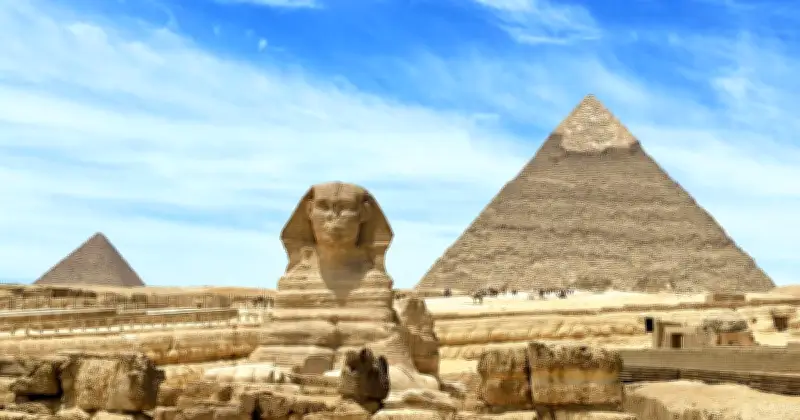
New research suggests the Great Pyramid of Giza may have had a purpose beyond serving as a tomb for Pharaoh Khufu. Independent researcher Sefy Levy has proposed that the monument was designed as a message, with its true meaning hidden within its shape and measurements.
Mathematical matches with natural cycles
By analysing the pyramid using fractions employed by ancient Egyptian scribes, Levy found numbers that appear to align with important natural cycles. One result, 27.5, is close to the number of days between the Moon's closest approaches to Earth. Another, 70, corresponds to the period when the star Sirius disappears in the Sun's glare.
These matches led Levy to suggest the pyramid was intended to preserve knowledge of mathematics, time and the sky. As he puts it, the monument was not simply a container for knowledge—it was "the knowledge, made stone".

A 'three-dimensional cosmological monument'
Levy wrote in his "The Pyramid As Memory" hypothesis that the structure was built to permanently encode the ancient "Zep Tepi" cosmological system. He describes it not as a tomb, but as a "three-dimensional cosmological monument that recreates the primordial landscape" from which ancient Egyptians drew their sacred worldview.
According to Levy, the pyramid was built to recreate the "First Time"—the era before a primordial "flood of sand" swept away the ancestors' world. He argued that the mystery visitors have felt in the empty chambers was never hidden inside, but rather "the form they were standing within".
Speculative hypothesis awaits verification
The hypothesis remains highly speculative. Levy's paper has not yet undergone formal peer review, and no surviving ancient texts explicitly tie the pyramid's dimensions to astronomical cycles. Mainstream historians have warned that because the dimensions and astronomical numbers were already known, some alignments could be coincidences found by testing various calculations.
For now, Egyptologists maintain the traditional view that the pyramid was built as Pharaoh Khufu's ultimate funerary complex. The Great Pyramid is the largest of the ancient Egyptian pyramids and the oldest of the Seven Wonders of the Ancient World, and the only one that remains today.
Built around 2560 BC, it stood as the tallest man-made structure in the world for over 3,800 years. Commissioned by Pharaoh Khufu, it was constructed over approximately 20 to 27 years. Originally 481 feet (146.6m) tall, its base covers about 13 acres, and it is composed of an estimated 2.3 million limestone and granite blocks, averaging 2.5 tonnes each.