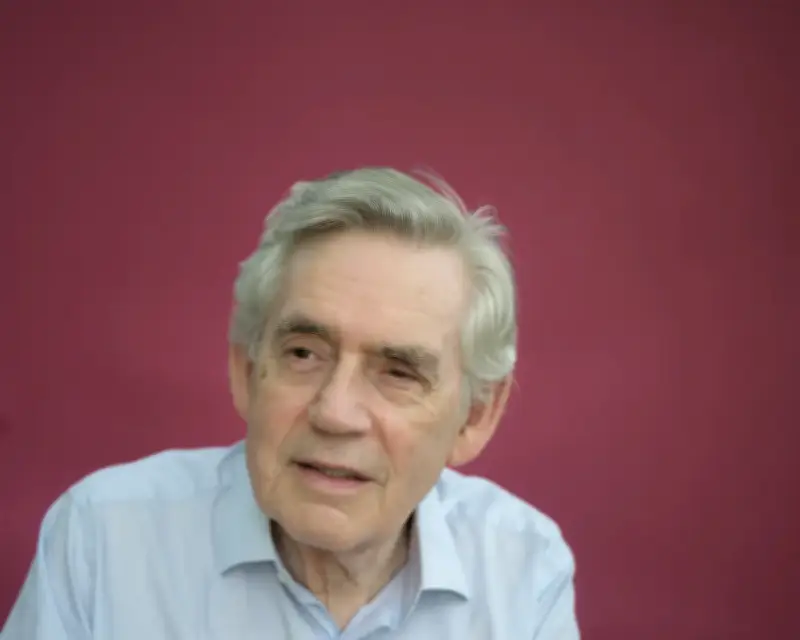
Gordon Brown, the former prime minister, has said he does not want to be a "backseat driver" in Labour politics, but he hopes Andy Burnham will heed his report recommending abolishing the House of Lords. In an interview at his home in North Queensferry, Brown discussed his new book, The Future Starts With Us, his views on global politics, and his continued influence on the Labour party.
Advice to Burnham and Labour's Future
Brown, who served as prime minister from 2007 to 2010 and as chancellor from 1997 to 2007, is an adviser to Burnham, the mayor of Greater Manchester, overseeing the G20 and defence spending. He said his advice to Burnham before appointing John Healey as chancellor would have been "not to take my advice," a line he also used regarding Rachel Reeves.
He expressed concern about the UK's economic growth, noting that it was growing about 2.5% a year when he was chancellor, compared to about 1% now. He believes focusing on Britain as an innovation nation is part of the solution to the growth deficit.

Global Politics and the Rules-Based Order
Brown is gravely concerned about the rise of the far right in Europe, noting that the number of truly liberal democracies has dropped to its lowest level in three decades – 29, as he writes in his book. He said some fear we are approaching a moment comparable to the run-up to the second world war.
He criticised leaders like Vladimir Putin and Benjamin Netanyahu for ignoring the rule of law, and noted that America was not able to stop the invasion of Ukraine despite knowing about it in advance. He also reflected on the Iraq war, admitting he made a "mistake" and would have resigned had he known the US knew Saddam Hussein did not have weapons of mass destruction.
Local Communities and the Book's Themes
Brown's book is dedicated to the people of Kirkcaldy, where he is an active force. He is patron of the Cottage Family Centre, a charity helping under-16s and their families, and set up a local multibank charity that redistributes goods from 90 companies, including Amazon, to the poor. He said they have turned over £250m worth of goods to people in need.
The book's central argument is built on the idea of empathy, a term he traces to Adam Smith's The Theory of Moral Sentiments. He stressed the importance of stronger communities as a resistance to extremism.
Brown also discussed his work as a UN special envoy for global education, his support for North Sea oil and gas transitioning to renewables, and his personal habits, including his refusal to pay £90 for a Scotland football shirt. He said he is still working as hard as he did 20 years ago, despite being 75.