
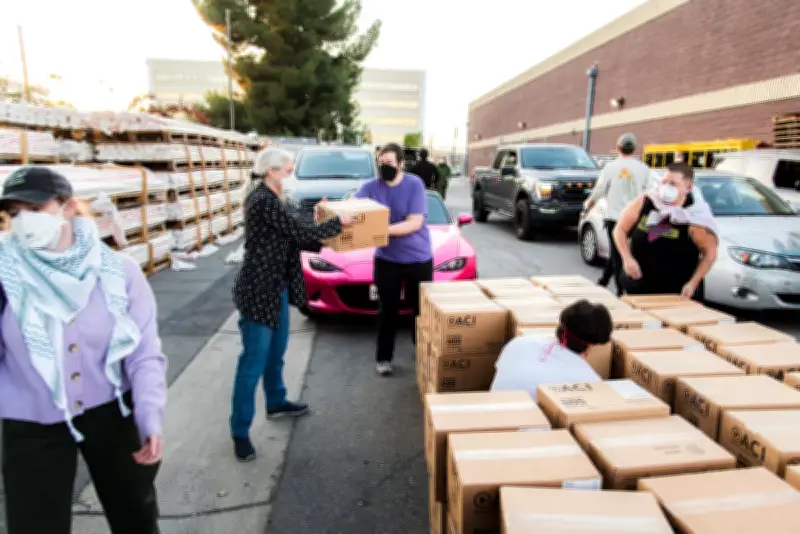
Mutual aid groups that began by distributing personal protective equipment during the Covid-19 pandemic are now lending air purifiers and handing out masks to communities affected by wildfire smoke.
Community response to hazardous air
Miquette Thompson's home in rural Mendocino county has been covered in smoke all week, from nearby fires in northern California and from wildfires in Oregon and Washington. Wildfire smoke is especially dangerous for elderly people and those with respiratory conditions; hospitalizations for asthma rise by 10% on smoke days, according to a recent University of California study.
Thompson, who has organized locally around airborne illness for years, said the local health department failed to distinguish which masks help with smoke. N95 masks filter tiny particles better than cloth or surgical masks. With her fellow organizers at Mendo Clean Air Club, she began partnering with local businesses to distribute masks.
Expanding lending libraries
Mendo Clean Air Club is one of over 40 clean air clubs worldwide. Emily Dupree, a Chicago resident, launched the first club to lend air purifiers to touring musicians during Covid. Now, Clean Air Clubs and Mask Blocs offer free masks and air purifiers from their lending libraries to help communities stay safe from wildfire smoke and monitor air quality. Mask Bloc Los Angeles handed out more than 300,000 masks in two weeks during the January 2025 LA fires.
Dupree said the lending library was created in response to a failure of public health, but it can also serve as a solution to governments' inadequate response to climate change and worsening wildfires.
Rapid mobilization
When wildfire smoke affected Chicago air quality in July, Dupree encouraged people to reserve purifiers from their library of 15; within hours, it was fully booked. “We are able to mobilize clean air resources extremely quickly because we are not dealing with bureaucracy or red tape,” Dupree said.
Shannon Durkin, a Mask Bloc Delaware organizer with cystic fibrosis, helped launch the group in 2024 with her husband Jimmy. They distribute KN95 masks at protests and partner with local groups. In July, they walked around Wilmington, Delaware, as wildfire smoke from Canada permeated the east coast, and people were surprisingly enthusiastic about receiving masks.
Growing need and hope
Organizers say the work feels more necessary than ever, as the current administration casts doubt on the usefulness of masks and the severity of the Covid pandemic that killed more than 350,000 Americans in 2020. Thompson navigates Covid hesitancy by explaining health impacts, especially for manual laborers who cannot afford to get sick.
Awareness of Clean Air Clubs is growing; Dupree created a Google doc explaining how to start one. Organizers say being part of these groups offers hope. “A lot of people, when they’re looking at the various horrors of the world, can feel overwhelmed and then stuck regarding what they should do about it,” Dupree said. “But what this shows us is that even if you decide to focus on one problem, it turns out usually what you come up with is going to be able to pivot and solve other problems that you didn’t initially try to address. There’s a kind of freedom in that.”




