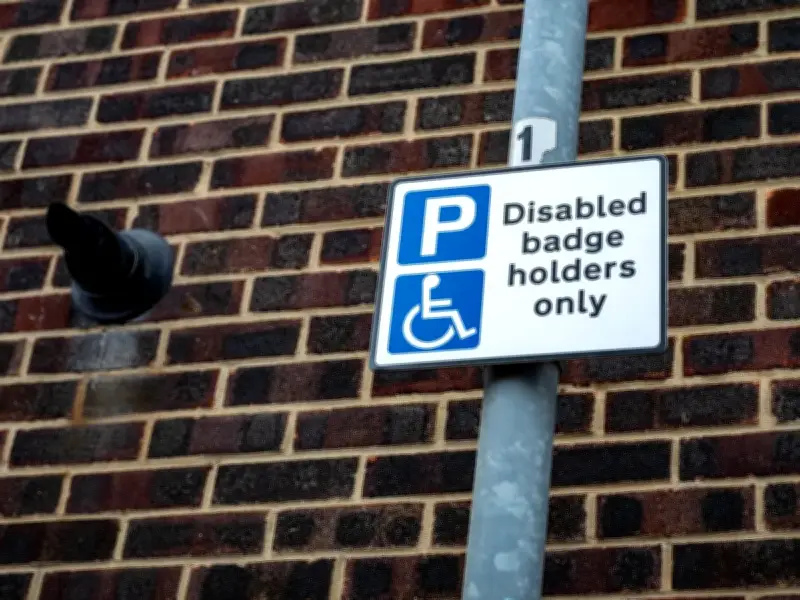
The Department for Transport (DfT) has issued an update on Blue Badge rules after the three-year renewal requirement was questioned in Parliament. A Blue Badge allows holders to park closer to their destination, whether travelling as a driver or passenger. The badge is designed for on-street parking only, with off-street car parks - such as those at shopping centres, hospitals or supermarkets - governed by separate regulations.
MP questions three-year renewal for progressive conditions
Badges are typically valid for up to three years, depending on individual circumstances, though in some cases they may be issued for shorter periods. Holders must reapply before their badge expires, with applications recommended at least 12 weeks ahead of the expiry date. This requirement has now been called into question in Parliament.
Peter Swallow, Labour MP for Bracknell, asked the Department for Transport whether it would "review the requirement for people with progressive health conditions to reapply for blue badges every three years."
Government response and exceptions
This month, Justin Madders - Parliamentary Under-Secretary (Department for Transport) - issued a formal response, saying: "Under the Blue Badge legislation, a badge may only be issued with a validity period of up to three years. The three-year validity period helps ensure that photographs and personal details held by local authorities remain accurate and up to date.
"The Blue Badge Digital Service enables local authorities to mark cases as not requiring a further evidence review where there is no ongoing need for applicants to resubmit evidence of their eligibility. This option means that future applications can be processed more easily and with less administrative burden for many Blue Badge holders, including those with long-term and progressive conditions."
There are some circumstances when the three-year rule does not apply - although this does not mean you get it for longer. Department for Transport guidance online says "in accordance with the regulations that govern the scheme most badges must be issued for three years. However, certain exceptions apply" - and lists two. It says that "in the case of children under three, the badge should be issued for a maximum period ending on the day immediately following their third birthday."
And it adds "where entitlement for a Blue Badge is linked to an award of the higher rate of the mobility component of Disability Living Allowance (HRMCDLA), War Pensioner's Mobility Supplement (WPMS) or Personal Independence Payment (PIP) the period of issue should be linked to the period of receipt of that allowance, where that period is less than three years". The guidance then notes: "In this specific context there is no minimum period of issue for a Blue Badge. For example, a badge can be issued for 9 or 12 months if this corresponds with the period of issue of HRMCDLA, WPMS or PIP."
Criticism and costs
The three-year rule has drawn criticism from some quarters. One amputee recently questioned on a Facebook forum why they were required to keep renewing their Blue Badge – pointedly remarking that he had 'no hope of growing back' their leg. Applications and renewals can be submitted online via the GOV.UK website. Your local council should reach a decision within 12 weeks of receiving your application.
Fees vary depending on your local authority but are generally up to £10 in England and £20 in Scotland. In Wales, Blue Badges are issued free of charge. Contact your local council to confirm the specific fee in your area.
Eligibility criteria
You may be entitled to a Blue Badge if you receive the higher rate mobility component of Disability Living Allowance (DLA); receive Personal Independence Payment (PIP) because you cannot walk more than 50 metres; are registered blind; get a War Pensioners' Mobility Supplement; you get the mobility component of PIP and have a score of 10 points for descriptor E under the 'planning and following journeys' activity; or you have received a lump sum benefit within tariff levels 1 to 8 of the Armed Forces and Reserve Forces (Compensation) Scheme and have in addition been certified as having a permanent and substantial disability that causes inability to walk or very considerable difficulty in walking.
Government guidance says you may also be eligible if: walking is dangerous to your health and safety; you have a child under the age of 3 with a medical condition that means the child always needs to be accompanied by bulky medical equipment; you cannot walk at all; you struggle severely to plan or follow a journey; you have a child under the age of 3 with a medical condition that means the child must always be kept near a vehicle in case they need emergency medical treatment; you have a severe disability in both arms and drive regularly, but cannot operate pay-and-display parking machines; you find it difficult or impossible to control your actions and lack awareness of the impact you could have on others; you have a life limiting illness, which means you cannot walk or find walking very difficult and have a SR1 form; you regularly have intense and overwhelming responses to situations causing temporary loss of behavioural control; you find walking very difficult due to pain, breathlessness or the time it takes; you cannot walk without help from someone else or using mobility aids; you frequently become extremely anxious or fearful of public/open spaces; or you are constantly a significant risk to yourself or others near vehicles, in traffic or car parks.