
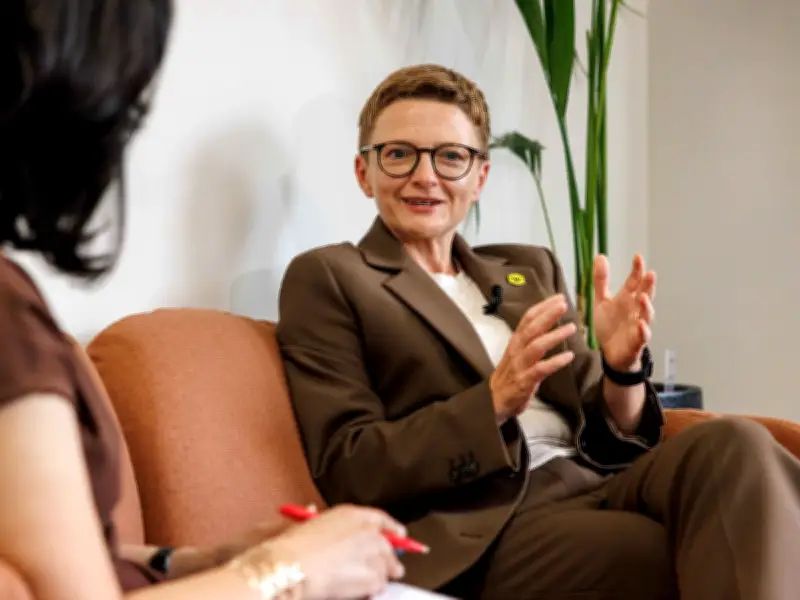
New Greater Manchester mayor Bev Craig has unveiled plans for a major cost of living summit aimed at easing pressure on struggling families, as she vowed to put the city-region ahead of party politics in her dealings with Prime Minister Andy Burnham.
In a wide-ranging exclusive interview with the Manchester Evening News, her first since winning last week's mayoral election, Craig revealed she will bring together businesses, charities and financial institutions in September to explore new ways of cutting household costs. She also insisted she would not hesitate to push Burnham for more powers and funding, saying: "My job isn't to be friends with the Prime Minister. It's to get the best deal" for Greater Manchester.
Prison plans and early releases
The Labour mayor also renewed her call for Strangeways prison to be replaced, describing the Victorian jail as 'not fit for purpose', and urging ministers to build a new prison before closing the existing site.
Last week, Labour's Bev Craig won the race to succeed Andy Burnham as mayor of Greater Manchester after the biggest by-election in British political history. The former Manchester council leader saw off Reform UK's Sian Astley to become just the second person and the first woman to hold the region's highest office.
First week in office
In her first week, the new mayor announced free bus fares for 11-16-year-olds, as well as baby bundles including certain essentials for mothers and their baby's first three months, such as a Moses basket, seasonal clothes and toiletries. Yet in Greater Manchester there are 168,000 children under the age of 16 living in poverty.
Acknowledging that 'too many people' are struggling with the cost of living, she wanted to do some things in the short-term to ease some of those pressures. "The moment your baby's born is meant to be the happiest moment in your life, but for too many people, they don't have the cots they need," she said. "They don't have the baby grows, they're struggling and worry about where they can afford the nappies and those basic essentials. And I think it's stuff like that that brings us back down to earth, about the reality of what people face."
Cost of living summit
It's why she's convening the 'cost of living summit' next month, which will be chaired by Lord Walker, the executive chairman of Iceland supermarket. "I keep bringing myself back to the cost of living test that I set myself in the manifesto that I had, that I've – in my first week of work – have been really clear to people," she continues. "If we're doing something, the question we have to ask ourselves constantly: is it making life easier? Is it making life cheaper? And do people see the benefit in their pockets? I think that would be a feature of what I'll focus on over the next 18 months."
Prison overcrowding and Strangeways
Aside from cost of living, a major row has erupted over the early prisoner release scheme – plans which were made law under Sir Keir Starmer's government but something Mr Burnham has had to deal with as the new leader. The new PM was told that scrapping the plans wasn't an option because of prison overcrowding.
"What a mess we've got ourselves into as a country, to have governments successively not investing in prison placements but also not preventing crime in the first place," says Craig, who believes Mr Burnham is trying to 'pick up the pieces of a really broken system'. She does not know how many of those prisoners will be released in Greater Manchester, but she'll 'be looking very very closely at those numbers'.
In 2024, a scathing report called Strangeways prison in North Manchester 'the most violent' in the UK and said standards had completely collapsed. Almost one in four inmates at the crumbling Victorian jail tested positive for illicit substances, one of the highest rates in England and Wales. Rates of serious assaults remained very high and violence against staff had actually increased since the last inspection.
"Strangeways is not fit for purpose and it needs to be closed down, and a new facility needs to be built up," says Craig. "It's time to move it out of the city centre." Before Burnham became the PM, Craig says she was in regular contact with the previous government on the matter around getting new sites. She wants to continue that dialogue with incoming ministers as well as the Justice Secretary.
Personal reflections and family
Dressed in an olive-grey suit, Craig seems slightly more relaxed compared with when she first launched her campaign to be the mayor. It's hard to believe it has only been a week since she won the by-election. "It's been a great week actually," she smiles, searching around for the right words. "The week's flown by. People have been great. So many people have been coming up to me, congratulating me. And in a proper Greater Manchester way, telling me to get on with the job and giving me the things that they want sorted."
She went for a 'quick drink' at a bar on Friday night, not long after her round of interviews. It was her father-in-law's birthday on Sunday so they all went out to celebrate at a restaurant. He was not, however, expecting the staff lining up for a selfie with Bev. "He was mortified, he's like, it's my bleedin' birthday!" she laughs.
Turnout and mandate
Delivering her acceptance speech at the Co-op Live, Craig vowed to 'fight for a better life for all of us', adding: "I will be a mayor for everyone." Yet just one in four went to the polls, having been overshadowed by Mr Burnham's rise to Downing Street. The turnout was 25.14pc, with 538,659 votes cast from an electorate of 2,142,779. That's the lowest in history for the mayoral role in the region.
It's a 'low figure', she says. She admits having multiple elections around the same time didn't help. But she doesn't seem overly concerned on the surface. She says having a summer election made it more 'tough', and notes that turnout in the 2017 inaugural Greater Mayoral election was just 27 percent. Craig adds: "But I also think that across local government, for local council elections and mayoral elections, you know, the high watermark is 33 pc. That's the most people that have ever voted in a mayoral election before and we want to do a real job to show that local politics makes a difference, but national politics makes a difference too."
Housing and homelessness
One area where people can see a difference is in Manchester's skyline, the looming skyscrapers an obvious sign of growth and investment. Yet people are increasingly being priced out of the city. Average house prices have tripled in some areas. Craig reiterated her plans to build 50,000 new council and genuinely affordable homes by 2039 with 10,000 delivered under construction or in the pipeline by 2028.
There are 6,000 households living in temporary accommodation. Furthermore, Andy Burnham has promised to end rough sleeping nationwide, something he claimed he would eradicate as mayor of Greater Manchester. But rough sleeping is on the rise again. Defending Mr Burnham's record, Craig says he 'didn't have all the levers of control' to achieve his laudable goal. Now that he is Prime Minister, she believes it will be easier to tackle homelessness.
"I know there's been a lot of criticism that he said he wanted to do it in Greater Manchester, and he's not fixed it here," she says. "But I think what that showed is that you do need a national government working with you. You need a national government that's committed to ending poverty, a national government that makes it easier, not harder, to build council and social homes."
Relationship with Burnham
Does it feel slightly surreal having Mr Burnham, a friend and former colleague, in the top job at 10 Downing Street? "It is a bit strange. You turn on the telly, and Andy's on the TV, but it's not Andy that you would text to wind him up when Everton lost a game of football," she says. "It's Andy the prime minister and that does take some adjusting to get your head around. But I think it's also one of the things that I think is most exciting."
She realises she has big shoes to fill, with people regularly reminding her of his popularity. She sees it as an opportunity for Greater Manchester, with someone who used to be mayor now in Whitehall who 'gets us and knows our challenges,' she says. Yet, she won't allow that cordial relationship to prevent her from getting the best for her residents. "I've got a shopping list of powers and controls that I think mayors across the country can have. He's proven that he wants to start handing to those out," she continues. "My job as Greater Manchester mayor isn't to be friends with the Prime Minister. It's to get the best deal for the place that we represent so there'll be times that we'll agree, there'll be times that I'll ask for more. And I'm looking forward to working with him and the Number 10 team, both in the north and south, to get what we need in this area."
Devolution and transport
Craig has been a vocal advocate for devolution. Last month, the Prime Minister accelerated the rollout of mayoral devolution after he pledged to 'rewire the state'. A document published by the Cabinet Office said that by the end of next year all parts of England would be 'in the process of establishing' a strategic authority so they are 'in place everywhere by the end of 2028'. By spring 2028 mayors would keep a share of local income tax, as well as having greater control over transport reforms.
Craig insists she remains committed to the plans for an underground station at Piccadilly, which forms a major part of Mr Burnham's regional Northern Powerhouse Rail vision. The Prime Minister previously said it could turn Piccadilly Station into the 'King's Cross of the North'. Craig said it wasn't a 'vanity project', adding: "Our railway system is grinding to a halt. If we want to get more people on trains we need more capacity."
Accountability and scrutiny
With the new powers and financial clout being offered to mayors, surely independent scrutiny becomes even more important. Craig insists she will not shy away from oversight. "I think I'm really clear that I want to be really accountable in this role: accountable to the public, accountable to other elected politicians and also accountable to the government," she said. "If governments are gonna give us powers to be able to deliver, I want to show that I'm delivering."
Air quality
There are plenty of other challenges waiting for Craig. She also inherits a long-running battle to improve the region's quality of air. Air pollution remains a significant problem in Greater Manchester, something that successive leaders have attempted to tackle. The most controversial policy was the Greater Manchester clean air zone, which cost around £104million. Cameras and signs were installed under plans to charge drivers of polluting vehicles up to £60 a day. But the plans were scrapped after a backlash in 2022, and Mr Burnham, then mayor, suggested investment in cleaner buses and taxis.
The region's local authorities have now submitted a case for a new Greater Manchester Clean Air Plan, arguing that the region can meet its legal air quality without introducing a Clean Air Zone. "Too many people across Greater Manchester experience dirty and polluted air," says Craig. Ruling out a charging zone, Craig said she wants to get more people on public transport, as well as planting trees to get cleaner air.
Immigration and asylum
Then, of course, she will have to navigate some of the more difficult and potentially divisive issues, such as immigration. It is a topic that has consistently cropped up in voters' main list of concerns ahead of the elections. Yet it remained conspicuously absent not only during Mr Burnham's by-election campaign in Makerfield, but also Craig's.
The North West has the highest number of asylum seekers in Britain – with one in every five (20 percent) placed in the region mainly due to cheap housing. Does Craig believe Greater Manchester gets more than its fair share of asylum seekers? "I think you can be proud as I am of a Greater Manchester that speaks 200 languages, that stands firmly against racism, that says no to people that want to divide and create intolerance within our communities. But also, be honest, about the kind of support that people need in their communities," she says.
She also supports Mr Burnham's previous calls for more 'equitable distribution' of migrants, recognising why some voters increasingly feel as though they don't recognise their areas anymore, and believe more new arrivals means more pressure on local services, like housing. "I want Greater Manchester to be a welcoming place. But I also want Surrey to be a welcoming place. I want the Cotswolds to be a welcoming place, and I want to make sure that across the country, people do see people that have been welcomed and supported in communities, but seeing that across the UK and that currently isn't the case at the moment."
LGBT+ rights and police apology
Beyond policy challenges, Craig's arrival in the role marks another significant moment for a region which has a complicated history with LGBT+ rights. In 2021 she became Manchester city's first openly gay leader. While the place is now seen as more inclusive, there have also been repeated calls for Greater Manchester Police to apologise for its historic treatment of LGBT+ people. But Chief Constable Stephen Watson has refused, saying it could be 'superficial and merely performative'.
Does the new mayor believe he should apologise? "I read back the stories of a time, when I wasn't in politics and sort of barely in school, and you see the behaviour of GMP in the 80s, it would have sent a chill down your spine today," she says. While she admits apologies can allow people to move on from past transgressions, she goes on to say: "I've spoken to the chief constable about his position, and his position is really, really clear. He wants people, all residents, including our LGBT+ residents in the city region, to feel safe now. And he is of a view that his job is what he can do today and make life better tomorrow. And I support that."
Andy Burnham, last year, issued a formal apology in a letter to prominent gay rights campaigner Peter Tatchell. Craig says this was enough for her and she will, in her new job as mayor, hold the chief constable to account.
Child sexual exploitation
One of the most difficult tests of that accountability will be confronting the failures of public agencies to protect vulnerable children. Police forces, alongside councils nationwide, have faced severe, widespread criticism for institutional failures in handling child sexual exploitation. Craig is determined to get justice for victims, and believes her background allows her to put herself in the shoes of the poor white girls who were groomed and sexually abused by men in places like Rochdale and Oldham.
"I think this is a whole systemic thing. I say this as somebody who grew up as a white working class girl on a council estate where services, at times, neither cared nor listened," she says. "And it didn't feel like anyone in my community ever had a voice. And if we ask ourselves, really, honestly, society, what did we think in the '80s or the '90s about how we believed young girls? And I think every public agency's got something to answer for and something to be accountable for."
For Craig, the first week may have been about signalling intent but the clock is already ticking. The challenge now is to turn that intent into actual results – and quickly.




