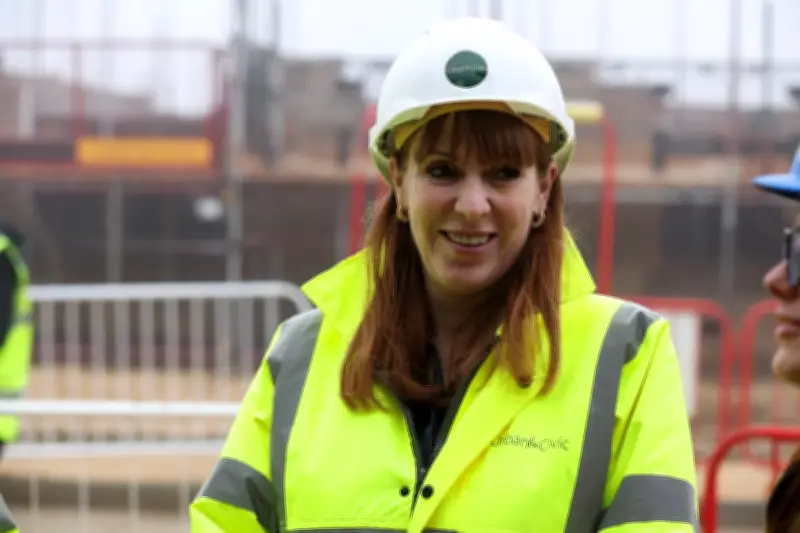
Housing Secretary Angela Rayner has announced a major shake-up of Britain's planning rules in a bid to boost building. Thousands more homes could be built near Tube and train stations, including on green belt sites, under a loosening of regulations. Councils will have to adopt a "default yes" approach to housing developments that are within a reasonable walking distance of well-connected transport hubs.
Ms Rayner said the guidance, which will be confirmed as part of the new national planning policy framework (NPPF) this week, would help address "too many people being priced out of the communities where they want to live and work".
Stations
London has a high concentration of busy Tube, tram and National Rail stations, and the shake-up could mean more flats and taller developments being approved near them. Councils should adopt a "default yes" position around proposed developments within 10 minutes of a transport hub under the guidance. In the past, boroughs have rejected high density schemes around busy stations over local complaints and amenity fears. But under the new rules this could be harder.
For example, in December last year Barnet town hall rejected plans for 283 flats on the car park at High Barnet Underground Station. Councillor objections included excessive height and harm to the local character and heritage. The scheme was subsequently called in by Mayor of London Sir Sadiq Khan and City Hall overrode the council decision and approved the new homes. Under the new rules, a similar proposal submitted today would be in a stronger position for approval at the local council planning committee stage and would be less likely to be delayed.
Ms Rayner said: "By unlocking thousands of homes around well-connected transport hubs, we're helping people live closer to work, school and the services they rely on, while backing local businesses and driving growth in our communities. That's how we'll tackle the housing crisis and raise living standards for people in every corner of the country."
Green Belt
The new policy will make it easier for homes to be built on green belt land, which has previously been more protected from development. But schemes proposed in these areas will have to satisfy important conditions, including higher ratios of affordable housing, new or improved green spaces and appropriate infrastructure.
Sir Sadiq's draft London Plan has already suggested that more homes should be built on green spaces on the outskirts of the capital. Tory-run Hillingdon Council last week branded proposals to build more than 14,000 new homes on greenfield land in the borough "wholly disproportionate". Enfield Council has also "formally withdrawn" its support for controversial "new town" plans. Councillor Alessandro Georgiou, who leads the newly-formed minority Conservative administration at the local authority, said the local authority would no longer support plans that could see up to 21,000 new homes built on large swathes of green belt land in the north-west of the borough.
Pubs
Pubs will get protection from being turned into houses or offices. Developers will have to prove there is no reasonable prospect of keeping the building running as a bar, including evidence that it was marketed for sale for at least a year.
Pubs like the Railway Tavern in Bethnal Green could potentially be saved by the new rules. Tower Hamlets Council agreed to let the building become flats in January. Local planning rules state that pubs cannot be converted unless developers can prove they have not been able to find anyone willing to run it. The pub had been vacant since at least 2014. However, a previous application to convert the tavern was rejected in 2019 and upheld by the Planning Inspectorate who ruled the proposed asking rent for the pub, at £45,000 a year, was too high for the area.
Between 2004 and 2024, London lost an estimated 930 pubs, according to data taken from the Office for National Statistics' Inter-departmental Business Register. But the majority of these closures came soon after the 2007 smoking ban. In the seven years leading up to the ban, 160 pubs closed. In the seven years afterwards, 680.