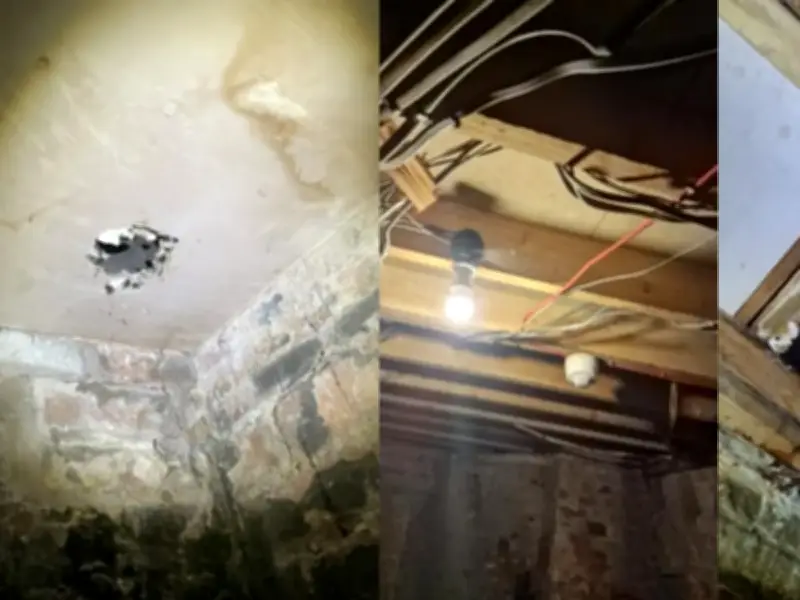
A 'staggering' 99 per cent of unregistered houses in multiple occupation (HMOs) inspected by Salford council failed to meet minimum safety standards, a report has found.
At 91 properties investigated, the local authority's new Private Sector Housing enforcement team uncovered more than 1,000 'unacceptable hazards'. These included 161 of the most severe type of issues - known as 'category one hazards' - that pose a risk to tenants' health and wellbeing, such as fire safety issues, mould and damp, and dangers of structural collapse.
Unsafe conditions uncovered
One home inspected by the team after a social worker flagged its conditions to the council contained 'a single timer-operated boiler', with tenants having no independent control over their heating. The conditions left residents in 'excessive cold', and living in rooms with 'damp and mould'. Another landlord was fined for lack of heating and fire risks.
The figures and cases come as the council considers introducing tougher licensing rules for HMOs across the borough. The local authority was a Greater Manchester pioneer for introducing extra rules that require developers to apply for planning permission before they can turn a home into shared accommodation. Previously, HMOs for up to five people didn't require any form of registration.
Calls for stricter licensing
But there are 'still problems' with the system. A report by local authority officers said the number of issues discovered in HMOs 'clearly identify the scale and severity of issues present in this type of accommodation, many of which lack the oversight provided by existing licensing schemes.'
More than 400 HMOs in Salford are estimated to be unregistered - and could have 'unacceptable hazards that are putting tenants at risk', according to the report. If introduced, the new rules would require HMOs that don't meet building regulations to apply for additional licensing. It would also require landlords to 'take all reasonable steps to prevent anti-social behaviour' at their properties, and ensure the exteriors and spaces around the buildings are kept free of litter.
Landlord opposition
Councillor Josh Brooks, Executive Support Member for Housing and Anti-Poverty said: “Evidence shows that many of these converted flats are not meeting the standards we expect, so we are taking decisive action. We estimate there are around 425 such properties across the city.
“This new scheme will require landlords of affected properties to obtain a licence from the council. To secure a licence, they will need to demonstrate that their properties are safe, well managed and meet the required standards, including appropriate fire safety measures.
“This will help us identify properties more effectively, hold landlords to account, protect tenants and ultimately drive-up standards in the private rented sector.”
The idea has already come under fire from local landlords and organisations such as the National Residential Landlords Association (NRLA). In a letter addressed to the council, Samantha Watkin, Senior Policy Officer, wrote: “Additional licensing schemes often place the greatest burden on compliant landlords, while those who operate under the radar are less likely to engage… the administrative and financial cost associated with additional licensing, especially for small-scale landlords, undermines the financial feasibility of renting their property and may lead to a reduction of supply within Salford altogether.”
HMOs have become an increasingly hot topic in Salford, with the Reform UK opposition group complaining of 'HMO hotspots' in Weaste and Seedley, Ordsall, and Broughton. A spokesperson said: “Residents can point to streets where HMOs appear one after another, creating a very different picture from what is seen in many other parts of the city.
“Why have so many HMOs become concentrated in a relatively small number of communities?”
The current rules under the Article 4 Direction mean that HMOs won't be approved in areas where more than 10 per cent of local buildings are already HMOs. The new rules are now open for consultation before they can be introduced by the council.