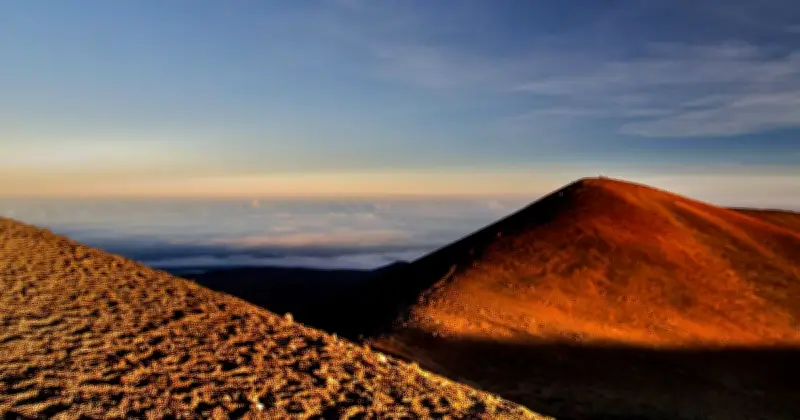
Mauna Kea in Hawaii, USA, is 1.4 kilometres taller than Mount Everest when measured from base to summit, with more than half of the mountain submerged beneath the Pacific Ocean.
Most people grow up being told that Mount Everest in Nepal is the tallest mountain on Earth, yet this may not be entirely accurate. The reality is somewhat more complex, as BBC Science Focus explains, and there could be one or even two other contenders vying for the title.
Determining which mountain is the tallest on the planet is not a simple matter, as there are in fact three legitimate candidates in contention.

Everest remains highest above sea level
Mount Everest is indeed the tallest mountain in the world, but the distinction lies in the detail — it is specifically Earth's highest mountain above sea level. Towering at 8,848.86 metres, or 29,031.69 feet, above the ocean, Nepal's celebrated peak is the loftiest mountain you can scale.
However, when you delve into the technicalities, there is another mountain in Hawaii, USA, that actually surpasses Mount Everest in height when measured from base to summit, reports the Daily Star.
The world's tallest mountain is in fact Mauna Kea in Hawaii, which measures a remarkable 10,205 metres (33,481 feet or 10.25km) in total height.
Most of Mauna Kea lies underwater
Mauna Kea — translating to 'White Mountain' due to its frequently snow-capped summit — is a long-dormant volcano, with only 4,205 metres visible above sea level, while roughly 6,000 metres of this enormous mountain lies concealed beneath the ocean.
More than half of Mauna Kea is submerged beneath the Pacific Ocean, making this relatively obscure mountain approximately 1.4 kilometres taller than Everest. While Mauna Kea has remained dormant for approximately 4,500 years, the United States Geological Survey (USGS) maintains it is 'likely to erupt again'.
There is little cause for immediate alarm, however, according to the USGS. As it is home to the largest astronomical observatory on Earth, the USGS notes that 'sensitive astronomical telescopes would, as a by-product of their stargazing, detect minute ground tilts possibly foretelling a future eruption'.
Mauna Loa and Chimborazo also contend
Should the same base-to-summit measurement be applied, the second tallest mountain in the world would also be found in Hawaii. Mauna Loa stands at a total height of 9.17 kilometres, with 5 kilometres of the enormous mountain concealed beneath the ocean, technically placing it as the second-tallest mountain on Earth.
Beyond Mauna Kea and Mount Everest, a third mountain peak can also stake a claim to the coveted title of the world's tallest mountain — or more precisely, the peak nearest to the sun — and once again, it hinges on which measurement reference is applied. Mount Chimborazo in Ecuador is regarded as the Earth's peak closest to the sun, owing to the fact that our planet is not a perfect sphere but rather an oblate spheroid. This essentially means the Earth bulges at the equator while being slightly flattened at the poles.
Mount Chimborazo sits within the Andes mountain range in Ecuador, and is itself an inactive volcano, with its peak reaching 6,310 metres above sea level. Given that Mount Chimborazo lies just one degree south of the equator — nearer than any other mountain on Earth — this relatively obscure summit can technically lay claim to being the closest peak to the sun.
In practical terms, this means that when measured from the centre of our planet, Mount Chimborazo could rightfully be considered the tallest mountain on Earth. However, as measurements are not conventionally taken from the planet's core, the above sea level and base-to-peak contenders, Everest and Kea, remain the leading candidates in the race for the title of the world's tallest mountain.
First complete ascent of Mauna Kea
Of the three contenders, Mount Everest is undoubtedly the most celebrated, having been first conquered on May 29, 1953, by Sir Edmund Hillary and Sherpa Tenzing Norgay.
Mauna Kea, meanwhile, saw its first complete ascent from base to summit in February 2021, when American adventurer and retired US Navy officer Victor Vescovo took on the feat alongside Hawaiian marine scientist Dr Clifford Kapono.

The record-breaking duo utilised the two-person submersible, Limiting Factor, to complete the underwater leg of their ascent, before spending upwards of five hours rowing towards Big Island in a three-person outrigger canoe.
Over the course of three days, Vescovo and Kapono went on to cycle, hike and ski their way to the summit of Mauna Kea, the world's tallest mountain measured from base to peak, ultimately securing the Guinness World Record.