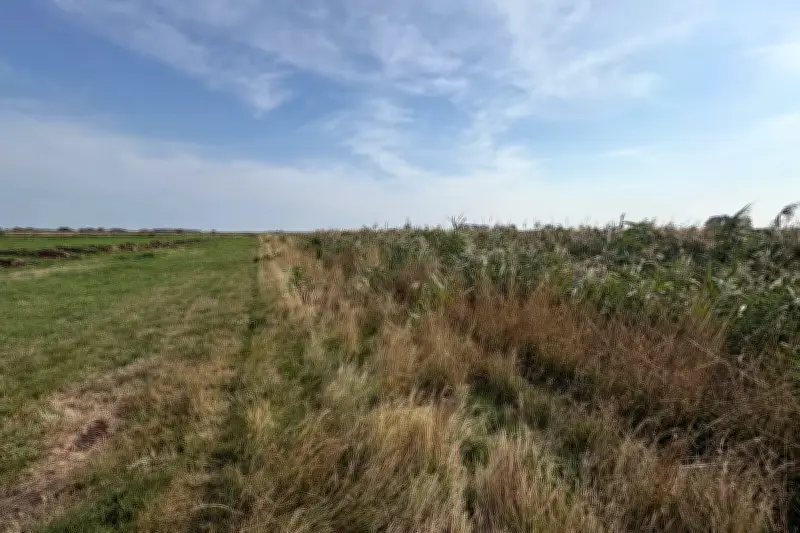
Diggers have begun work on a scheme to restore hundreds of acres of fen wetlands to create and connect a vast area of habitat for wildlife.
It is hoped the project across 136 hectares (336 acres) on former arable land at Speechly’s Farm, in Cambridgeshire, will become home to lapwings, snipe and cranes, water voles and “species nobody sees” such as rare water beetles.
Wet farming demonstration
The scheme by the Wildlife Trust for Bedfordshire, Cambridgeshire and Northamptonshire (BCN) also includes two large fields of “wet farming” or paludiculture, covering 6.5 hectares (16 acres) and growing typha, bulrush, which can be used for everything from puffer jackets to insulation boards.
Rewetting the landscape will stop currently drained peat, currently vanishing at a rate of two centimetres a year as it oxidises in the air, from disappearing and releasing carbon emissions, the charity said.
When it is complete, wildlife habitat will connect two of the last remaining fragments of ancient fen at Woodwalton Fen and Holme Fen for the first time in centuries in a region that has lost 99% of its original wet fen landscape.
Connecting ancient fenland
Alongside it, the wet farming scheme aims to demonstrate a commercial use for the fens that protects the peat, stores carbon and supports wildlife, the charity said. The scheme forms part of Wildlife Trust BCN’s Great Fen vision to recreate a vast 14 square mile restored peat landscape for wildlife and sustainable farming.
Wetland creation work has just been completed on next door New Decoy Farm, with channels and pools which have already attracted whimbrel, Chinese water deer, goose, oystercatchers and common terns.
But Great Fen project manager Lorna Parker said the project at Speechly’s Farm, funded by the National Lottery Heritage Fund, was on another scale, greatly increasing the space for wildlife in the area. And it will link up Holme Fen and New Decoy Farm with other farmland restored to fen around Woodwalton Fen, one of the UK’s first nature reserves which is rich in reedbeds, wet woodland and channels, dragonflies, butterflies, otters and bitterns – to create a vast connected wetland landscape for wildlife.
Protected habitat for wildlife
While other parts of the landscape will be more accessible for visitors, Ms Parker said that at Speechly’s Farm, “because there’s going to be limited public access, you’re creating a protected mecca for wildlife”. Ms Parker said it would attract lots of wading birds, water voles would be “all over the place” and she hoped cranes would settle there.
It could also become a stronghold for largely unseen species such as the great silver water beetle, an enormous but elusive beetle recently recorded at Woodwalton Fen for the first time in 50 years, while rare aquatic plants from the fens could “creep out through the ditch network”.
She said: “This area will be a mixture of reedbed and fen and swamp and dry grassland, a patchwork that will be managed ultimately by large grazing animals, ponies or cattle or a mixture. We also want to have some interesting scrub, alder, willow and bog myrtle.” And she said: “By raising the water table we can stop the peat from disappearing, stopping the carbon release.”
Diggers are creating channels, pools and reedbeds, and weirs are being installed so water can flow from the main river channel, through the paludiculture fields which will filter out excess nutrients, into the landscape. The wildlife trust is also working in a local partnership with farmers, the drainage board and Natural England in a funding bid to divert drainage around a wider area of restored land so it can be kept wetter within to create better wetland habitat.
Future of the fens
The project comes amid concern about food security and diverting land out of production. But local farmers are having to battle with drought summers and waterlogged winters as climate change makes weather more extreme, and the fertile peat soils of the fens are a source of carbon emissions as they shrink each year.
So the paludiculture fields aim to demonstrate the commercial viability of a crop such as bulrush, which grows where the water table is much higher. Wildlife Trust BCN has already run trials of wet farming crops at another fen site, and also wants to look at more foods that could work in wet farming, such as types of rice.
Farmers are passionate about feeding and looking after people, Ms Parker said, so “asking them just to rewild things or go over to nature conservation is not going to appeal to everybody”. “If we can offer them an alternative, particularly a food crop, what’s not to like.”
For the restored habitat, Ms Parker said: “We don’t have a target that we are working towards, partly because we are trying to build a landscape that works in a future climate and nobody knows what that will look like. We think it’s going to be wetland, we are going to put these natural processes back and see where it takes us. In 10 years time, it will look amazing.”