
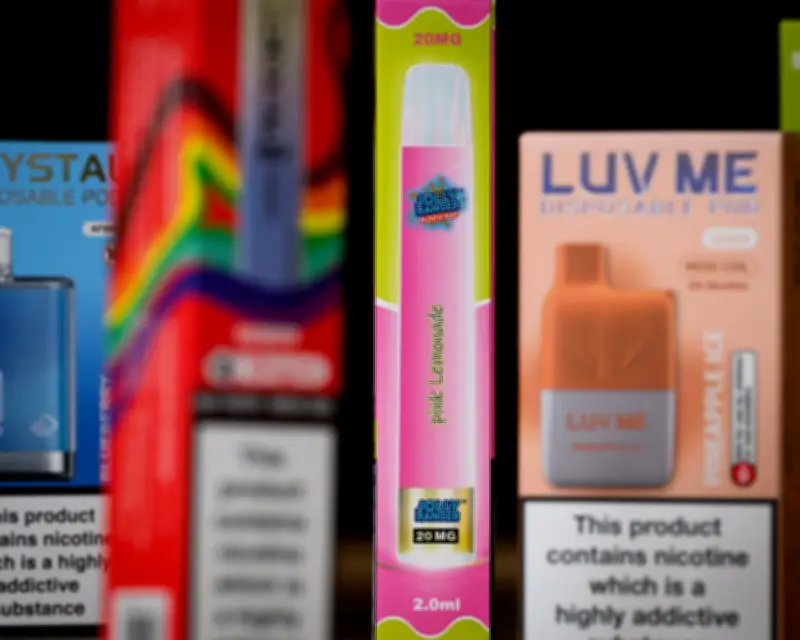
The UK government has unveiled plans to restrict vape packaging and flavouring in a bid to reduce their appeal to children. Proposals include selling vapes in plain packaging, limiting device colours to white, black, or grey, and keeping them out of sight in shops, according to the Department of Health and Social Care.
Consultation on Vape Marketing
Health Secretary James Murray announced a 12-week consultation on the plans, stating that the colourful packaging and sweet flavours of some vaping products “might be aimed at young people.” He said: “We all know that the way that some of the vaping products are promoted – the very colourful packaging and names that might be aimed at children and young people. That’s wrong because we want to make sure that, as well as being a smoke-free generation, we want children and young people not to start vaping in the first place.”
Teen Vaping Statistics
Data from a poll conducted on behalf of the charity Action on Smoking and Health (Ash) indicates that nearly one in five (19%) 11-17-year-olds in Britain have tried vaping. Prof Steve Turner, president of the Royal College of Paediatrics and Child Health, welcomed the consultation, stating: “For those of us working with children every day, it is clear that only strong and meaningful regulation will protect them from the harms associated with nicotine addiction.”
Proposed Restrictions
Other potential changes include restrictions on flavour descriptions, allowing simple names such as “apple” while banning names linked to sweets, desserts, and alcohol. The Department of Health said the consultation includes plans for white packaging for vapes with restrictions on text colour, imagery, branding, and standardised product information. Inserts for cigarette packs telling smokers where to get help to quit are also proposed, along with enforcing plain packaging rules on all tobacco products, including rolling paper and cigars. Exemptions allowing duty-free shops and airports to display tobacco products would be removed.
Industry and Charity Responses
Hazel Cheeseman, chief executive of Ash, said: “Protecting children from harmful vape marketing is the right thing to do. Attractive, colourful branding and images have driven the appeal of vapes to children leading to an increase in use.” She also noted the need for balance: “There is a careful balance to strike with regulations. While vapes are not harm free, they are significantly less harmful than smoking and vapes have helped millions of people successfully stop smoking in recent years.”
Research on Plain Packaging
Research published last year in the Lancet Regional Health Europe, led by UCL and King’s College London, found that among children and young people aged 11 to 18, 53% said their peers would be interested in trying vapes in their usual packaging. This dropped to 38% when shown vapes in standardised packs with usual flavour descriptions. Interest from adults remained the same whether the packaging was plain or branded.




