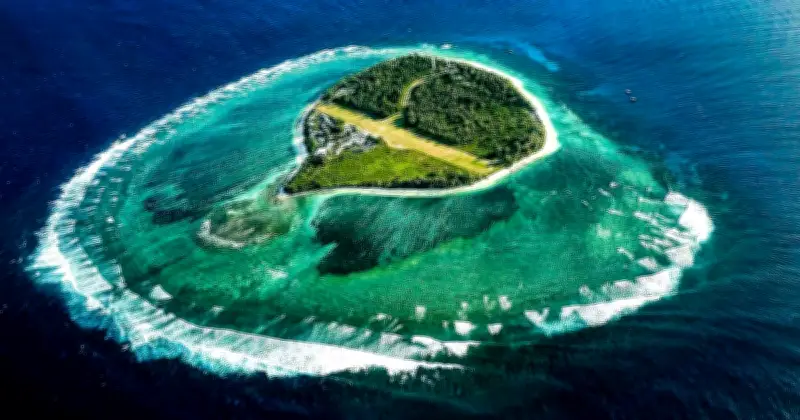
When Australian aviator Don Adams touched down on Lady Elliot Island in 1969, he found a sun-baked wasteland of loose sand, exposed bedrock and rubble. Today, the tiny 110-acre coral cay at the southernmost tip of Queensland's Great Barrier Reef is a thriving sanctuary covered in lush vegetation, home to thousands of nesting seabirds and surrounded by rich marine life.
A Wasteland Brought Back to Life
The island sits about five miles (8km) from the edge of the continental shelf, 46 nautical miles off the coast of Bundaberg. Deep ocean currents rise here, bringing nutrient-rich waters to the surface and fueling marine life.
For thousands of years, sea birds nested on the cay, creating thick layers of nutrient-dense guano. The island first formed around 1500 BC and remained stable over millennia as bird droppings hardened beach sediment into rock.
The Devastation of Guano Mining
In 1863, miners arrived to extract the guano. Over nearly a decade, they stripped away roughly three feet of rich topsoil and imported goats, which devoured every fresh shoot that tried to grow. The island was left completely bare and remained a barren moonscape for nearly a century.
By the end of the 1960s, Mr Adams struck a deal with the Australian Government that allowed him to bring tourists to the island if he built an airstrip, which he completed in 1969. It is still served daily by flights from Brisbane, the Gold Coast and Hervey Bay.
A Gruelling Restoration Effort
Rebuilding the island was a gruelling, manual task. With no fresh water on the cay, Mr Adams and his wife, Moya, flew barrels out themselves to keep early plantings alive. He strategically planted tough, salt-resistant native trees like casuarinas and pandanuses, whose roots stabilised the coral rubble and slowly rebuilt the topsoil layer by layer.
Mr Adams continued this tireless mission for 50 years until his death in 2019, at the age of 93.
Ecological Recovery and New Custodians
The return of trees triggered a vital ecological loop, as new vegetation stabilised the ground and brought seabirds back to nest, restarting a nutrient cycle that had been wiped out a century earlier.
Peer-reviewed research in the Australian Journal of Multi-Disciplinary Engineering detailed how Mr Adams's early plantings laid the groundwork for this recovery, while a 2024 Conservation Biology study showed that returning seabird colonies boost guano runoff to nearby reefs - directly driving faster coral growth and higher fish populations.
New custodians took over the island's lease in 2005, and the Reef Islands Initiative, launched in 2018, has since planted thousands more native trees. It is now protected under the Great Barrier Reef Marine Park's highest classification - a strict "Green Zone" - and features a 100% renewable solar-powered eco-resort.
Turtles now nest safely on restored beaches, while reef fish, sharks and hundreds of manta rays shelter in the clear waters offshore. It took more than 50 years of relentless effort, but Lady Elliot Island proves that even the most damaged natural environments can be brought back to life - one seedling and one bucket of water at a time.