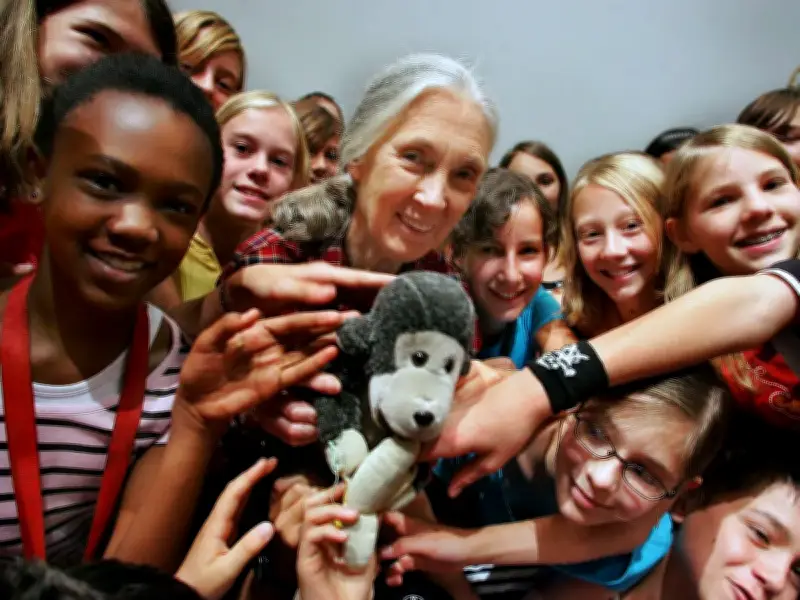
Almost a year after the death of primate expert Dr Jane Goodall at 91, supporters of the Jane Goodall Institute are determined to keep her legacy alive. Among them is Downton Abbey star Peter Egan, who has worked with the institute since 2017, when the anthropologist asked him personally to help with their youth programme.
Peter Egan's tribute to the 'Chimpanzee Lady'
Peter, who has since hosted various charities under the institute's umbrella, says: "Our planet is being degraded. If we don't continue her legacy it will ultimately be destroyed." He met the "extraordinary" woman on many occasions and says: "I never tired of hearing her speak."
Jane famously spent 15 years studying chimps from her camp on the shores of Lake Tanganyika, in what is now Tanzania. She discovered they were omnivores, made tools and had distinct personalities and emotions.

Peter adds: "The first great effect she had on the world was to help us understand that our closest relative in the animal world was more like us than we ever imagined." In scientific circles, he explains, researchers usually log animal subjects as numbers. But Jane, affectionately known as 'Tarzane' by her friends and family, chose to give the chimps names.
A message of hope for the planet
"She taught us that like humans they have close family ties and used tools in the same way that early man did," he says. "What made her special to me is that she never gave up, she pursued her commitment to all species and their great value to our wonderful planet."
Jane founded the Institute in 1977, two years after returning from Africa. It runs her Gombe Stream Research Centre in Tanzania, as well as supporting community-led conservation and youth empowerment projects.
Peter says: "Her commitment to understanding wildlife and the invaluable contribution wild animals provide, as both gardeners and pollinators, to the health of our wonderful planet cannot be underestimated. She understood that by witnessing it first hand, and it is vital that we share her understanding with both the youth and the adults in our world."
Institute continues her work
Last month, the actor joined a celebration of Jane's extraordinary work in Parliament. Supporters talked about her charity's continued projects, including global youth programme Roots & Shoots, which helps young people take action to improve the world around them.
The Institute is now in the hands of a board that includes Vice President Mary Lewis, the primatologist's former assistant. She describes her late boss, who died last October, as "dynamic, energetic and a visionary." Mary adds: "In the early days, she was speaking to small groups, and in the last 10-15 years she was attracting sellout crowns, often thousands strong, around the world."
Having spent 25 years in the oil and gas industry, Mary first met Jane in 1990 at a luncheon in Phoenix, Arizona. She started volunteering her time, and the London offices of her employers, Conoco Inc, to the Institute. She went on to work with the scientist for more than 30 years – and says her legacy already lives on through her books, documentaries and interviews.
"Jane empowered us to do so," she says. "She inspired people with her stories, and she showed so many that they too could and would make a difference with their daily actions and that it was up to them the kind of difference they would make."
The Institute is still moving forward to advance her mission. Mary says: "We have regular virtual committee meetings focused on the key areas of our work to ensure that we are all up to date, and our global office is convening a meeting in October to bring together a representative from each of our institutes from around the world to liaise on our shared strategy."
The group has faced stumbling blocks in recent years – including security issues, unhelpful Government policies and trouble attracting funds. But Mary is clear they are determined to keep going no matter what. "Jane didn't give up and neither will her colleagues," she says. "We know that we are making a difference to the lives of the human and non-human communities, and that is a source of energy for us all. As Jane would often say: 'We can, we will and we must change the world!'"