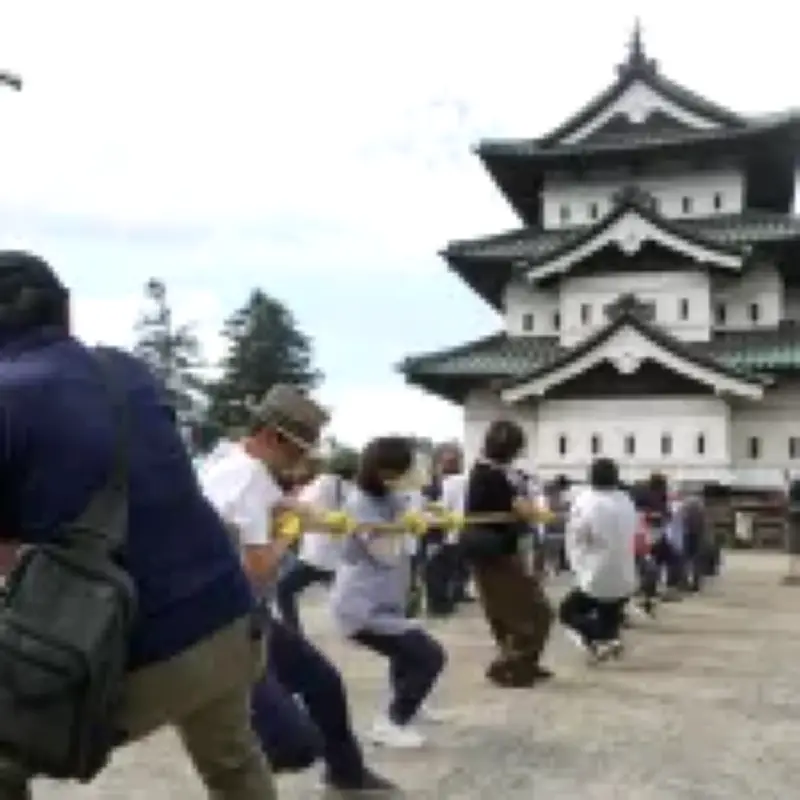
Almost 2,000 volunteers in northern Japan have hand-dragged a 360-tonne castle as part of earthquake repair works, with the historic Hirosaki Castle moved to its original spot using ropes and rollers.
The castle, known for its cherry blossom garden, was moved just over six feet in the Aomori prefecture on Saturday and Sunday. The structure, which includes a fortified tower, has been undergoing refurbishment since an earthquake caused damage in 2015.
Thousands apply for 1,800 spots
In total, 1,800 people were needed for the job, but around 8,000 people applied to take part in the tug-of-war. Organised in groups of 80, participants wore gloves and latched onto 98 ft ropes to pull the building for the first three feet and seven inches on Saturday. On Sunday, they moved it another 42 inches while chanting 'so-re, so-re' (go on in English) to set the pace.

Kensuke Hayasaka, head of the parks and green spaces division with Hirosaki City, told the Guardian: 'We had about 8,000 applications for the 1,800 slots over the last two days, roughly four times oversubscribed, so not everyone could participate.'
Traditional hikiya technique
The options for the castle were either dismantling or moving it using the traditional technique called hikiya, which has been used in Japan for at least 400 years to move entire buildings and is most common in road-widening projects. The technique is back in the spotlight after being used to preserve heritage sites.
After a public call-out by the city council in 2015, the Hirosaki Castle project became the first time in a century a citizen-powered hikiya has been used to move a building. Some fans travelled from far and wide to take part in the 2026 hikiya.
Motoharu Nakata, 61, who took part in the first tug-of-war and travelled to the site again, told the Sankei Shimbun outlet: 'I pulled it 11 years ago too. It's very moving to be able to participate again. There's absolutely no other opportunity to pull a castle, it was fantastic.'
Project continues for another week
The mammoth project will continue for another week with the help of around 4,100 people in total, who will pull the castle for 16 feet. However, the refurbishment will continue even after the castle is firmly on its original spot. It is not expected to reopen to visitors until 2033.
The iconic castle was built by the Tsugaru samurai family in 1611, but it burned down in 1627 after a gunpowder accident. The current structure was erected in 1810. Hirosaki city at the foot of Mount Iwaki is one of Japan's top spots for seeing the cherry blossoms or sakura, which pop up between March and April.