National Geographic photographer and WWF ambassador Jasper Doest joined conservation teams during the latest mountain gorilla census in Bwindi Impenetrable National Park, capturing images of the apes and the people essential to their survival.
New Life and Resilience
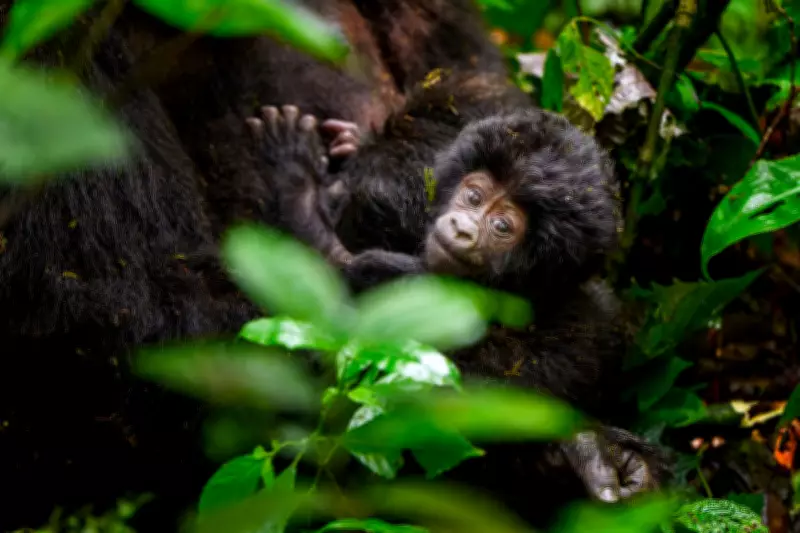
A newborn mountain gorilla peers through the foliage in the Nkuringo sector of Bwindi Impenetrable National Park. New births symbolise resilience and hope for a species that teetered on the brink just a few decades ago.
The Landscape of Conservation
At sunrise, the volcanic peaks of Muhabura, Gahinga and Sabyinyo rise through the mist, marking the meeting point of Uganda, Rwanda and the Democratic Republic of the Congo. These ancient volcanoes form the Virunga Massif, the high-altitude home of the endangered mountain gorilla.

A dense canopy of ancient trees stretches across the steep ridges of Bwindi Impenetrable National Park, one of Africa’s oldest and most biologically diverse rainforests. It shelters more than 400 species of plants and nearly half of the world’s remaining mountain gorillas. Layers of mist cling to the valleys each morning, earning Bwindi its name – ‘the place of darkness’.
Community and Conservation
Kikobero village, Bwindi. Once threatened by logging and agriculture, the park is now protected as a Unesco World Heritage site, where conservation and tourism sustain wildlife and the communities living nearby. More than 50,000 people live along the park’s borders, depending on the same rainfall, fertile soils and natural resources that sustain the forest ecosystem.
Loss and Leadership
Rafiki Jr lies at ease under the watchful eye of Rwamutwe, the silverback who leads the Nkuringo group. In 2020, the original Rafiki was killed by a poacher. His loss became a symbol of how fragile progress can be, even after decades of protection and coexistence.
A mother mountain gorilla rests with her month-old infant. At birth, a mountain gorilla weighs barely 2kg and depends entirely on its mother for warmth, food and protection.
A baby mountain gorilla peers through the foliage in the Nkuringo sector of the park. Mountain gorillas share more than 98% of human DNA, and their eyes are capable of curiosity, recognition and empathy.
Tabu, the second silverback of the Nkuringo group, moves through the dense undergrowth of the park. As second in command, he mirrors Rwamutwe’s leadership.
A member of the Nkuringo group reaches for fresh foliage in the canopy. Mountain gorillas spend much of their day feeding, selecting tender shoots and leaves from hundreds of plant species.
Females give birth only once every four to five years, which makes each infant vital to the species’ future. Fewer than 1,100 mountain gorillas remain.
Rwamutwe, the dominant silverback of the Nkuringo group. As the group’s leader, he determines when to move, feed or rest.
Tourism and Funding
Tourists pay $800 (£590) for a one-hour permit to spend time with a single gorilla family in Bwindi. Only eight people are allowed to visit each group on any given day, accompanied by rangers and trackers who ensure safety. Much of the fee goes toward park management and infrastructure in nearby villages, helping to turn local communities into key stakeholders in gorilla conservation.
The Census Process
Every five years, the International Gorilla Conservation Programme (IGCP) coordinates a census across Bwindi Impenetrable National Park. Samples taken by the team of more than 80 people are analysed in Kampala to build a genetic map of Bwindi’s gorilla population. Bwindi’s 2025 census will provide the most accurate estimate of the remaining population of gorilla groups across this dense ecosystem. Results will be released later this year.
Census teams search for and record fresh nesting sites in Bwindi, where mountain gorillas sleep each night. By counting the number of nests and collecting dung samples, they can determine the size of each family group and extract DNA to identify individual gorillas.

Conflict Resolution and Livelihoods
Members of the human-gorilla conflict resolution (Hugo) team in a tea plantation within the buffer zone that separates Bwindi’s dense forest from the surrounding farms. When gorillas wander beyond park boundaries in search of food, these trained volunteers respond first – guiding the animals back to safety. The tea itself forms a living barrier: gorillas dislike its bitter taste.
Members of a Nkuringo women’s artisanal tailoring and weaving cooperative near Bwindi. Created to provide alternative livelihoods for women living along the park’s borders, the group offers training in sewing, basket weaving and small-scale entrepreneurship.