
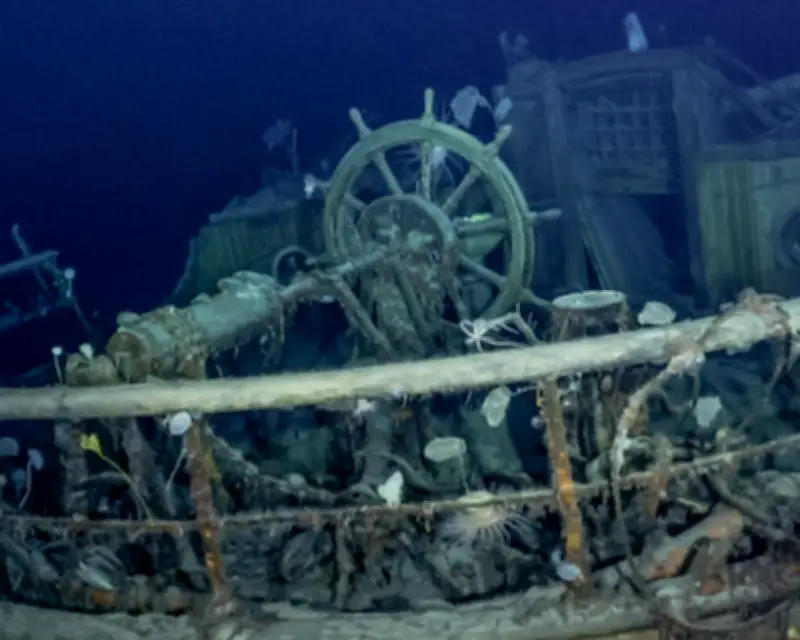
The Antarctic seabed's near-freezing conditions have helped keep the wreck of Ernest Shackleton's Endurance intact for more than a century, providing a reef for wildlife. But that is likely to change as the oceans warm, with a wood-eating lobster possibly colonising the wreck.
Threats to the Endurance
The harsh temperatures, treacherous currents and shifting pack ice of the Antarctic's Weddell Sea, which crushed and sank the ship in 1915, led Shackleton to describe it as the 'worst portion of the worst sea in the world.' For more than a century, these inhospitable conditions helped protect the lost wreck, discovered in 2022 with its structure still largely intact. Now conservationists fear that the rapidly changing climate and potential for exploration vessels to access the ship may pose a threat.
New Species Discovery
Marine biologists have discovered what could be a new species of wood-eating crustacean living on the wreck. In Antarctica, unlike warmer oceans, no timber-eating creatures have been recorded, which is part of the reason the ship has remained intact. The UK Antarctic Heritage Trust (UKAHT) has proposed that the ship and surrounding sea become the region's first specially protected underwater area.
'This is about foresight,' says Camilla Nichol, chief executive of UKAHT. 'What's going to happen in the next 10, 20, 30 years? In the last 10 years there's been much less cover provided by seasonal ice and we know there's more shipping.' Shipwrecks have a romantic appeal, and 'submarine activity is growing,' she adds. 'The Antarctic is the last frontier, which adds to its appeal and accessibility will only increase.'
Political Progress
At a meeting in Hiroshima, Japan, of countries governing Antarctic activities, the proposal for a protected area was passed without dissent. However, it must also be agreed by the Commission for the Conservation of Antarctic Marine Living Resources (CCAMLR), which meets in September. The CCAMLR, comprising 27 member states including China and Russia, has faced geopolitical stalemate over marine protected areas, but UKAHT is hopeful based on past discussions.
'South Korea, Japan, Norway, everyone around that table agreed that it matters,' says Nichol. 'Culture, heritage, our stories matter to us and they matter to the rest of the world.'
Protection Measures
Endurance lies on the seabed at 3,000 metres below the surface, similar to the Titanic's depth. Vessels already require a permit to approach within 1.5 km of the site. Making it an Antarctic specially protected area would prohibit entry unless rigorous conditions are satisfied. 'We would love to see what is inside the wreck, when technology permits,' says Nichol. The submersible expedition that found the ship produced remarkable 3D images of its exterior but could not enter.
Ecological Concerns
As the climate warms, different species could colonise the ship. Dr Huw Griffiths, a marine biogeographer with the British Antarctic Survey, notes: 'The Antarctic is one of the few places in the world that a wreck could exist without damage to the wood.' Most animals on the wreck are filter feeders, but images from 2022 picked up squat lobsters from the genus Munidopsis, one species of which only eats wood. 'It is likely that this species is new to science,' says Griffiths. 'Is it potentially something that will eat the wreck?'
The Endurance has become a natural laboratory. Griffiths wants to find out what will happen in a warmer world as sea ice retreats and ensure no invasive species are carried to the region. 'We can already see what happens over 100 years in a place where there is very little food. If we were to do some damage to the reef, it would take decades to recover.'




