
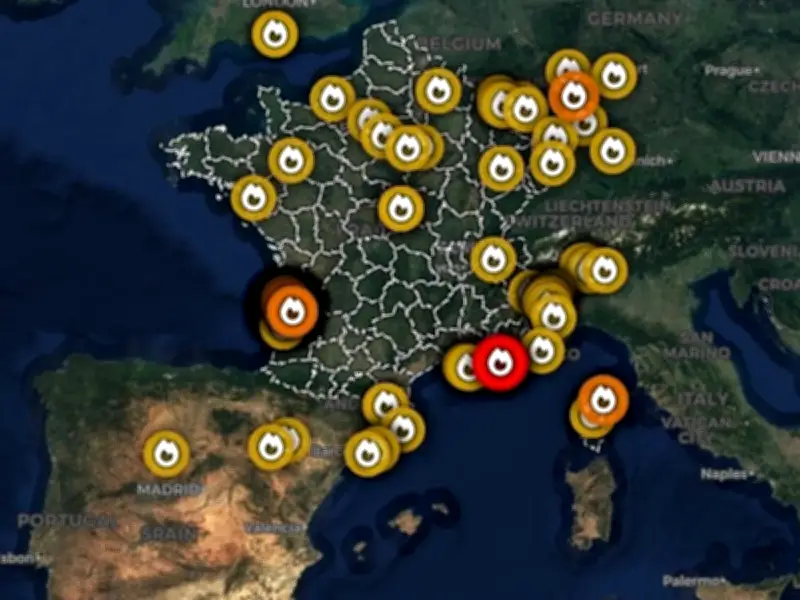
French President Emmanuel Macron called an urgent meeting of his ministers this morning after a huge fire continued to rage just nine miles outside of Bordeaux, with over 1 million living in the nation's sixth largest urban area, amid fears that the entire city may have to be evacuated.
Since the wildfires began last week, 220,000 people have abandoned their homes in south-west France, while another 116,000 have been evacuated in Spain. One person has died, and two firefighters have lost their lives amid a major emergency response.
British tourists are being warned to 'check ahead' if they have plans to travel to one of the affected regions.
Where are the fires burning and how big are they?
In the Gironde region of south-west France, the flames have now burned a 162-square-mile area four times the size of Paris. Alongside fire engines on the ground, water- and retardant-dropping aircraft have been used in the operation, including a French A400M military transport plane which has been 'bombing' areas with thousands of litres of water at a time.
Regional officials said that the situation had remained 'stable' overnight into Monday after several days of intense escalation. But temperatures are forecast to surge past 40°C, making fighting the flames even more difficult.
In Spain, massive fires continue to rage across multiple fronts – including west of Madrid and along the eastern coast – having already forced the evacuation of 116,000 people and claiming at least one life over the weekend. Smaller fires are also burning across Europe, including several in the west of Germany.
Holiday destinations impacted as British tourists warned
In the Gironde region, authorities have taken steps to keep tourists away from popular spots such as Arcachon Bay, Cap-Ferret and Le Porge by closing a major motorway and banning holiday camps for children. A giant blaze has been edging closer to Bordeaux, forcing the mayor to consider a 'total evacuation'.
Local official Sophie Brocas said: 'We urge tourists not to come to this region, at least until the situation is under control. I encourage tourists who are already here to consider another destination.'
Spanish holiday destinations such as Avila, Toledo, Valencia and Castellon have also been impacted by disruption caused by wildfires. The Foreign Office said British nationals heading to affected areas should 'check ahead' with their accommodation provider, while travel agency industry body ABTA told the Mirror: 'For people due to travel, they should keep in touch with their travel provider, as any operational changes or advice will depend on the specific destination and itinerary. They should monitor the local news in the regions and any instructions or updates from the local authorities, as well as any guidance provided by their accommodation provider and travel company. We would also advise people scheduled to travel to check the Foreign Office advice for travel to France and Spain.'
French foreign minister Éléonore Caroit said that although the country is facing an 'exceptionally intense' fire season, tourists should continue to visit unaffected regions – as long as they remain 'well-informed'.
What's a 'fire cloud'?
Experts have observed 'fire clouds' developing above some wildfire-hit regions in France – a rare weather phenomenon that could further hamper the emergency response. This occurs when a wildfire generates large amounts of heat, causing the air directly above it to warm rapidly and rise in a powerful updraft. When this reaches the cooler upper atmosphere, water vapour cools and condenses around ash and smoke particles, forming a massive, billowing cloud known as a pyrocumulonimbus. This can cause the fire to create its own unpredictable weather, such as intense, shifting winds at ground level, and unleash sudden lightning strikes without any rain, which can start further fires.
UK braced for more wildfires this week
Emergency services are braced for further wildfires this week as the UK's fourth heatwave of the summer looms. At the height of the third heatwave, in mid-July, firefighters were battling 19 significant wildfires simultaneously in England and Wales. Crews continued to battle fires in Wales, Scotland, and the north of England over the weekend, including one at Tintwistle Moor in the Peak District that has now been burning for over a month. A National Fire Chiefs Council (NFCC) spokesperson said: 'With the Met Office warning that a fourth heatwave could develop this week, bringing another period of very hot weather to parts of the UK, fire and rescue services remain on alert and are continuing to prepare for renewed wildfire risk.'




