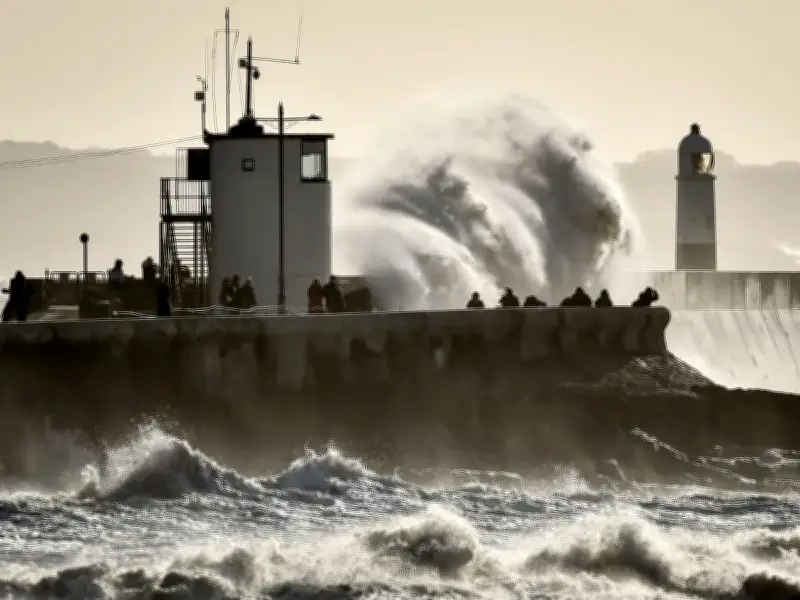
The Met Office says El Nino is set to make the UK's autumn and early winter particularly wet and stormy, as the weather system also threatens to hit the nation's food supplies. Environment Secretary Angela Eagle has urged households to stock up on food to prepare for extreme weather, warning that this El Nino event could be the strongest since at least 1950.
El Nino set to bring stormy UK autumn
El Nino, a weather phenomenon that develops in the Pacific Ocean, is "firmly established" and will strengthen into a "very strong event" in the coming months, impacting rainfall and temperature patterns across the world and fuelling extreme weather, according to the World Meteorological Organization (WMO).
The Met Office says it expects this El Nino to "increase the chances of wetter, stormier conditions for North West Europe, including the UK, in the coming autumn and early winter".

And Environment Secretary Angela Eagle has urged UK households to stock up on food in preparation for the weather system causing "more extreme storms in this country".
Threat to global food supply
Meanwhile, the extreme weather may also put pressure on global food supply, including the UK's. Analysis from the Energy and Climate Unit (ECIU) found that countries that could be exposed to climate extremes were the source of 13 per cent of UK food imports.
That means food such as rice, for which India is the UK's biggest supplier, and citrus fruits from South Africa and Peru, coffee from Brazil and tea from Kenya could all be impacted.
Dame Angela said: "We're about to experience probably the largest El Nino that has ever been seen, and that will lead to drier summers, wetter winters, with more extreme storms in this country.
"It will do a lot more damage in Asia with flooding, and therefore I think that we need to take it seriously. If you've got a store of a bit of food that can keep you going for a while before the emergency services can get to you, you're going to be a lot better off than if you haven't. So some of it is that kind of preparation for just being a bit more resilient."
Global impact and record temperatures
The regions most likely to bear the brunt of El Nino are North and South America, Central America, Africa, the Euro-Asian continent and Australia, the European Commission said in June.
The World Food Programme said in August that the El Nino was likely to push almost 50 million people into acute hunger, with those in countries in Central America and southern Africa expected to be the hardest hit.
Sea surface temperatures across the central-eastern equatorial Pacific - the region at the heart of El Nino - are already well above average and are continuing to rise, WMO said. The widely used Nino 3.4 index shows sea surface temperatures between late July and mid-August were between 2.2C and 2.6C above average.
El Nino is forecast to peak in November, when monthly sea surface temperatures could reach around 4C, according to the average of 14 different models. This would make it the strongest event since at least 1950.
Research shows that global heating is intensifying El Nino cycles, which in turn worsens the impacts of the climate crisis. UN Secretary-General Antonio Guterres said: "El Nino is being supersized before our eyes. The science leaves no room for doubt: the planet is in uncharted waters, and those waters are heating up.
"The world is in the danger zone of extreme weather. The race now is between rising risks and our commitment to take climate action and protect people. We must win that race."