Record-breaking levels of sewage have been pumped into the UK's seas and waterways this summer, according to alarming new figures, with hundreds of people reporting sickness after swimming. A new report states that more than 2,000 hours' worth of sewage was discharged into designated bathing waters across England during July and August.
Holidaymakers and families visiting some of the UK's most popular beauty spots have reported vomiting, diarrhoea, stomach bugs and ear and eye infections after taking to the water. Campaigners say the worst-hit bathing spots included Wallasey Beach and Moreton Beach in Merseyside, Readymoney Cove in Fowey, Cornwall and Plymouth Hoe East in Devon, with Wallasey recording 183 hours of sewage discharges over the two-month period.
Across the August Bank Holiday alone, sewage was discharged into bathing waters for the equivalent of 34 days - or 821 hours - triggering alerts at 105 locations across England.

Surfers and families share their stories
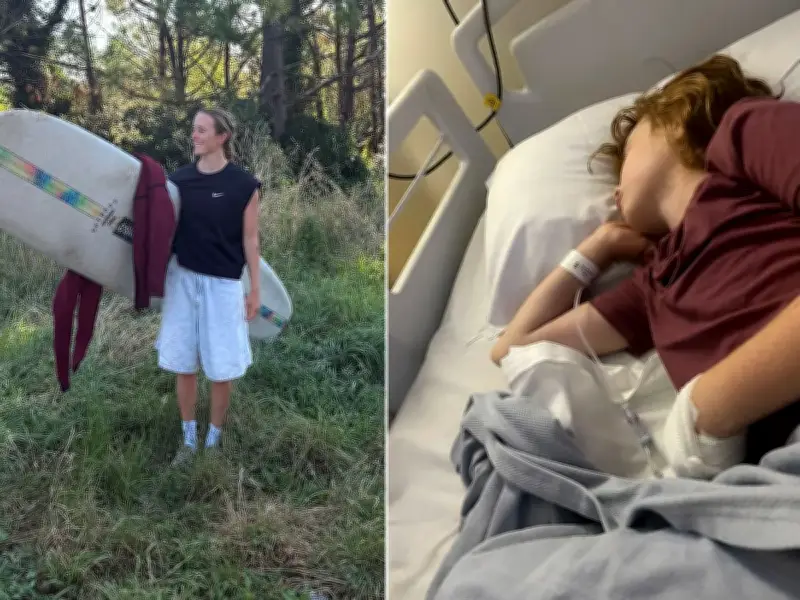
Professional surfer Beth Leighfield, 27, has been surfing since she was 10 and now spends almost every day in the water, either training or coaching through her surf business, Zest, in Newquay, Cornwall. She says what once felt like an occasional problem has become a daily peril. She has suffered repeated ear infections, earache and sickness bugs after going into the water. In 2020, she remembers surfing in Falmouth, Cornwall, with a group when the water suddenly turned brown.
"A bunch of us got ill immediately," she says. "Violent sickness, vomiting. It's become a normal part of being a surfer or water user."
For Beth, checking the Surfers Against Sewage Safer Seas and Rivers Service app for news of a sewage leak has become part of her daily routine, with pollution often forcing her to cancel lessons or move to another beach. "If you're already in the sea, sometimes the sewage can suddenly appear out of nowhere. Even if it clears, the bacteria is still there and you can get ill," she says.
It was the case with the Interclubs competition in 2025. Over 140 surfers from across the country had to leave the water mid-event when RNLI lifeguards raised a red flag due to the pollution warning. Surfing England said they were "devastated" at the time and noted it was an absolute first for them to cancel an event due to raw sewage output.
Families affected
The fear has now spread beyond surfers and into families who once saw their local beach as one of the safest, simplest pleasures of summer. Aisling McCarthy took her eight-year-old daughter Keeva and her twin sister to Avon Beach in Dorset on August 3. At one point, a large wave went over Keeva's head that left her spluttering from swallowed seawater. Days later, Keeva's condition deteriorated. She was sent to an out-of-hours doctor before Aisling noticed blood in her stool and took her straight to A&E. By then, Keeva was dehydrated and needed to be put on a drip. She spent two nights in hospital, before being discharged and eventually regaining her appetite. But since then, the once active eight-year-old has become noticeably weaker and less energetic.
A doctor called with the results of Keeva's tests. She had campylobacter. When Aisling asked how she could have contracted the bacteria, she was told it could be caused by contaminated water or food. Aisling began to suspect the seawater Keeva had swallowed at Avon Beach. "I highly suspect it was that swim, and her swallowing the water," she says. Avon Beach is a designated bathing water site which has been awarded an 'excellent' water quality classification by the Environment Agency.
Aisling says she has since heard from other families who claim to have become ill after swimming in the same area. She says people have reported seeing faeces and toilet paper in the water, while she has heard of other children developing bacterial infections. Aisling contacted Wessex Water, BCP Council and environmental health authorities asking for information. She says the responses felt dismissive, with her concerns met with generic information and advice. "I wasn't taken seriously," she says. "I told them she was sick, they didn't even comment on it."

The family's relationship with the water has completely changed since Keeva's illness. Their boat, paddleboards and regular swims were all part of their lives, including during the winter. Now, her children are frightened of the water. "They are eight years old and they don't trust their water is safe," she says.
Data and response
According to Surfers Against Sewage (SAS) data, water companies discharged sewage into England's waters for more than 43,000 hours across July and August. More than 2,000 of those hours were in designated bathing waters - the equivalent of around two and a half months of continuous pollution. During the three heatwaves between May and August, SAS says sewage was discharged into bathing waters for almost 14,000 hours.
Its Safer Seas and Rivers Service recorded 290 sewage alerts over the summer, with almost 85 percent occurring at designated bathing waters rated 'good' or 'excellent' by the Environment Agency. SAS also received 636 reports from people who said they became ill after swimming in England's rivers, lakes and seas during July and August. Those reports included stomach illnesses, skin, ear and eye infections and, in some cases, hospitalisations.
For Beth, the figures reinforce what she and other water users have been experiencing for years. She says people coming to Britain's beaches on holiday should not have to understand sewage systems or check an app before allowing their children into the sea. "People coming on holiday aren't going to expect to see sewage in the sea, so they aren't going to think to check," she says. "If more people come out, report to the council, report to local societies, it will make a difference."
SAS is calling for the Government to use the Clean Water Bill to transform the water industry, including taking action against failing water companies and removing the profit motive. The charity has delivered a petition signed by more than 330,000 people to Downing Street, demanding action on sewage pollution. "The key message is that the Government needs to stop putting profit before the health of everyone who uses the water, and the health of the oceans themselves," Beth adds. "We need public ownership. I think that shouldn't be off the table. A big restructure is needed. People shouldn't be getting sick."
An Environment Agency spokesperson said: "Our officers' sampling showed E. coli levels to be within the range we would expect to see in Christchurch Harbour. We have thoroughly checked water company discharges and investigated other potential sources of pollution linked to the elevated E. coli readings and are yet to identify a source. Bacterial levels in natural waters can vary significantly due to factors such as weather, tides water conditions and time of day. The harbour is also subject to a large range of bacteria sources including birds, urban run-off, agriculture and private treatment systems."
A Wessex Water spokesperson said: "Last month's reported high E.Coli readings in the Stour did not relate to Wessex Water or its assets. Christchurch Harbour is a catchment serving a largely rural area where water quality can be influenced by wildlife, agricultural run-off, private sewage sources and numerous other factors. Environment Agency data does not identify discharges from water industry assets as the reason for the harbour not achieving a higher ecological status."
A Defra spokesperson said: "We know the water industry hasn't been working in the public interest for far too long and it’s totally unacceptable to see the scale of discharges polluting our rivers, lakes, and seas. Storm overflows should only be used in very specific circumstances, and this government has already taken action against water companies who are failing to perform, making it a criminal offence to cover up illegal sewage spills. But we know the status quo isn't working, and it's why we're driving forward the biggest overhaul of the water sector in a generation to deliver improved water quality for swimmers across the country and creating a powerful new regulator to hold companies to account."
A Water UK spokesperson said: "The latest data from the Environment Agency show 87% of bathing waters achieved a 'good' or 'excellent' rating. This is a stark contrast to the 1990s when less than a third of bathing waters would have met today's standards. No sewage spill is ever acceptable, and we are working to end them as fast as we physically can. That's why we are tripling investment to halve spills from storm overflows by 2030 and upgrade the capacity of 1700 wastewater treatment works."