
UK scientists have uncovered a key driver of worsening global warming: newly-formed clouds in the Arctic. An international team led by the University of Birmingham found that melting Arctic ice creates clouds that act as a natural blanket, heating the planet and accelerating ice melt.
Published in Nature Geoscience, this is the first real-world evidence that when Arctic sea ice meets open ocean, marine life and sunlight combine to release a chemical mixture that seeds the sky with cloud-forming particles. Naturally occurring iodine, sulphur, and organic compounds are emitted, creating new atmospheric particles. At the ice edge, the number of particles that form cloud droplets rose fifty-fold in a day.
Key findings from the study
Professor Zongbo Shi, who led the study, said: "Our discovery is important because these new particles can influence clouds, which play a critical role in determining how much heat is retained or reflected. More clouds or thicker clouds in the warming season could potentially accelerate ice melt while cooling down the open ocean."
The Arctic has warmed more than three times faster than the global average over the past 40 years, making it one of the most sensitive regions on Earth to climate change. The warming atmosphere causes ice to melt, exposing more of the productive ice edge, which subsequently creates particles. These particles can alter cloud cover, sunlight reflection, and future climate change, affecting Earth's radiation balance.
Expedition and validation
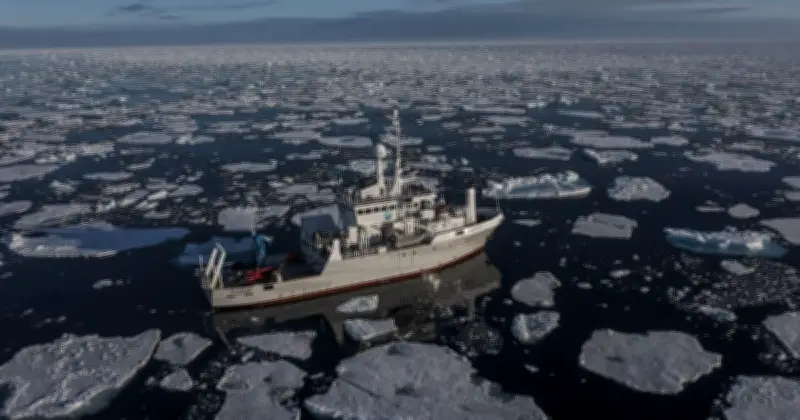
Backed by funding from the Natural Environment Research Council (NERC), the team gathered data during an expedition aboard the Royal Research Ship Discovery around Greenland and the Davis Strait in spring and summer 2022. Co-author Dr James Brean said: "Our findings provide the first real-world validation of a recently identified atmospheric chemistry mechanism involving iodine oxoacids and sulfuric acid. Until now, this process had only been demonstrated in laboratory experiments at the CLOUD chamber at CERN."
Researchers also identified a new class of atmospheric compounds known as iodine-containing oxygenated organic molecules (I-OOMs), which help newly formed particles grow large enough to influence clouds. New particles formed on more than 80% of sunny days, showing the process is common in this part of the Arctic.
Implications for climate models
The strongest effects came from the marginal ice zone, where open ocean meets melting sea ice and marine algae are most productive. During one event, cloud-seeding particles rose from roughly 50 to 1,500 per cubic centimetre. That band is widening as Arctic sea ice retreats. Because the process is missing from current climate models, its influence is not yet accounted for in projections, and the team is now working to build it in.
Dr Brean added: "These newly identified compounds help small particles grow into larger particles that can seed clouds - we believe this is the first time such molecules have been observed and implies important new pathways for iodine chemistry."




