
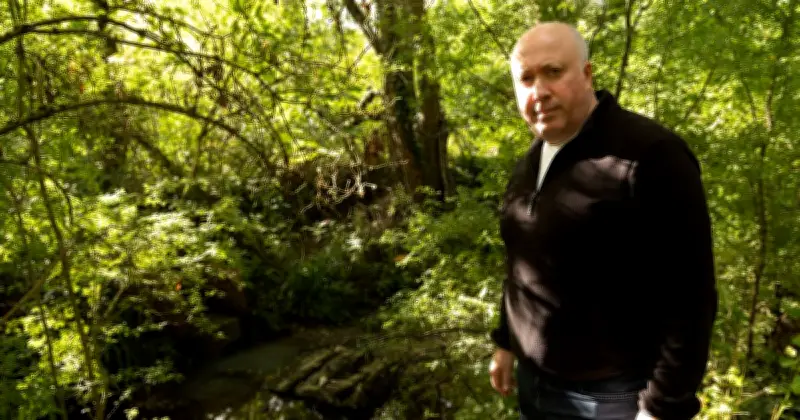
Families are calling for warning signs beside a contaminated stream in Cheshire after scientists identified a nearby nuclear plant as the UK's radiation hotspot. The area around Urenco's Capenhurst uranium enrichment facility has recorded the highest radiation doses to the public of anywhere in Britain, according to a report by UK environmental and food safety regulators, although levels remain within government safety limits.
The plant, nestled by the leafy suburbs of Ellesmere Port, employs 650 people and enables power stations worldwide to generate electricity. Flowing past the facility towards Rivacre Valley Country Park, and past primary schools and villages like Great Sutton and Little Sutton, is the popular waterway Rivacre Brook.
Radioactive materials found in brook samples
The report reveals that samples taken from the brook's "sediment and freshwater" include radioactive materials such as tritium, technetium-99, uranium, neptunium-237 and gamma-emitting radionuclides. Although these are also within safety limits, villagers and Professor Patrick Byrne of Liverpool John Moores University have called for warning signs by the stream.
The local council has set up two play areas for youngsters within yards of the brook, and young cyclists also ride into the water in the Rivacre Valley Country Park to cool off, while the park is surrounded by housing.
Prof Byrne told the Express: "Uranium and technetium-99 are measurable within the brook sediments. So to avoid unnecessary exposure from regularly entering the water or coming into contact with sediment, clear signage advising against this would be a reasonable and proportionate precaution."
Both Urenco and the Environment Agency claim the discharges are well within national safe limits, but Prof Byrne said: "It is important not to confuse low risk with no risk." Ingesting uranium or technetium-99 particles from the brook's water, air or silt could still be potentially harmful.
Local concerns and personal stories
Father-of-two Dave Williams was walking his pet dog Willow by the brook when the Express visited the site in September. Dave, 53, told us: "On a couple of occasions Willow has splashed about in the brook, especially on really hot days to cool down, and drunk some of the water. The next day she has been ill. There should definitely be signposts up there to warn kids not to play in the water. It's not right."
Secondary school teacher Alison Ravenscroft, 48, of Little Sutton, has taken her dog Archie by the stream but says her serious concern is to warn children who may splash in there during hot weather. She told the Express: "It’s vital we protect our children from the radiation in the brook, especially with the play areas only a few hundred yards away. It’s shocking that Capenhurst is allowed to make the discharges. My own young children have played in the water when they were younger and there’s an obvious worry about potential side effects and the health indications that might arise. We need signs to be installed by the brook to raise awareness."
Amanda Basnett, 60, a retail worker of Great Sutton, played in the brook as a child as did her daughter Jade, 32. Jade was diagnosed with lymphoblastic leukaemia and is now in remission. Her mother said: "Jade used to feed the ducks by the brook when she was a child. People need to be given more information about the health risks of playing in the brook - everybody in Ellesmere Port is worried about Capenhurst."
Alan McGrath, 60, a retired landscape gardener, of Great Sutton, said: "The kids gather on the BMX park and in summer they go for a paddle in the brook to cool off. It’s disgusting that they’re not being told the brook is radioactive, they need to be warned for their safety."
Cath Robinson, 61, of Little Sutton, said: "It is wrong that radiation is being discharged into the water, it is bad. I have seen kids splashing around in the brook. During this last record-breaking summer the water by the bridge has been packed out with children and dogs. We need to raise awareness. The youngsters playing in the brook, and some of the adults with them, are not aware of the risks."
RIFE report details and official response
The Radioactivity in Food and the Environment (RIFE) report is an annual assessment published by UK environmental and food safety regulators that measures radiation levels in the food chain and surrounding environment. The latest RIFE edition, published in October 2025, looks at 2024 radiation levels. It names the area around the Capenhurst plant as the radiation hotspot of the UK, where the public received the highest radiation doses that year, and notes that levels have increased from the previous year.
The 2024 report states Capenhurst recorded levels around a quarter of the 'UK National Limit of 1 millisievert (mSv) per year' - while levels in Rivacre Brook are lower than by the plant itself. A millisievert (mSv) is one-thousandth of a sievert - the standard international unit used to measure the biological effect and health risk of ionizing radiation on the human body.
The RIFE report explains: "In 2024, radiation doses from authorised or permitted releases of radioactivity to people living around nuclear licensed sites, remained well below the UK national limit of 1 millisievert (mSv) per year. The locations where the public received the highest doses in 2024 were: Capenhurst (0.22mSv), the Cumbrian coastal community near Sellafield (0.20mSv), and the Grove Centre, Amersham (0.087mSv). The dose at Capenhurst increased from 0.15mSv in 2023, this is due to a higher estimate of direct radiation, which is the dominant contribution to doses to the public from this site."
The RIFE report uses the scenario of a 10-year-old child playing in the area as a model for safety assessments. It adds: "The dose for children (10-year-old), who play in and around the brook and may inadvertently ingest water and sediment, was 0.007mSv in 2024 (up from 0.006mSv in 2023). The increase in dose was due to higher gamma dose rates measured over the riverbank at Rivacre Brook in 2024. As in previous years, sediment samples collected downstream from the Rivacre Brook contained very low but measurable concentrations of uranium (enhanced above natural concentrations) and technetium-99. As expected, enhanced concentrations of these radionuclides (and others) were measured close to the discharge point (Rivacre Brook). Concentrations of radionuclides in freshwaters at the discharge point (and at other freshwater locations) were very low in 2024. Downstream of the Rivacre Brook, at the location where children play, (gamma) dose rates over grass were higher in 2024. Concentrations of technetium-99 in sediment (Rivacre Brook) from liquid discharges were detectable close to the discharge point in 2024."
Urenco UK is a wholly-owned subsidiary of Urenco Group - 33% of which is owned by the UK government, one third by the Dutch government and the final third equally by two major German utilities, E.ON and RWE. The permit for the Urenco UK Capenhurst site allows liquid waste discharges to the Rivacre Brook for uranium and uranium daughters, technetium-99 and non-uranium alpha (mainly neptunium-237).
A spokesperson for Urenco UK said: "Urenco operates in compliance with permits issued by the Environment Agency, which are in accordance with national and international standards and assessed to ensure the safety of the public." The Environment Agency stressed: "We have monitored the concentrations of radioactive substances in the water of Rivacre Brook over a number of years. Concentrations remain very low and within limits."
Cheshire West and Chester Council said: "The Environment Agency regulates emissions through an Environmental Permit for Urenco. The Environment Agency and the Food Standards Agency (FSA) undertake surveillance monitoring and produce an annual report. Cheshire West and Chester Council takes advice on any relevant health matters from the FSA and UK Health Security Agency (UKHSA)."




