
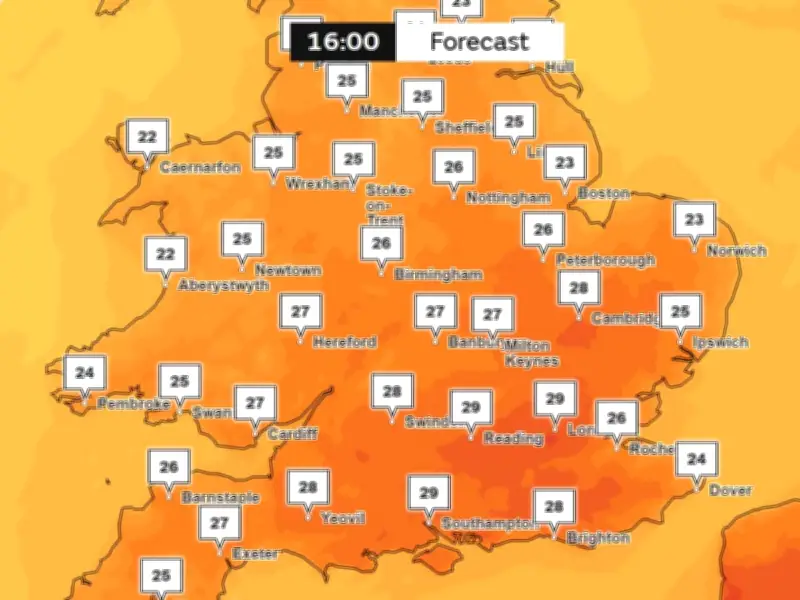
Health officials have issued a health alert across parts of the UK as temperatures are set to soar later this week. Yellow alerts have been issued by the UK Health Security Agency (UKHSA) for four regions in England, warning of a possible 'risk to life' for vulnerable people due to temperatures topping 32C in parts of the country.
The alert covers the East Midlands, East of England, London and the southeast of England from Wednesday (June 17). It remains in place until Monday evening (June 22).
It comes as the Met Office forecasts heatwave conditions across large parts of the UK. Temperatures of 32C are expected on Friday (June 19) in eastern parts of England, possibly climbing to 33C in the south and southeast of England by Monday.
No heat health alerts have been issued in western or northern parts of England, including Greater Manchester. The Met Office said wet and humid weather is forecast across the north and west on Wednesday and into Thursday, with a 'marked north–south split' developing by the end of the week.
Deputy Chief Forecaster, Gregory Wolverson, said: 'This week’s weather reflects a contrast we often see in summer, with more unsettled conditions passing to the northwest of the UK while heat builds in the south and east. As we move towards the weekend, we’ll see conditions become more widely settled and temperatures rise all round. Many parts of southern and eastern England are likely to see temperatures high enough to meet heatwave thresholds.'
In the UK, a heatwave is officially recorded if a place has at least three consecutive days with daily maximum temperatures meeting or exceeding the heatwave temperature threshold, which varies from 25-28C, depending on where you are in the UK.
Despite the heatwave in the forecast, the Met Office warns it likely won't bring 'wall-to-wall sunshine', with a chance of heavy rain and thunderstorms in many areas. Mr Wolverson added: 'It’s important to note that while temperatures may be high, we might not all see the wall-to-wall sunshine and blue skies we experienced back in May because there is more cloud around. There is also a chance of thunderstorms developing in places, particularly later each day, which could bring heavy showers and localised impacts.'
Staying Safe in Hot Weather
The main risks posed by hot weather are dehydration, overheating, as well as heat exhaustion or heatstroke. The NHS warns that hot weather can pose significant health risks to vulnerable people. These include:
- Older people aged 65 years and over
- Babies and young children aged 5 years and under
- People with underlying health conditions particularly heart problems, breathing problems, dementia, diabetes, kidney disease, Parkinson’s disease, or mobility problems
- People on certain medications
- People with serious mental health problems
- People who are already ill and dehydrated (from diarrhoea and vomiting, for example)
- People who experience alcohol or drug dependence
- Runners, cyclists and walkers, or physically active people who spend a lot of time outside
- People who work in jobs that require manual labour or extensive time outside
- People experiencing homelessness
- People who live alone and may be unable to care for themselves
Ahead of the hot weather, the Alzheimer's Society has warned that people living with dementia are more vulnerable to hot weather. Angelo Makri, Senior Knowledge Officer for Wellbeing at Alzheimer's Society, said: 'People should absolutely enjoy the warmer weather, but it’s important to remember that high temperatures can pose serious risks for people living with dementia if they are not supported to stay cool and hydrated. People with dementia may not always recognise when they need a drink or wear suitable clothing, which can increase the risk of dehydration and heat-related illness. As temperatures rise this week, we’re urging families, friends and carers to check in and make sure loved ones are drinking enough, wearing light clothing and staying out of direct sunlight.'




