
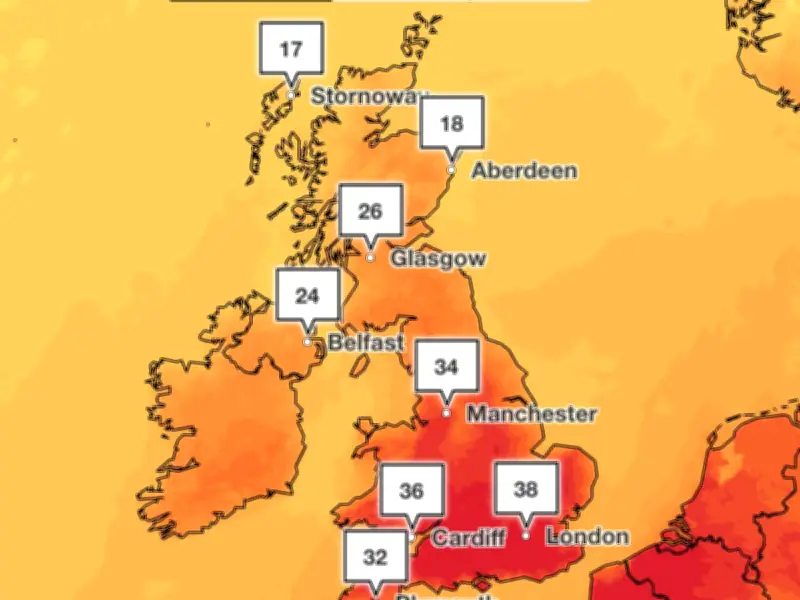
Scientists have issued urgent warnings as the UK braces for a humidity 'heat dome' that could push summer temperatures above 43C, with daytime highs expected to reach 38C this week and 'tropical nights' making it difficult for homes to cool down. The unprecedented heatwave, driven by climate change, poses serious risks to health, transport, and energy infrastructure.
Record-Breaking Temperatures Expected
The Met Office has extended an amber alert for extreme heat until at least the end of Thursday, with temperatures in the high 30s forecast across much of the country. The current June record of 35.6C is likely to be broken, with temperatures expected to reach 38C or 39C. Prof Liz Bentley, Chief Executive of the Royal Meteorological Society, said: "This will lead to two consecutive months, May and June, in which the UK temperature records have been annihilated by well over 2C."
Health and Infrastructure Risks
Dr Akshay Deoras, research scientist at the National Centre for Atmospheric Science and the Department of Meteorology at Reading University, described the event as "not just a heatwave, it is a heat-dome driven furnace that will grip most of southern UK and push temperatures into truly exceptional territory." He warned that elevated humidity levels would make conditions "feel even more oppressive and dangerous by severely reducing the body’s ability to cool itself through sweating."
Bill McGuire, professor emeritus of climate hazards at University College London, highlighted the broader implications: "This has massive implications for health, energy infrastructure, and transport, which are simply not built for these conditions. As 40+ temperatures become ever more common, expect many thousands sleeping in the streets as poorly insulated homes become uninhabitable heattraps, widespread power cuts as power cables sag and break, transport chaos as rails, overhead wires and signalling fail, and A&E departments overwhelmed by the old, very young, and vulnerable suffering from overheating."
Heat Dome Mechanism
Dr Deoras explained the driving force: "The driving force behind this event is a heat dome, which is a vast area of high pressure parked over the UK and western Europe. Think of it as a giant atmospheric lid, suppressing cloud formation and allowing relentless sunshine to bake the ground day after day. At the same time, air sinking beneath the high pressure compresses and warms, much like air heating up inside a bicycle pump when it is squeezed." He added that human-driven climate change has "provided the springboard for this event, loading the atmosphere with extra heat and making extreme temperatures far more intense than they would have been in the past."
Tropical Nights and Humidity
A key concern is the likelihood of widespread tropical nights, where temperatures remain above 20C after dark. This prevents homes and buildings from cooling down, leaving many people struggling to sleep and reducing the body’s ability to recover from the daytime heat. The increased humidity distinguishes this heatwave from previous events, such as those in May 2026 and July 2022.
Climate Change Context
Richard Allan, professor of climate science at Reading University, noted: "A heatwave in June is par for the course but temperatures nudging toward 40C were unprecedented for the UK up until 2022. Whilst May brought record dry heat, this week will see a more muggy heatwave that makes it difficult to stay cool and critical for those with underlying health conditions." He emphasized that "it is blindingly obvious that heatwaves will increase in severity as rising greenhouse gases stifle the planet’s ability to lose heat to space."
Dr Chloe Brimicombe, climate scientist and heatwave researcher at Oxford University, said: "It’s possible that for a second month in a row record temperatures could be broken which is quite alarming. The UK record dates back to the infamous 1976."
Wider Impact and Precautions
The heat is spreading from mainland Europe, where parts of western France are expected to hit 44C in the coming days. More northerly areas of England and Wales are under the amber alert only on Wednesday and Thursday, with daytime temperatures expected to exceed 30C widely. Scientists urge the public to take precautions, stay hydrated, and check on vulnerable individuals as the heatwave intensifies.




