
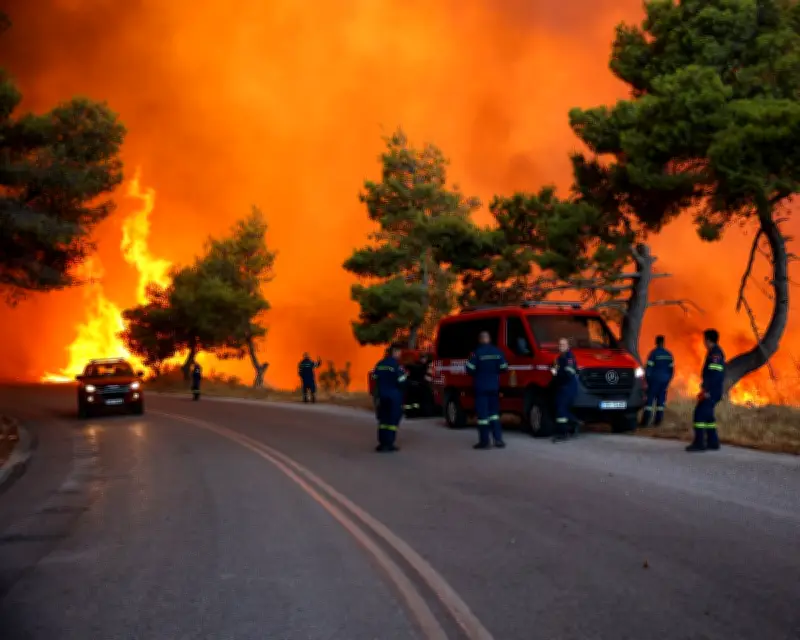
Wildfires across the globe are contributing to air pollution in the UK, with researchers finding that they account for about 10% of the country's particle pollution. The study, led by the University of Edinburgh and the UK Centre for Ecology & Hydrology, warns that the climate crisis could make this problem worse.
Impact of European wildfires
Dr Mark Parrington, a senior scientist at the Copernicus Atmosphere Monitoring Service, noted that recent wildfires in south-western Europe produced large quantities of smoke, significantly degrading air quality across southern France and central Spain. Cities like Bordeaux and Madrid, downwind of the largest fires in Gironde and Ávila, recorded PM2.5 concentrations well above air quality guidelines.
The study also found that large fires anywhere in the northern hemisphere can increase UK air pollution. Damaris Tan, at the University of Edinburgh, created a computer simulation of global wildfires and agricultural burning. She said: "While wildfires may not impact air pollution in the UK as acutely as other countries, wildfires globally add to the UK population’s long-term health burden. The relative importance of this is likely to increase in the future."
Long-range transport of smoke
Time lags of months are possible, depending on the location of fires and meteorology. Tan noted that it took over three months for the effects of 2018 wildfires to become negligible in UK concentrations. In 2019, almost half of the wildfire pollution in the UK originated from Russia, with contributions from both east and west winds.
Canadian fires dominated in 2023 and continued to impact the UK over the following two years. Tan said: "The Canadian contribution to the UK in 2024 and 2025 was likely more than double that of most years prior to 2023."
Policy implications
Prof Mathew Heal, part of the study team, said: "To meet legal targets for particle pollution, the UK may need to over-deliver on the emission reductions to allow for the potential of increased wildfires in the future." He added that limiting climate change is key, as it could increase the frequency and intensity of extratropical wildfires.
Wildfire smoke also reacts with existing air pollution to form more harmful particles, potentially doubling the amount of particulate matter inhaled. Dr Eiko Nemitz, science lead on the study, said: "Reducing emissions from traffic, heating, industry and agriculture could limit the secondary component of particle pollution from wildfires. This is something … directly within UK policymakers’ control."




