
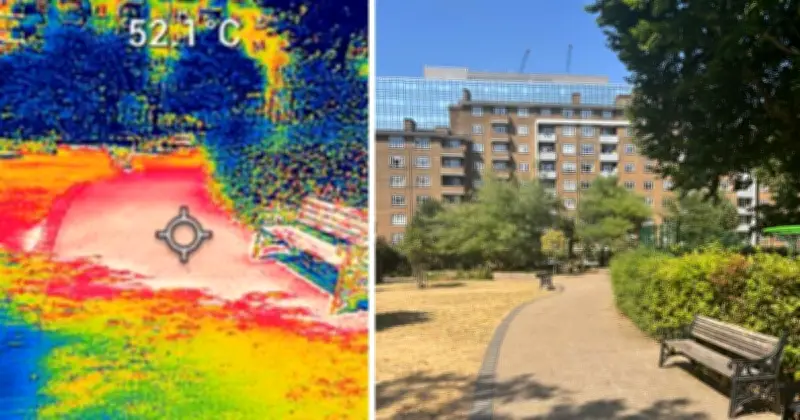
Campaigners have hailed trees as an “urban wonder drug” during dangerous heat waves while calling for more to be planted. There is a huge disparity in the temperature of playground equipment, benches and pavements exposed to sunshine compared to those in shade, the Create Streets Foundation found.
Temperature disparities in urban areas
During one experiment in the UK capital during 34C weather, a bench recorded a temperature of 43C compared to another in shade that hit 26C.
Kitty Thompson, head of policy and campaigns at the Create Streets Foundation, said: “It’s time for a greening-up revolution. Trees make streets cooler in heat waves and more pleasant all year round. They are an urban wonder drug. Every site we measured showed that, where street trees are present surface temperatures drop by around 20 degrees. This is just another stone in the wall of evidence that street trees are not just ‘nice-to-haves. They are so much more than aesthetic niceties. They are essential public infrastructure, helping people and pets cope as heatwaves become more common.”
Evidence from park measurements
The think tank visited a park and compared two hopscotch games sketched with chalk on the ground, with one in sunshine hitting 53.2C and another in the shade reaching 26.9C. One piece of climbing equipment at Nelson Square park, in Southwark, was a scorching 51.9C. The addition of tree shade can reduce temperatures by 12C on concrete and 9C on grass.
Ms Thompson added: “For too long government has placed too many obstacles in the path to planting more street streets. We are therefore calling on the Government to amend the Highways Act 1980 which makes it much harder than it needs to be for councils and community groups to green up our streets.”
Tree cover inequality
The Woodland Trust said tree cover in urban neighbourhoods varies hugely, from as little as 3% in Lancashire’s Fleetwood to 45% in Farnham, Surrey. The average tree canopy cover across towns and cities in the UK is around 16%. The most affluent neighbourhoods often have more than double the tree cover of the poorest and most underserved, the Woodland Trust said.
Experts at the Woodland Trust, the Horticultural Trades Association (HTA) and the Royal Horticultural Society (RHS) last month urged all tiers of government to focus on maximising “green infrastructure” to effectively lower summer temperatures across urban environments. Professor Alistair Griffiths, RHS director of science and collections, warned extreme heat is no longer a future threat, saying: “It is here now, and our towns and cities are feeling the strain.
He said: “Trees are one of the most effective natural tools we have for cooling urban environments, improving air quality and supporting biodiversity. But to realise these benefits at scale, we must urgently grow, establish and provide long-term care for more resilient, home-produced trees.”
The summer of extreme weather has seen two record-breaking heatwaves, in May and June, that led to more than 2,800 excess deaths, and two more heatwaves in July which has fuelled drought and wildfires.




