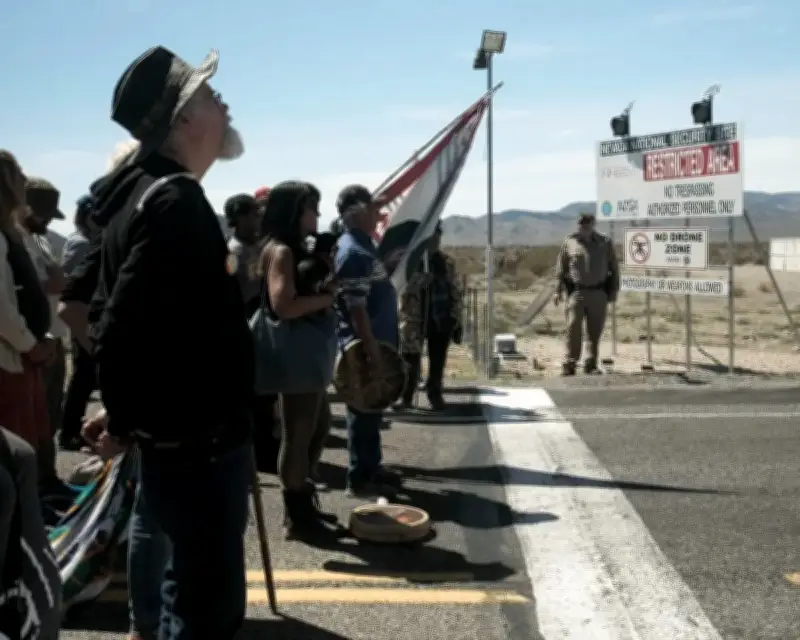
Casey Carter's avant-garde documentary To Use a Mountain spotlights the pain and triumph of resisting government efforts to turn parts of rural US into nuclear waste disposal sites. The film, now out in the US, focuses on the 1982 Nuclear Waste Policy Act, which placed six rural communities across the country as candidates to become the permanent site for more than 90,000 tons of high-level nuclear waste.
Yucca Mountain and the Western Shoshone
Ultimately, Nevada's Yucca Mountain, about a two-hour drive from Las Vegas, was selected as the nuclear burial site. However, after decades of development, legal challenges, and obstruction from activists and politicians such as Senate majority leader Harry Reid, the project was halted, leaving the US with no permanent repository for its nuclear waste. In the meantime, the federal government pays utility companies tens of billions of dollars to hold onto their spent fuel.
Advocates against the Yucca Mountain site argue that its designation as a Department of Energy (DoE) disposal ground disregards a US government treaty obligation to the Western Shoshone tribe. The area's history of seismic activity is another reason cited for concern about the site's structural integrity over millennia.

Environmental violence and community resistance
The film follows Ian Zabarte, a Shoshone principal who has lost family members to radiation-related diseases connected to the government's nuclear testing on tribal lands. Zabarte, who testifies on Capitol Hill as a young man and later hikes the desolate area, argues that eminent domain is "just racism by another name."
Carter's documentary unspools like an art installation, using DoE surveys, analyses, and internal memos alongside contemporary footage of decaying storage sites and interviews with community members. The film also draws on archival footage from Hanford, a decommissioned site described as "the most contaminated place in the western hemisphere," where a storage tank has been leaking contaminants into the groundwater system and threatening the Columbia River.
Ongoing nuclear waste challenges
"In traveling to these places, you realize each one of them has dealt with issues of environmental violence or racism even prior to being nominated as a potential nuclear waste storage facility," Carter says. "It's gut-wrenching to think about people encountering this level of treatment from their government."
Just last month, Idaho, Louisiana, Oklahoma, Tennessee, and Utah were named as finalists for "nuclear lifecycle innovation campuses" – federal sites that would handle spent fuel and waste management. The DoE plans to pick three host states by the end of this year.