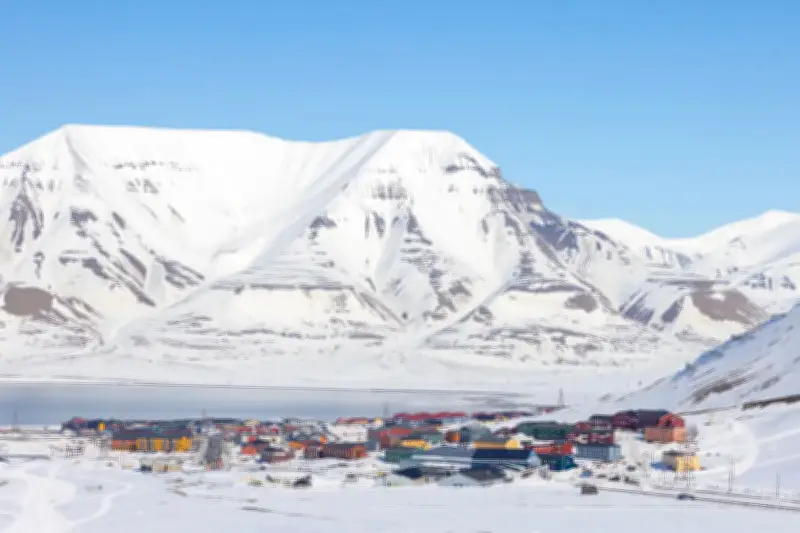
Longyearbyen, the largest settlement on the Arctic archipelago of Svalbard, is confronting unprecedented challenges as one of the fastest-warming places on Earth. Temperatures here are rising up to seven times faster than the global average, with glaciers covering 57% of the land and permafrost now thawing, leading to toxic tap water, landslides and housing instability.
Andy Hodson, a glaciologist and professor at the University Centre in Svalbard (UNIS), points to Foxfonna glacier, 8 miles (15km) outside the village, as a stark example of the changes. The glacier, named after the arctic fox for its "ears" of ice, is "slowly dying," Hodson says. Its concave profile indicates it no longer accumulates snow, and precipitation increasingly falls as rain. The glacier is thinning by between 1 and 4 metres a year.
Rapid Ice Loss Across the Archipelago
In the fjords, glacial fronts that once extended into the sea are retreating at an even faster rate. Over the past two years, 10 have pulled back entirely onto land. In 2024, "things went crazy," Hodson notes, after record-high summer temperatures caused a 1% ice loss across the archipelago, driven by Arctic amplification, a feedback loop where sea-ice retreat and atmospheric warming reinforce each other.
"Pretty much the whole island is losing ice now," Hodson says. The village, home to 2,600 people at 78 degrees north, is used to extremes, with winter temperatures dropping to -20C (-4F) and over 100 days of darkness from late October to early March.
Thawing Permafrost Brings New Dangers
The thawing permafrost has had unexpected consequences. Residents have been warned not to drink tap water because heavy metals from the bedrock are leaching into the supply. They now collect filtered water from a central tank at the village supermarket while the municipality investigates long-term solutions. The thaw has also caused landslides, damaged foundations and cracked walls, leaving some homes uninhabitable and creating a housing shortage.
The most devastating event was an avalanche in December 2015 that buried nine people, killing one man and an infant in their homes beneath Mount Sukkertoppen. "It was terrible," says Gunhild B Sætren, a professor of safety psychology who manages the Unis Arctic Safety Centre (ASC), established after the tragedy. "Climate change is impacting us in very many ways. The greatest risk is avalanches. The area used to be an Arctic desert, but now there is more rain."
Adapting to a Changing Environment
Since the avalanche, snow fences and avalanche traps have been installed on the mountain, and some houses have been pulled down, including Sætren's own. The ASC now provides weekly snow observations for the municipality's avalanche warning system. A new tour guide approval system, introduced by the governor of Svalbard to assess climate and other risks, is expected to be in force by 2027.
Tour operators are curtailing activities due to the changes. Matilda Weihs, 30, a guide for Svalbard Wildlife Expeditions, says they had to move snowmobiles seven miles out of the village to find enough snow for tours. "We are losing snow earlier and the melt is starting earlier," she says. "There are big changes in the fjords. You need to stay away from glacier fronts due to the danger of glaciers calving into the sea."
Rethinking Water and Construction
The loss of drinking water has been a shock, says Terje Aunevik, mayor of Longyearbyen. "In Norway, where we have always taken for granted that we can drink the water from the tap, it's challenging to start thinking that we need to carry our water." He notes that the village uses "maybe 1-2%" of cleaned water for drinking, calling the current energy use "crazy," and suggests two separate water-supply systems could be installed, one for drinking and one for grey water.
Aunevik says the village is "in the beginning of building a completely new town," as thawing permafrost challenges construction methods. Ingvild Sæbu Vatn, a partner at the architecture firm LPO Arkitekter, says one solution has been to drill foundations into the bedrock, but this has risks. In the settlement of Ny-Ålesund, some buildings began to be pushed up by ground movement. "If you put foundations in bedrock but you don't do it properly, the buildings will still jack up," she says. Another explored solution is to freeze the ground by blowing cold air under buildings in winter.
Sæbu Vatn hopes Longyearbyen's experience can offer lessons for other Arctic regions, including Inuit populations in Greenland and Canada. "The big resource that Longyearbyen has is its population," she says. "People are adventurous and resourceful, and a lot of companies are very innovative. Maybe we can build knowledge from this strange little place that is rapidly warming. That would be a nice goal."