
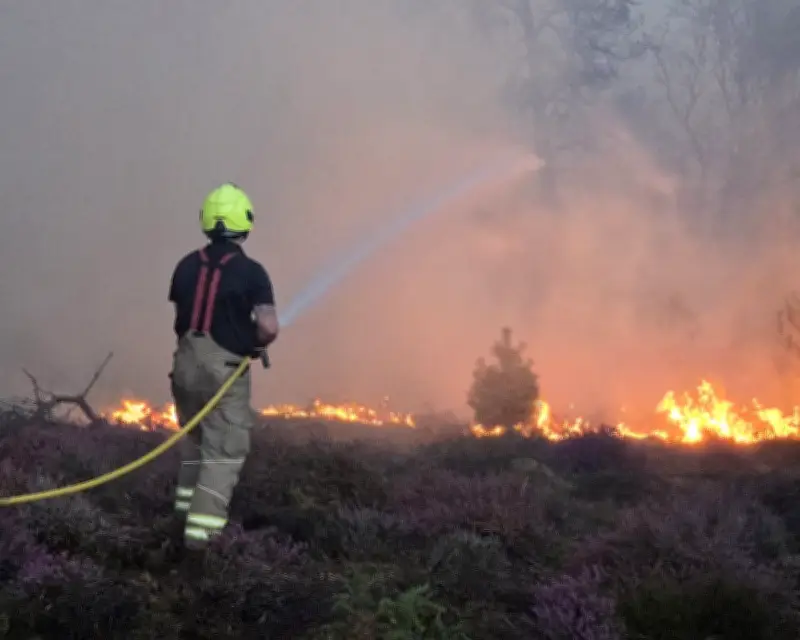
About 90 firefighters are battling a large heathland wildfire on the Suffolk coast that forced the evacuation of a holiday park with 200 caravans. The blaze at Dunwich Heath, near Leiston, prompted the declaration of a major incident and is being closely monitored by the nearby Sizewell B nuclear power station.
The fire broke out shortly after 5.30pm on Wednesday, with crews remaining at the scene on Thursday. Suffolk fire and rescue service said 18 fire engines were tackling the blaze, which covered approximately 100 hectares (247 acres). Cliff House holiday park was evacuated as a precaution.
No immediate risk to Sizewell B
Firefighters stated there is no current risk to Sizewell B due to the distance from the fire and its easterly direction. An EDF spokesperson confirmed the wildfire is not affecting operations at the power station, which has an emergency plan covering various scenarios including a fire on site. Earlier media reports that Sizewell B was on “high alert” were denied by EDF's media office.
People have been urged to avoid the area where possible and keep windows and doors closed. Prime Minister Andy Burnham, speaking during a visit to Cumbria, said: “We’ve got the situation under close monitoring, and I’m receiving regular updates. It is a very serious incident. I will make sure that Suffolk fire and rescue service have all of the support, the mutual aid, the other services that they need, and any other resources that need to be brought to bear.”
Unprecedented blaze amid drought
The wildfire comes as half of England was officially declared in drought, including East Anglia and six other areas. Natural Resources Wales also declared a drought across the whole of Wales, with the country on course for its driest July since records began nearly 200 years ago.
Incident commander Christopher May said crews would continue to fight the fire for the next 24 to 48 hours due to its size and complexity. Station manager Dan Davis described it as a “large-scale, wind-driven forestry fire” and noted crews were working in arduous conditions.
The blaze has spread to parts of RSPB Minsmere nature reserve, which remains closed to visitors. Adam Rowlands, an RSPB area manager, called the scale of the blaze “unprecedented in living memory” and described the damage as “quite devastating”. He said: “It’s been tinder dry, so with the drought conditions all the vegetation, the ground, is extremely dry, and so once this fire took off it spread dramatically and quickly.”
Climate context and response
Specialist drones were used overnight to assess the fire’s behaviour, while crews deployed multipurpose all-wheel-drive Unimogs and 4x4 quad bikes. Dr Zakary Campbell-Lochrie, a lecturer in fire science at the University of Edinburgh, noted that the wildfire coincided with drought conditions, saying: “The hot, dry weather conditions, including the multiple heatwave events across much of the UK in recent weeks, lead to strong drying conditions for vegetation, which can subsequently be highly susceptible to ignition and can present a much greater danger when fires do occur.”
The UK Health Security Agency stated that England was on track to record its highest ever number of heat-related deaths this summer, as the climate crisis, driven by burning fossil fuels, intensifies heatwaves. Meanwhile, in Scotland, crews reported significant progress in tackling a wildfire in the Cairngorms that broke out two weeks ago.




