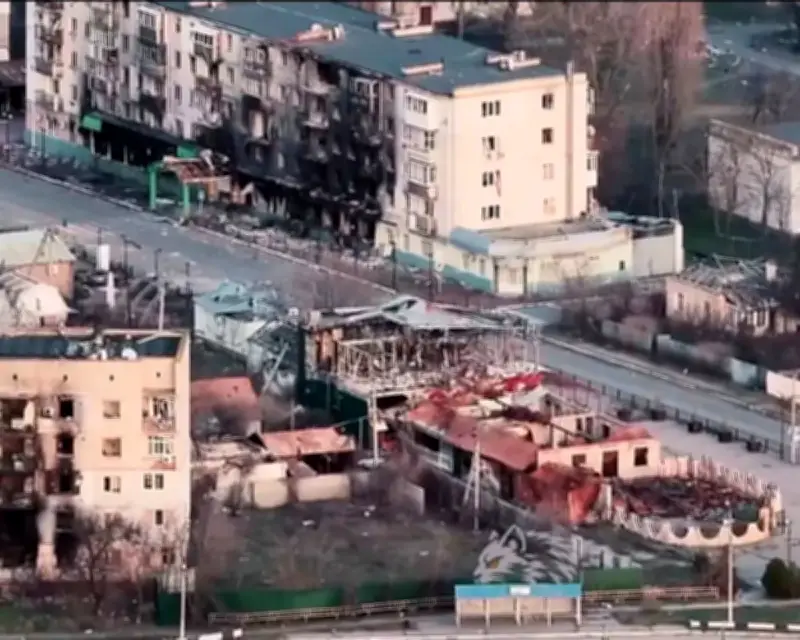
Russian-occupied Oleshky has become “a hell on earth,” according to Ukrainians familiar with conditions there, as the last 2,000 or so civilians, including 50 children, face starvation, with food supplies entirely halted since May.
Phone messages sent out of the city, once home to 24,000 people, described a grim reality: food has run out, and residents are down to one meal a day—soup without potato, made with courgette grown in former flower boxes, sometimes with foraged purslane, an edible weed.
Desperate Messages from Besieged City
“We’re in Oleshky [and] we can’t get out. We’re going hungry … Right now, I’ve got absolutely nothing to eat,” read a message from a woman waiting to be evacuated by occupying forces. Before the war, she weighed 110kg (17st); now she weighs just 67kg. “At first I was glad [to lose some weight], but now I realise I’ll die without proper protein-rich food. It’s very hard. The house where we stayed last winter was also destroyed and burned down. Just like our own home … We’re still alive.”
Another resident messaged: “A week ago, the orcs [a Ukrainian term of abuse to describe Russian soldiers] came into people’s yards and dug up all the potatoes, onions, and garlic. They took all the food supplies from the elderly women. When one of the grandmothers started shouting, they replied that people ‘soon to be living in heaven’ like them should subsist on nothing but water.”
Airdrop Operation and International Response
This weekend, military authorities in Kherson carried out a large-scale airdrop of emergency food, water and medical supplies into the city and surrounding areas, using large drones, after Russia reportedly again rejected a ceasefire to evacuate civilians. The military governor’s office in Kherson said the operation dropped about four tonnes of food to 100 locations, but it was unclear how much the Russian military had intercepted.
The Ukrainian foreign minister, Andrii Sybiha, raised the situation in Oleshky at the UN general assembly in New York this week. In a statement published on Monday, he warned of a “humanitarian catastrophe” and called for an immediate evacuation, accusing Russia of standing as “the only obstacle.” He said: “Russia is deliberately making life there impossible. They are starving them to death.”
Russian Blame and Worsening Conditions
The Kremlin spokesperson, Dmitry Peskov, this month acknowledged the “critical situation” in Oleshky but accused Ukrainian forces of blocking humanitarian supplies intended for its residents.
Until May, food supplies were still getting through to residents. But since May, as occupying Russian forces expanded minefields and drone cover, the trickle of supplies has entirely halted. Ukraine’s summer drone campaign against Russian supply lines has caused shortages for invading forces’ frontline troops, who in turn steal what little food Ukrainian civilians have managed to save.
On 1 September, a food convoy heading to the city was attacked. Moscow blamed the Ukrainian armed forces for the attack, while Kyiv blamed Russian troops. Ukrainian officials say attempts to drop food by drones have done little to help: the supplies are seized by Russian soldiers and in at least one case the intended recipient was arrested.
Officials Describe Horror and Human Shields
Commenting on the airdrop, Kherson’s military governor, Oleksandr Prokudin, described it as the largest operation of its kind so far. “Food was delivered directly to 100 distribution points. And now I would like to address the Russians,” he said. “Civilians have absolutely nothing to do with the Ukrainian armed forces. Because of the conditions you have created in Oleshky, people simply have no choice but to take food. Do not deprive people of the chance to survive and avoid starvation.”
According to Tetiana Hasanenko, a Ukrainian official serving from the western side of the Dnipro as the head of the Oleshky military administration, problems began in earnest late last year as access to the city from the Russian side became ever more difficult. “The density of the minefields has become very high,” she told the Guardian. “From December onwards, food deliveries became much less frequent because vehicles were hitting mines and being targeted by drones. By winter, supplying food had already become very difficult.”
Hasanenko described a reported incident where a 74-year-old man was digging out a cellar flooded with mud after Russia blew up the Kakhovka dam in 2023, looking for stored food. Refusing to allow soldiers into the cellar, he was murdered by them. “Some people have been digging out these cellars looking for canned vegetables, pickled vegetables and canned meat that people were storing up for winter,” she said.
Ukrainian officials believe the occupying forces are dragging their feet with the evacuation of the remaining civilians to discourage a Ukrainian counterattack. Hasanenko said: “The Russians are afraid that an offensive [against Oleshky] will start from Kherson city and they are just keeping people, civilians, as human shields.” She added: “It’s an old city. It has existed for almost a thousand years – and in all this time, people never lived in such horrible conditions, in such a hell like they do now. There are dead bodies not only in the basement of the hospital, but all over the city. They’re just lying there because you cannot pick up the dead body. The drones are flying constantly and then the dogs are eating the bodies.”