
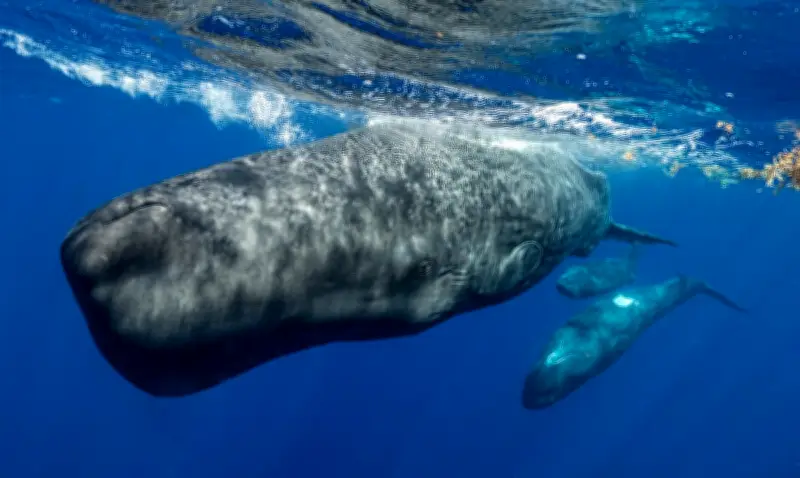
Researchers from Project Ceti, a non-profit research organisation working to decode sperm whale communication, have found that sperm whales produce a specific pattern of clicking noises when they hear the noise of boats. The pattern is so distinct that the scientists said they can now use it to predict when ships are nearby.
The team spent four years tuning in on the calls of 15 sperm whales off the coast of Dominica. They discovered specific differences in sperm whale “codas”, the discrete and distinctive patterns of clicks that this species utters to communicate when those whales encountered shipping. Individual click sequences became shorter, and one type became more prominent than another. Their findings are published in the journal Ecological Informatics.
Changes in click patterns and vowel-like sounds
Under normal conditions, recordings from one of the whales, named “Atwood”, picked up one type of coda comprising five clicks in a 1-1-3 pattern (two clicks preceding three quicker ones). With the background hum of a ship, Atwood issued the same 1-1-3 click rhythm but noticeably faster, reducing the intervals between each click.
“This research begs the question: are whales talking about the ships, or is it an impact on their voices because the ships are around?,” said David Gruber, the founder and chief executive of Project Ceti. “And then if we’re able to discern what they’re saying about the ships, how might that impact policy and laws?”
The association was so strong that “in general, from their vocalisations alone, we can predict whether ships are around,” said Gašper Beguš, linguistics lead at Project Ceti.
Study methodology and findings
For the study, Beguš and colleagues recorded more than 1,000 codas from the 15-strong sperm whale pod, using audio tags attached to whales by drones to be minimally invasive. Where background shipping noise was detected, it was verified using digital geolocation data to confirm that vessels were in the whale’s vicinity when the recording was made.
Several studies have shown that marine animals increase the volume of their vocalisations when there is noise pollution, but the researchers were surprised not to see this trend in the sperm whales. Instead, the creatures seemed to prioritise altering not just the speed but the types of codas they produced.
This related to previous studies where Project Ceti researchers described the “use of vowels” in sperm whales. Communication among sperm whales has long been viewed as a series of morse code-like clicks, but in that work the team found that if the gaps between individual clicks in a coda sequence were condensed to speed up the recording, they formed a continuous unit of sound that resembled two human vowels – the sounds “aaaa” and “iiii”.
In the latest research, in addition to the changing coda tempo, the team identified differences in the prevalence of these two vowel-like sounds in noisy conditions, with sperm whales using the “aaaa” coda more frequently.
“The study is actually one of the first glimpses that the vowels that we discovered might actually carry meaningful information. Because in the presence of shipping noise, they change the way they use those vowels,” Beguš said.
Expert reactions
Some researchers have criticised Ceti’s previous studies, finding fault with its methods and saying that describing whale communication using terms such as “vowels” and “language” stretches the associations between whale and human communication too far. Gruber says they try to address this concern by using terms such as “vowel-like” or “language-like”.
Nathan Merchant, an underwater noise specialist at the UK government marine research agency Cefas, who was not involved in the research, said there could be other unknown factors driving the change in whale vocalisations aside from shipping noise. But he said his “hunch” was that the relationship was causal.
A large body of work now showed changes in behaviour and call volume when marine animals encountered shipping noise, Merchant noted. “Something that marks this study out is that it shows changes to the fine-scale content of those calls,” he said. “It really adds another dimension of nuance to that story about how underwater noise can affect cetaceans.”
He added that it would take more research to determine what these audible changes meant. “Are they [the whales] just struggling to say the same thing, or are they saying something different in the presence of this noise?” he said. “It’s a really intriguing question.”




