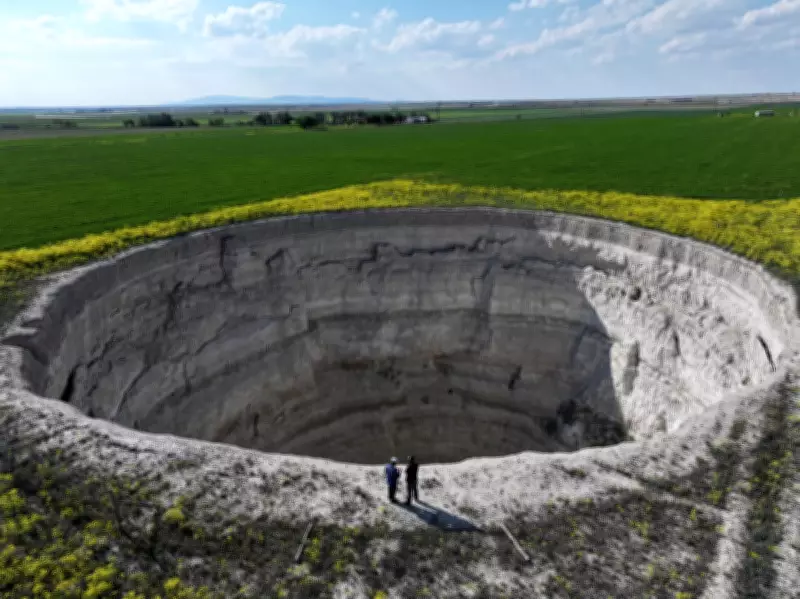
Sinkhole Crisis Engulfs Turkey's Agricultural Heartland
In the Konya province of Turkey, often hailed as the nation's breadbasket, a silent menace is rapidly expanding beneath the feet of farmers. Giant sinkholes are appearing with alarming frequency, driven by plummeting groundwater levels, extreme heat, and intensive agricultural practices. This geological phenomenon is accelerating land collapse, compelling a fundamental reassessment of farming methods across the region.
A Farmer's Tale of Constant Dread
Fatih Sik, a 47-year-old farmer, experienced this terror firsthand. While enjoying tea at home, he was startled by a thunderous boom. Peering outside, he witnessed water and mud erupting skyward, nearly as high as the surrounding trees, just meters from his property. The cause was unmistakable: another massive sinkhole, measuring fifty meters wide and forty meters deep, had yawned open on his land. This event occurred almost exactly one year after a previous sinkhole formed on the same farm in August, the hottest month.
Sik, who inherited the farm from his father, now lives in perpetual anxiety. Scientists have warned residents that the area is becoming uninhabitable. "Every night I pray before I go to bed and when I wake up I pray again," Sik confessed. "I live in constant fear that a sinkhole will take my house." His fears are grounded in reality; a nearby house has already been swallowed by the earth.

The Geological and Climatic Drivers
Konya, part of the historically fertile Central Anatolia region, is geologically predisposed to sinkholes due to its limestone bedrock. However, the crisis has intensified dramatically. Professor Fetullah Arik, a geology expert at Konya Technical University, attributes the surge to dwindling rainfall and severe groundwater over-extraction. Local farmers, facing water scarcity, are drilling deeper wells, further depleting aquifers and destabilizing the subterranean landscape.
"Over the past two years, things have accelerated and the difference is hard to ignore," Professor Arik states, noting that Konya now exhibits the highest density of sinkholes globally. The region has lost 186 of its 240 lakes over the past six decades, a stark indicator of the escalating drought. Turkey confronts a severe desertification threat, with nearly 90% of the country at risk.
Economic Devastation and Agricultural Adaptation
The human cost is profound. Sik estimates 100 sinkholes plague his neighborhood alone. Two have devoured his beetroot fields, resulting in an annual loss of approximately £17,000. Remediation would require 6,000 truckloads of sand, costing nearly £35,000—a sum beyond his means without governmental support. Consequently, Sik has directed his children toward careers in nursing and dentistry, believing he represents the final generation to farm this land.
In response, innovative farmers are pioneering sustainable alternatives. Mahmut Senyuz leads a collective reintroducing hemp cultivation, which reduces irrigation needs from nine or ten waterings per season to just three. Simultaneously, Dr. Ece Onur, a former academic, advocates for ancient dry-farming techniques. Her female-led cooperative in Burdur cultivates roses and medicinal plants without irrigation, relying instead on deep-rooted plants to access natural soil moisture.
"Soil is a living organism," Dr. Onur emphasizes. "The only way to solve this crisis is to stop trying to make nature do things our way. We have to imitate her ways."
Broader Implications and Climate Policy Questions
This environmental emergency unfolds against a backdrop of global climate breakdown. Central Anatolia, within the rapidly warming Mediterranean basin, bears a disproportionate burden. Notably, Turkey is co-hosting the UN climate summit Cop31 this year alongside Australia, raising critical questions about its climate leadership. Independent assessments, such as those by Climate Action Tracker, deem Turkey's current policies "highly insufficient" to meet the Paris Agreement's 1.5°C warming limit.

The sinkhole surge in Konya serves as a potent microcosm of the interconnected challenges of water management, agricultural sustainability, and climate action. For farmers like Fatih Sik, the rumbling beneath the earth is not just a geological curiosity but a daily reminder of an uncertain future, forcing a painful reckoning with practices that have sustained generations.