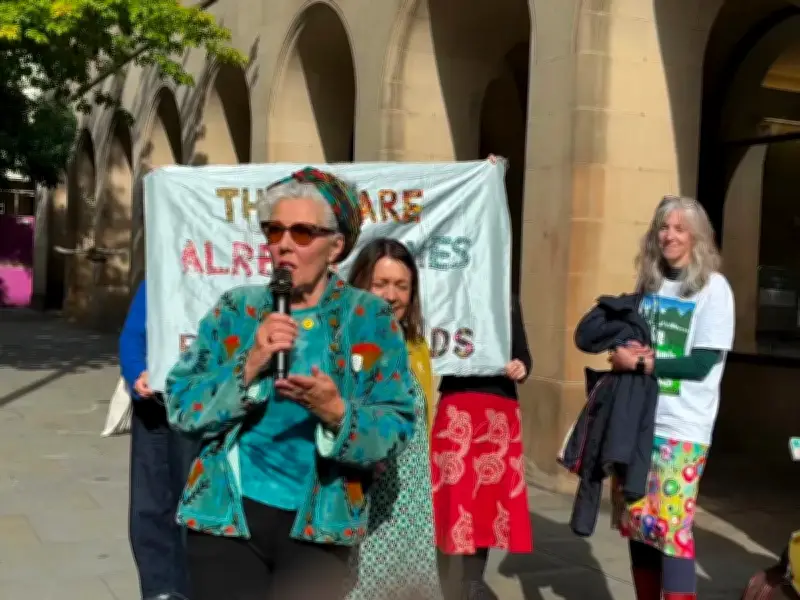
Cheers, laughter, and singing echoed in the halls of Manchester City Council after permission was granted to turn Ryebank Fields in Chorlton into a 'community woodland and meadow'.
The former university playing fields have long been at the centre of a major spat between developers and the local community. Manchester Metropolitan University, who own the land, have submitted a planning application to build 120 new homes there. But local residents have been using the 'rewilded' 4.5-acre park as a community space for decades.
Now campaigners say they've scored a 'symbolic goal' against the University, after a 'rival planning application' was unanimously approved by a planning committee.
Campaigners celebrate approval
Dr Rhetta Moran, of the Ryebank Fields Community Group, told the LDRS: “Today, Manchester City Council honoured their promise for the retention of Ryebank Fields in all its glory as a rewilded and stunning space for everyone. Now MMU have the opportunity to honour that too and we look forward to their cstm and agreement to work with us so that the pcls gm that is Ryebank Fields remains in property.”
The application to officially designate the land as a community green space received almost 700 supporting comments and 64 objections. It was recommended for approval with conditions by planning officers, who added: “Whilst the Council as local planning authority has two separate applications for differing end uses of the application site it is entirely acceptable in planning terms for both proposals to be considered for determination with either the same or differing recommendations”.
University stands firm
The application by MMU includes 52 homes to be sold on the open market with 42 earmarked as age-friendly, social rent properties, and eight homes for young autistic adults and 18 co-housing units. It includes remedial works on land contamination, and one third of the site would be kept as green space.
Kevin Hartley, a solicitor for the university, told the committee that regardless of what decision they make, the university would not change their mind.
“The university, as land owner, will not support implementation of any consent provided for this application,” he said. “The public will not obtain ownership rights or a right to lawfully access Ryebank as a result of this application. Ryebank has been closed to the public since 2020 due to the repeated discovery of surface level asbestos, and anyone entering the site without our consent is trespassing.
“Our own application for Ryebank, which will be brought to this committee at a later day, provides the only feasible, deliverable, and responsible solution to the challenges facing the site.”
Environmental concerns and next steps
The university has long maintained that surface-level asbestos and heavy metal contamination on the site presents an environmental health hazard. The council's environmental department found that the risk to members of the public was 'low', and requested conditions that would see regular monitoring and any areas of risk closed off for wildlife use only.
Addressing councillors, Dr Moran, the official applicant, agreed to the conditions, and argued: “Since 1996 the fields have been rewilding into a biodiverse green lung for our city, enhancing air quality and reducing pollution. Lovingly cared for and respected, the fields are home to over 1,500 trees, rare plants and flowers, and protected and endangered species. It offers a lifeline to our depleting urban wildlife.”
Members of the public were sternly reprimanded by the chair after breaking into applause following Dr Moran's statement. Councillors voted unanimously in favour of the proposal.
Despite gaining permission, the proposal does not mean the site is now a designated community woodland, as this would require the agreement of the landowner.
The decision comes a day after Trafford councillors went against the advice of their officers over a new access road to MMU's 120-home development that would cross into the neighbouring borough. Officers had recommended delegating the decision to Manchester city council. But an 'upswell of public opinion' prompted councillors to reject the suggestion, meaning they will now weigh in on the decision-making process.
However, the campaign group faces considerable obstacles in getting the plans thrown out entirely, as council officers have deemed the project acceptable in principle in planning terms.