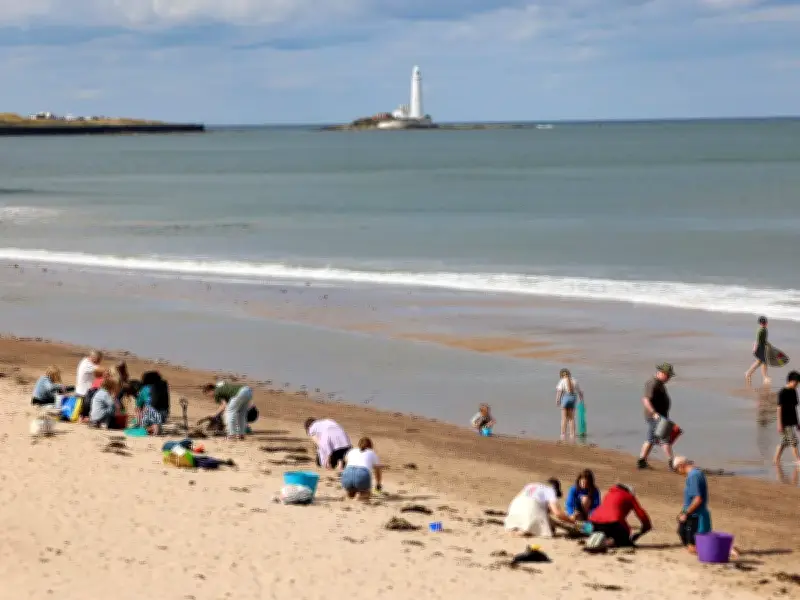
The majority of plastic nurdles released into the environment following the River Tyne spill are likely to have dispersed beyond the Tyne estuary into the North Sea, according to the latest scientific modelling. The advice, provided by the Scientific and Technical Advice Cell (STAC), will guide the next phase of the recovery operation.
Since the incident on July 19, significant recovery work has been carried out on the River Tyne and across affected coastlines. Of the 17.92 tonnes of nurdles estimated to have entered the marine environment, 4.78 tonnes in cleaned weight had been confirmed as recovered through on-water and shoreline operations as of September 3. Between September 3 and September 23, a further 358.85 kg (0.36 tonnes) was recovered, reflecting the much smaller quantities now being found. The total recovered from the water and beaches is 5.14 tonnes.
Added to the amount which the Port of Tyne were able to remove from damaged containers on board the cargo ship BG Orange before they fell into the water, this means that almost three quarters of the original nurdle cargo has now been recovered overall.
Modelling indicates dispersal patterns
STAC has reviewed available evidence including recovery data, shoreline surveys and specialist modelling undertaken by Newcastle University and the Centre for Environment, Fisheries and Aquaculture Science (Cefas). The modelling indicates that many of the nurdles released into the environment are likely to have dispersed beyond the Tyne estuary out into the North Sea, while some material may remain within the river system.
It also suggests nurdles may continue to wash up on parts of the coastline in the future, with weather conditions, tides and winds influencing where and when this occurs. The number of nurdles being found on beaches along the North Sea coast is now very small, while samples taken from the Tyne river bed have not found deposits there.
However, STAC advises that while modelling can help identify broader patterns and areas that may require monitoring, it cannot accurately predict the precise location of individual nurdles or whether they will appear at a specific beach at a particular time.
Recovery of every nurdle unachievable
Dr Robert Bradburne, STAC Chair, said: "The evidence gathered over recent weeks has significantly improved our broad understanding of how the nurdles are likely to have moved through the Tyne and wider marine environment. Our assessment indicates that a substantial proportion of material is likely to have dispersed offshore. The modelling also helps us understand broader transport patterns, although there remains uncertainty about exactly where nurdles may appear in future."
The STAC has recommended a multi-evidence approach to support future decision-making. Under this approach, recovery data, environmental monitoring, scientific modelling and shoreline surveys will be considered together to help determine where activity should be focused and when intervention may be required.
The approach recognises that complete recovery of every nurdle is not considered achievable, while ensuring monitoring and response arrangements remain in place to identify any future accumulations and support further action where appropriate. The Recovery Working Group is now considering how the recommended framework should be applied, including developing appropriate thresholds to help determine when active recovery at individual locations should move to monitoring, and what levels of renewed accumulation should trigger further recovery activity.
Community informed
Recovery partners continue to coordinate the wider response and consider the latest scientific advice. Gary Kirsop, Director of Community Operations at South Tyneside Council, speaking on behalf of the multi-agency response group, said: "Recovery partners remain committed to responding to this incident and continuing to work together to protect our coastline and river environment. The scientific advice gives us an important framework for determining how recovery and monitoring activity should continue. We will continue to review evidence, adapt our response where necessary and keep stakeholders and local communities informed."
Further scientific advice, including an ecological assessment, is expected and will help inform ongoing recovery planning.