The National Trust has used an innovative approach to rapidly rewet peat on upland moors, protecting landscapes and communities from extremes such as wildfire and flooding, conservationists said.
More than 3,000 “scallop bunds” – semi-circular embankments a few metres wide – have been created across hundreds of acres of upland peat on the charity’s Holcombe Moor, north of Manchester. The bunds, built of peat and re-covered with vegetation to protect it, capture rainwater in thousands of spots at the top of the moor.
This has created pools and boggy ground that support wildlife such as dunlin and curlew, and allow vital sphagnum moss, which holds huge amounts of water, to be restored. Some 1.5 million small clumps of sphagnum have been planted in two phases of the project.

Restoration methods and benefits
Restoration work on the moor and the charity’s adjacent Stubbins Estate above Ramsbottom, Lancashire, has also involved damming gullies on the moorland, creating “leaky dams” on the hillsides below, and protecting exposed peat.
The work aims to deliver multiple benefits: rewetting the peat so it can store carbon and be more resilient to fire, supporting rare wildlife found on the moor, and slowing the flow of water down the hills to the River Irwell to reduce flooding.
Upland landscapes often face competing interests from farming, shooting, public access, wildlife and water management. But at Holcombe, the National Trust has worked with the commoners who have grazing rights to enter into a Countryside Stewardship agri-environmental scheme that pays them to reduce livestock and support the peatland restoration, and is focusing on community engagement. The charity has also worked with partners including the Environment Agency, the Environment Department (Defra), Natural England, Ministry of Defence, United Utilities and tenant farmers.
Ground conditions and wildlife impact
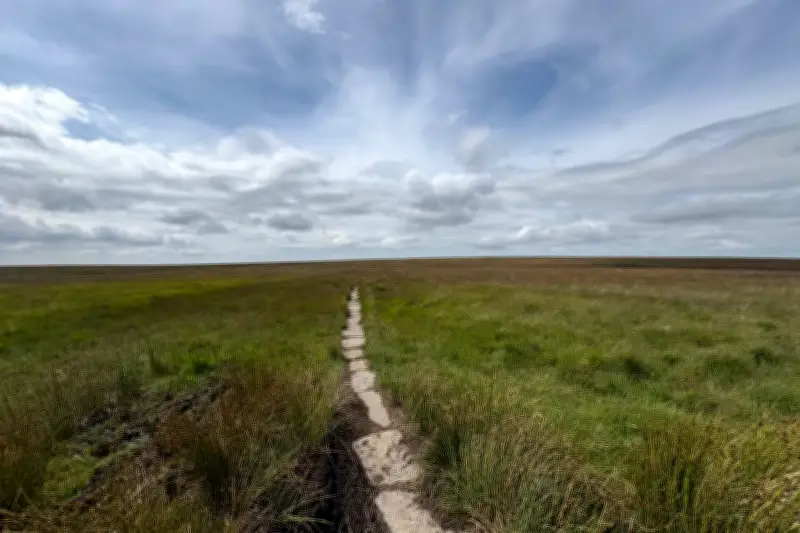
On the top of the moor at Holcombe, from where, on a clear day, you can see Manchester, the ground stayed wet this summer despite prolonged dry weather that left landscapes tinder dry and prompted wildfires elsewhere in the region. Area ranger and project supervisor for the peatland restoration work Nik Taylor drives his walking stick into a patch of peat and it comes up wet just a few centimetres below the surface. He also plucks a small handful of sphagnum, squeezing it so water trickles out, demonstrating just how much it can hold.
Like much upland moorland, Holcombe Moor was degraded by centuries of land management, exposed to burning, draining, grazing and pollution from the industrial revolution which killed sphagnum. The landscape is one of deep peat, up to 4.5 metres in places, and averaging 2.5-3m, but is marked by gullies that water pours down, and “weather edges” of exposed peat.
While work at Holcombe has followed other peatland rewetting schemes in damming the gullies that carry water off the moor, which slowly allows moisture to spread out into the surrounding area, the bunds speed up the process by holding water in thousands of places across the landscape.
Long-term progress and community benefits
Mr Taylor said the approach, the first to use the bunds at scale in an upland setting, was about “first of all trying to stop the rot, stop the degradation”. “Then we rewet and plant sphagnum that in time allows us to accumulate peat, that’s a millennial process, but at least it means it’s not deteriorating, so we start to sequester, not lose (carbon).”
It is, Mr Taylor says, a work in progress, with the grass and sedge moor about three fifths of the way to where it should be – a process he estimates could take 50 years. “On a good moor, you’d be sick of insects, you’d be wet most of the time, it would be lumpy and difficult to walk, you wouldn’t know where you’d be putting your feet, it would be bouncy,” he says.
But some impacts have been almost immediate – the population of dunlin were “just hanging on” but numbers have increased. Communities further down the hill have also benefited from the leaky dams lower down in the estate – wood or stone structures which hold some of the water back to slow the flow downstream – with no flooding reported in a storm just weeks after a set of dams were completed.

Ben Eardley, National Trust nature recovery project manager, said historically people had drained and disconnected the landscape, and there was now a need to have areas in a catchment that were more naturally functioning and wilder. With climate change, “these extreme weather patterns are locked in now, it’s the new normal, so we need to rethink our relationship with rivers in these catchments”, he said. “With peatland restoration, what you’re doing is trying to restore ecosystem function to a whole habitat, so then you get multiple benefits, during all weather conditions.”
Much of the work at Holcombe has concentrated on outcomes such as natural flood management or storing carbon in the peat, but Mr Taylor says it has also made the landscape more resilient to fire. “It’s stayed wetter in the areas where we’ve done the scallop bunding on deep peat. It stays wetter for longer, and the groundwater level raises closer to the surface for longer, and that makes the ground more resilient to those deep fires that can get into the peat.”
It may not be suitable everywhere, he said, but added: “We’ve proven that actually on the ground, it doesn’t make a massive difference to the landscape characteristics, the aesthetics of the place. But it can create so many benefits, one of which is wildfire resilience.”