
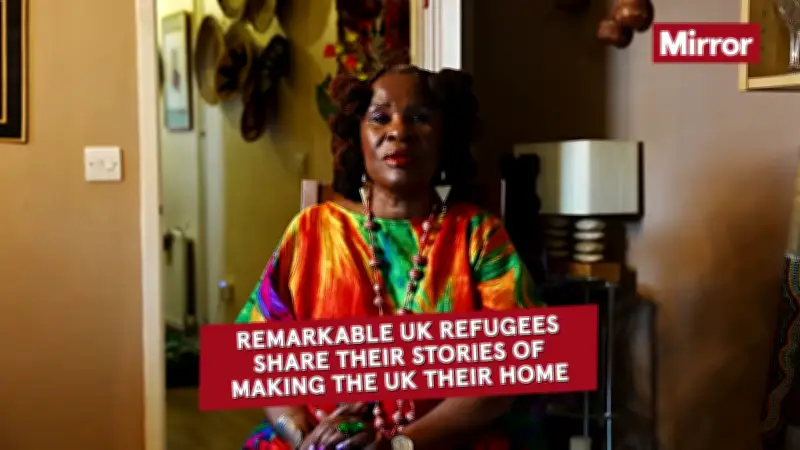
They say every object tells a story - and for people displaced to the UK, even the smallest possession can mean everything. To celebrate Refugee Week we asked three people who came to the UK seeking sanctuary to tell us about something precious to them that links them to home.
For Pritesh Pattni it's his plane ticket, from when he fled Uganda in 1972. For councillor Alice Mpofu-Coles, her childhood photos still have the power to evoke special memories of Zimbabwe. And when Ruslan Panchyshyn holds his gold medal given for valour in Ukraine, he says it's a symbol of strength.
The Mirror's #PeopleMove Instagram project provides a platform for refugees and displaced people to tell their stories - and share the importance of a beloved object. In the case of Pritesh, Alice and Ruslan – who have all been determined since day one to give back to the country that took them in – their contribution has been beyond anything that could have been asked of them. And their journey started with a plane ticket, child photos and a gold medal.
Dr Alice Mpofu-Coles, 61 - Zimbabwe - Childhood Photos
"These are my family photos. They are all I brought with me when I left Zimbabwe in 2002. Happy memories of me with my parents, four brothers and husband. Photos of me dancing with my parents and aunt. Life was good. I had a big house and worked as a diplomat in the Government for 12 years, travelling the world. I was posted to the former Yugoslavia and Mozambique before returning to Zimbabwe.
But between 1999 and 2008 things changed. People in Zimbabwe were being persecuted. About four million people were forced to leave because of political and economical reasons - and I was one of them. I left my two daughters aged just five and 10 with relatives and came to the UK. I had nothing, I couldn't bring my money over so I slept on my friend's sofa and took any job I could – cleaning, cooking, being a carer and a sandwich factory worker. I didn't know anything about the benefit system, I just worked and worked hard.
Although I was lucky and my refugee status was granted quickly, my children's visa was denied. I had to work harder to pay the lawyer again, and fight to bring them over and eventually they came. I rented a small house. It was expensive but mouldy – I didn't have enough money to feed my family. Reading's Refugee Support Group helped me. They gave me a 5kg packet of pasta. Pasta goes a long way in making meals. We soon started volunteering here and my daughters helped teach English. I later became an ambassador. I embedded myself in Reading, it became my home.
After graduating with a PhD and getting my children to university, I became a local councillor. I made it my mission to help others. I campaign against poverty, I can't stand to see anyone suffer. Politics fascinates me, it is what makes me tick, it is who I am. Now I'm a senior research fellow at the university and in 2025, I became Reading's first black Mayor for the Labour and Co-operative Party. I worked hard and attended over 260 events. As a society we are facing racism, misogyny, patriarchy, discrimination, but I don't listen to the noise. I keep focused, I embrace everyone as there is one human race."
Ruslan Panchyshyn, 46 - Ukraine - Gold Cross
"This is the Gold Cross I was given for outstanding achievement when I served in Ukraine's Armed Forces. It was awarded in 2023 - a time when I was very low and when the situation in Ukraine was very difficult. My unit came under fire and three out of five men were killed. I had joined the Armed Forces of Ukraine in February 2022, because if there was no one to defend the country, there was no future here.
Although there was talk of a war, nobody actually believed it was going to happen. Then I got a call from my friend at 5am to say the war had broken out. We thought it would be resolved soon. We hid in a large bomb shelter in Kyiv but they continued to bombard us. I drove my wife and three children to western Ukraine. The road we travelled on was heavily attacked just 20 minutes later, but we were lucky.
In April 2022 my family applied for the Homes for Ukraine Sponsorship Scheme. I drove them to Poland where they caught a flight and I returned to serve my country. Life before the war was wonderful. I was a university professor and former Mayor of Novodnistrovsk. My wife worked as an IT manager. After I was injured, I joined my family in Stockport, Greater Manchester in 2025 and we have had our fourth baby here.
I decided to continue with my charity work here too. I launched the International Centre Ukrainian House and thanks to a National Lottery grant, I started Drop of Life - a blood-giving initiative to encourage Ukrainians living in the UK to give blood, so we can save lives here, while the world supports us in Ukraine. British people have really supported Ukrainians and I want to reply to that kindness with more kindness.
I've also joined an Employment Programme called STEP, run by the World Jewish Relief charity - they've helped me expand my organisation and supported me learning English. I have joined the Advisory Board for the War and Recovery Research Centre in London too to further integrate myself into British life. I'm still working as a professor - via online classes now - but I miss my homeland a lot."
Pritesh Pattni, 59 - Uganda - Plane Ticket
"This is the plane ticket I travelled with when I left Uganda with my parents and older brother in November 1972. And here is my mother's passport - passport control stamped 'cancelled' on it as we left. It was a significant moment - it meant we were no longer residents. I came from a wealthy family. My grandfather was a business man and owned jewellers across the country. I had a very good life.
I was just five when Idi Amin came into power, he wanted Asians out of Uganda. It was a very traumatic time, especially for my brother, he lost friends. Many fled but one was shot and killed by military police who looted their home. When we arrived in the UK we lived in a refugee camp in Wales for nine months, then moved to Birmingham where we rented a single room for six years. My parents worked in factories. School was difficult. There was racism and animosity towards refugees.
After graduating in computer aided product design, I opened a petrol station. I later did an MA in engineering design and achieved a MPhil in medical engineering. I became a trustee at the research charity at the Royal Orthopaedic Hospital. In 2018, I opened a convenience store and post office in Edgbaston, Birmingham. It was the best decision I ever made. It is community-focused, we are helping people.
I got married and have three children. I'm chairman of Bidgley Power Foundation. It was started by a group of restaurant workers who had a passion for badminton like me. I wanted to help more people access sports and other activities in Aston, which is one of the most deprived areas in Birmingham. At first we ran it from a shipping container, with no light and electricity. Then we became a charity and moved into the Pavilion Community Centre. Now we deliver sports programmes, baby and toddler classes, youth clubs and ESOL classes. We support 1,200 young people with free meals in the school holidays and run a holiday camp.
This year, I was awarded the New Years' Honour in recognition of my charity work in the community. I was nominated by England Badminton to be an Olympic Torch bearer in 2012 and in 2014 I carried the Commonwealth baton. It felt like such an honour."
To read more stories visit People Move.




