
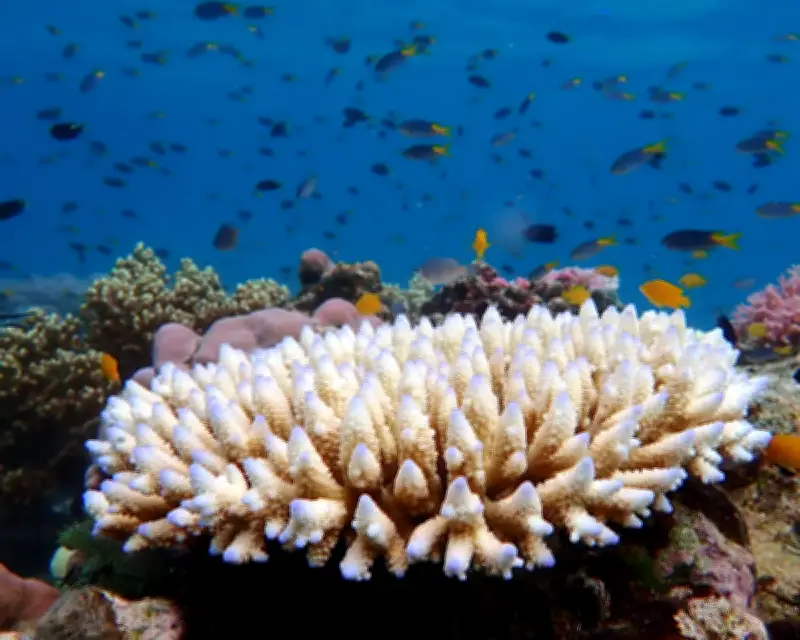
The Australian newspaper has claimed that official data showing the Great Barrier Reef's "continued good health" proves climate change warnings are wrong, but the science agency behind the data says the newspaper's framing is "oversimplified".
The newspaper's front page story pointed to government data showing the reef is "refusing to die" despite decades of warnings about global heating. An editorial said the reef's health was a "welcome reminder that physics rather than the pseudo-religion of climate change doom still holds sway over the natural order."
Scientific concern misrepresented
The Australian Institute of Marine Science (Aims), which produced the data, told Guardian Australia that the newspaper's interpretation was incorrect. "The scientific concern is not that the GBR should already have disappeared, it's whether reefs will have sufficiently long periods between disturbances for full ecosystem recovery," the institute said.
Aims' long-term monitoring program, which between August 2025 and June 2026 surveyed 121 reefs, found coral cover at "near record levels" across the reef. The institute said coral cover "increased slightly or remained similar to levels recorded in 2025, signalling the start of recovery from the impacts of the 2024 mass bleaching event."
But Aims rejected the suggestion that this contradicted scientific consensus. "The [monitoring] findings show that many reefs in the Great Barrier Reef retain a strong capacity to recover when disturbance pressure eases. That is evidence of resilience, not evidence that climate-related risks have been overstated," Aims said.
Volatility shows instability
Aims also responded to the editorial's claim about "continued good health", saying the phrase "overlooks the volatility of the reef during the past 15 years when rapid gains in coral cover have been followed by sharp losses." The institute added: "Volatility is evidence of ecosystem instability; it shows how quickly recovery can be reversed."
The Australian's report gave prominence to Dr Peter Ridd, a long-time climate science sceptic who rejects the risk to corals from global heating. Ridd said recent bleaching events had "not produced a major drop in coral cover" and that low coral cover periods are "entirely natural."
Aims countered: "High coral cover in 2026 doesn't demonstrate low mortality in preceding years" and it was "wrong to suggest [coral bleaching events] have killed very little coral." The institute noted that the 2016 and 2017 events caused serious coral mortality at very large scales, and the 2024 event drove the reef's largest coral loss in nearly 40 years of monitoring in two of the three regions.
Study findings misinterpreted
The Australian also reported on a Macquarie University study of "potentially climate-resilient reef locations", claiming about one-third of the Great Barrier Reef was judged resilient. Dr Stacy Jupiter, one of the study's authors, told Temperature Check the newspaper had "misinterpreted" the conclusions.
Jupiter said the study, not yet published in a journal, modelled coral cover to 2050 and was "pre-designed to select 30% of coral reefs from each ecoregion" to match global targets to protect 30% of oceans by 2030. She said it was "not predicted that every identified reef will survive" and it was "an incorrect interpretation to say that the study judged a third of the GBR to be resilient with any degree of certainty."
Dr Mark Eakin, a US-based oceanographer, told Temperature Check that "the rapid return of five severe marine heatwaves causing widespread bleaching in less than a decade shows that the reefs of the GBR are not being given enough time to recover." The Guardian sent questions to The Australian but received no response.




