
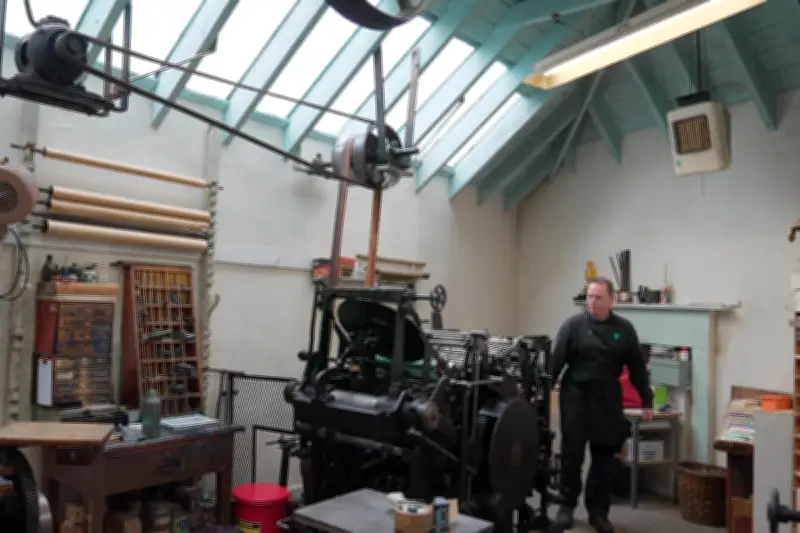
A rare late Victorian printing press has been restored to full working order in time for the 160th anniversary of the UK's oldest working commercial letterpress printing works.
The machine at Robert Smail's Printing Works in the Scottish Borders is now operational again for the first time in 10 years after undergoing restoration. It is one of six presses at the printing works which produce print to stock the stationer's shop there and fulfil bespoke orders.
Restoration details
The printing works, now cared for by the National Trust for Scotland (NTS), were founded by Smail, who acquired the current location on Innerleithen's High Street in 1866 for £500. The newly restored automatic Falcon Safety Platen Press is believed to be the only known example of its type still in operation.
During the restoration work, specialist conservators at the Leather Conservation Centre in Leicester repaired a hole in the leather bellows, an essential component which releases a small puff of air to ensure only a single sheet of paper is lifted at a time.
Expert comments
Lesley Scott, NTS regional conservator for Edinburgh and east, said: “It’s wonderful to have all six machines here at Robert Smail’s busy at work and serving the community again.
“Industrial heritage is best appreciated and understood by audiences when they can see the working machinery in its authentic setting being used for its original intention. That’s exactly what visitors can experience at Robert Smail’s Printing Works.
“Through the live demonstrations of our skilled printers, the presses are not just static artefacts, but dynamic, working machines that engage the senses and give visitors a glimpse of how our printing needs were met before the digital age.”
Further restoration work
New rubber suckers, designed by 3D product designer James Barr, were created during the restoration and other components of the press were repaired and conserved. NTS said comparatively few Falcon Safety Platen Press machines were ever produced because the design was soon superseded by the more versatile Original Heidelberg Platen Press.
Visitors to the printing works this summer can now see the machine, thought to date from 1908, working as it did in the late Victorian and Edwardian eras.
Significance and future plans
Ylva Dahnsjö, NTS visitor service supervisor for Robert Smail’s Printing Works, said: “Letterpress printing is still here and thriving – partly because of the beautiful quality of the print, but also because the physicality of the artform contributes so greatly to our general wellbeing, as our popular workshops demonstrate.
“Printing also offers a level of authenticity that is disappearing rapidly from modern media. The increasing prevalence and accessibility of generative AI calls into question the origin and veracity of everything we see and hear. The pieces that pass through our inky presses are a tangible reminder of past times and treasured by those who love the handmade and unusual.
“This press was restored through the generous support of trustees, staff, and friends of the National Trust for Scotland, given with heartfelt thanks to Sir Mark Jones for his leadership and dedication as chair of the trust from 2019 to 2025.”
This year also marks 40 years since NTS acquired the printing works following a “monumental” fundraising effort and contributions from public bodies and private donors. It acquired a collection representing 120 years of continuous printing in Innerleithen, including four printing presses, about 160 cases of types and an archive of printing work that served the local community over decades. Since then the collection has expanded through donations and loans to six presses and around 500 cases of type.
The printing works are open to visitors for guided tours from March to October, and regularly host letterpress, and other related workshops. The team at the printing works are producing a facsimile specimen book sourced from the 1877 section of the oldest “guard book” in the collection at the site, which recorded type faces in use during that period, as part of the 160th anniversary celebrations. A celebratory lecture with printing historian and academic Dr Helen S Williams will be livestreamed for online audiences on October 2 this year.




