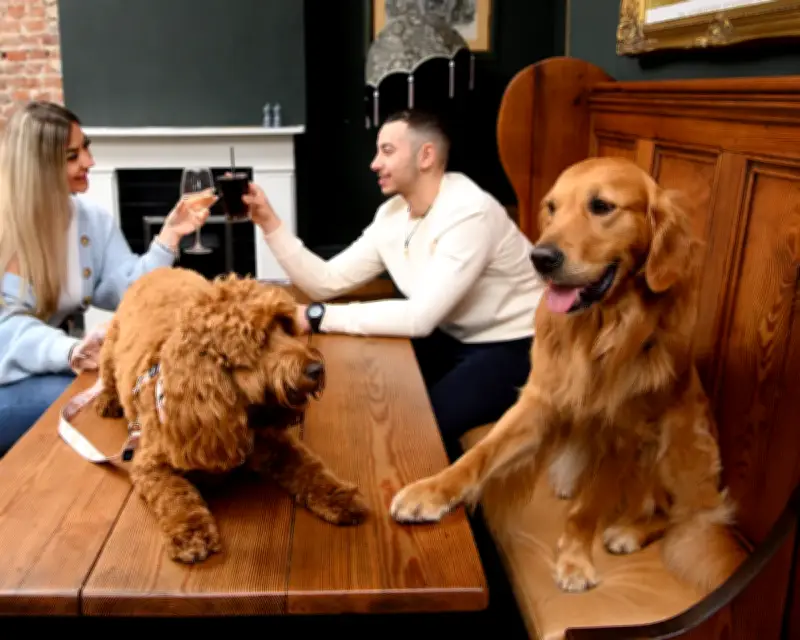
Dogs in Victoria could soon be formally allowed into pubs if the Carroll Labor government is returned at the forthcoming state election. Paul Daley, a Guardian Australia columnist, argues that not every dog, just like not every person, should go to the pub.
Etiquette for canine patrons
Daley writes that obstreperous drunks should stay home along with incessant barkers. Brawlers and biters, human or canine, are not welcome. His blue-heeler-collie-cross Olive, who lives in Sydney but hails from inner-city Melbourne, would vote for the amendment to the Food Act 1984 if she could, but she is aware that not every dog understands pub etiquette.
There is no place in her books for growlers and sniffers and frisky types that don't understand "back off", or dogs that won't get the message either. Olive can go anywhere, sitting contentedly at Daley's feet in pubs and restaurants in Sydney's inner west. She is not food driven, not interested in the schnitty and chips at the next table, and wary of taking treats from strangers. She is well in control of her bodily functions in public places at all times.
Observed incidents and mixed opinions
Daley recently witnessed a considerable human fracas involving bouncers at one of his regular watering holes when a small poodle-cross accidentally relieved itself in the crowded dining room. It was a divisive episode among patrons. The dog seemed ashamed, more so than the humans we've all witnessed do far worse with greater deliberation at closing time.
As a dog person, Daley understands not everybody wants to see dogs treading the sticky red carpet down at the local. Some people are legitimately scared of dogs. Others don't like them around kids on the grounds of safety, with a simple solution suggested: ban children from pubs and allow in dogs. Others cite hygiene, even though children with dogs may develop better immunity.
Breed and behaviour considerations
Daley notes that gentle and sweet dogs who've lived in his household would never be taken to the pub, or anywhere food was being served. Ronda and Nari were labradors, both could have competitively eaten for Australia, and there was no end to the disgusting dead stuff they scavenged and consumed in various parks. Potential admission to the pub should not be judged on breed alone, as Daley has seen perfectly chilled labs in the pub, and even the odd beagle.
He recounts a mate who had a much-loved black labrador with a sweet tooth, which once pounced on and ate an entire cake at an alfresco birthday party at an off-leash six-year-old's birthday party. That dog was never going to get to the pub.
Current practice and outlook
On a recent car trip to a Victorian wine district, Olive was given a list of dog-friendly wineries, with water bowls, dog beds, and even treats. But there were also signs making it clear that people were responsible for the behaviour of their animals. In any public place, that's got to be the rule.
Daley loves seeing dogs in the pub and always assumes their behaviour and training deems them fit to be there. He's rarely seen a problem. Last time in Melbourne, he and Olive went to several pubs in the inner north, where other dogs were present, nobody barked, and nobody complained. It's already happening and might not be a human vote-changer. Finally, Daley notes that bouncers are often on the doors of pubs mostly due to the behaviour of people, not dogs.