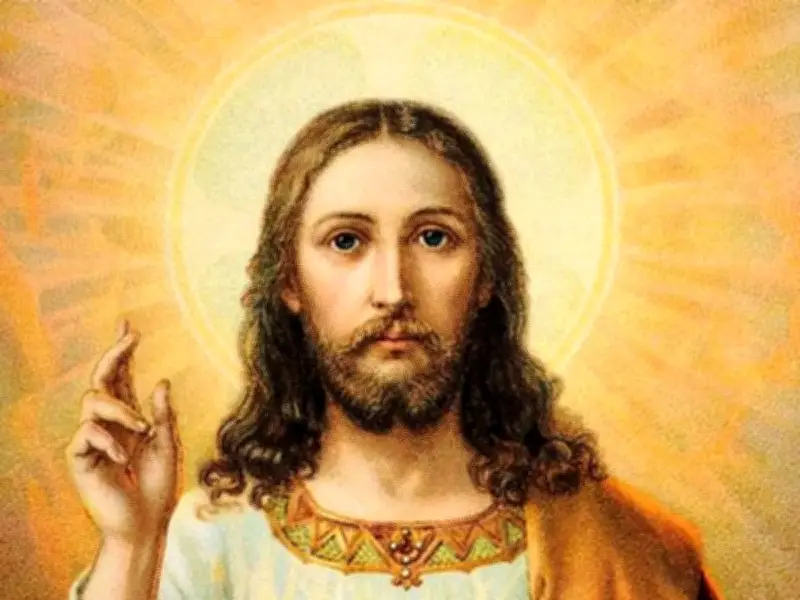
In 1970, archaeologist John Allegro published The Sacred Mushroom and the Cross, a book arguing that Jesus Christ was not a person but a psychedelic drug. Through analysis of the New Testament, Allegro claimed to find code words for psychedelic rituals, declaring that every miraculous happening was in fact a drug trip.
The book was dismissed as fantastical nonsense at the time, but academics are now showing renewed interest in it, according to Popular Mechanics. In 2009, Gnostic Media Research & Publishing released a 40th anniversary edition of The Sacred Mushroom, and the book was later featured on Joe Rogan's podcast.
Allegro's background and theory
Before his controversial book, Allegro was known as an expert on the Dead Sea Scrolls, a collection of nearly 1,000 ancient Semitic texts around 2,000 years old. Bedouin shepherds first found them in a cave along the Dead Sea's shores in 1947. Throughout the 1950s, archaeologists and other Bedouins discovered more scrolls and text fragments in a total of 11 caves. The Dead Sea Scrolls are now seen as the oldest known evidence of written Hebrew.
Allegro argued that the New Testament's authors used encoded language to invoke a secret fertility cult dating back to ancient Mesopotamia. This sect used psychedelic substances, namely the Amanita muscaria mushroom. He reached this conclusion by using Sumerian, the language of ancient Mesopotamia.
Linguistic challenges and criticism
“For him, Sumerian was almost this sort of panacea to all the linguistic challenges that scholars of the Old and New Testament faced,” says Geoffrey Smith, PhD, an associate professor of religious studies at the University of Texas at Austin and director of the Institute for the Study of Antiquity and Christian Origins. “I think he believed that Sumerian basically just blows the whole Bible wide open.”
Allegro believed Sumerian had a connection between the New Testament's Greek and the Old Testament's Hebrew and Aramaic. He also believed the Mesopotamian fertility cults continued underground through Roman times. However, linguists do not think Sumerian is the language bridge that Allegro believed it to be, according to Smith.
“A lot of his argument is based on Sumerian, and some of the reviews of the time by people who know that language [were] like, ‘This doesn’t make any sense,’” says Matthew Goff, PhD, a professor of religion at Florida State University. “They’re saying, ‘I don’t think this guy knows Sumerian as much as he claims to.’”
Psychedelics in the Bible
Allegro's methodology was unsound. However, there may have been some presence of psychedelics in the Bible. “It’s possible his method was wrong, but he got to the right place,” Goff says.
This is particularly relevant when it comes to Jesus' time in the desert. “I’m not a doctor, but I think if I was out in the desert without food for 40 days I’d probably see all sorts of interesting things,” Goff continues.
There is ample research on the importance of psychedelics in many religious rites, but it could be understated in the Bible. “It’s always the Amazon or the Hopis in the Northwest in those traditions,” Goff says. “Their visions, their ecstatic experiences were triggered by peyote or ayahuasca.”
“Allegro’s general intuition about the ritual use of hallucinogens across the Mediterranean and Near Eastern cultures that gave rise to biblical tradition has witnessed some corroboration in recent years,” says Brian Muraresku, author of The Immortality Key, which investigates whether early Christian rites included hallucinogenic communion wine.