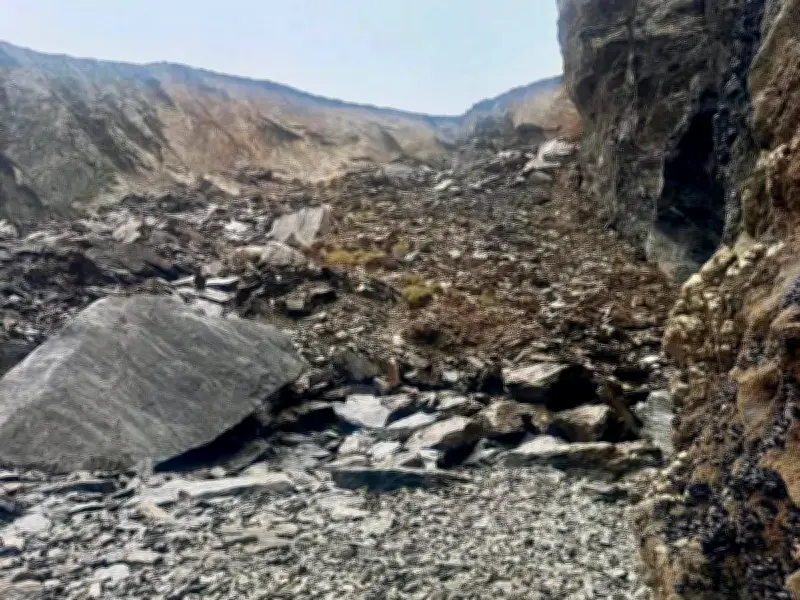
Holywell Cave in Cornwall, which featured in the BBC series Poldark, has collapsed following a cliff fall, leaving the popular site inaccessible.
Collapse at Holywell Cave
The cave, also known as St Cuthbert's Cave, is located in Holywell Bay near Newquay. The collapse is believed to have happened overnight on Saturday. The grotto, tucked beneath the southern cliffs of Kelsey Head, was known for its multi-coloured walls and white steps, formed by calcareous deposits from mineral-rich water dripping from the roof.
Newquay Coastguard said a "substantial rock fall" has sealed off the cave and urged people to avoid the area as it is "still unstable". The cave could be accessed at low tide from the north-east end of Holywell Bay beach.

Poldark filming location
According to the National Trust, which is understood to have guardianship of the cave, Holywell was one of the filming locations in the BBC's Poldark series. Chris Barnard, who lives near Callington, Cornwall, told the BBC he and his wife previously ran Poldark tours because it was one of the locations the BBC drama was filmed.
He told the broadcaster he was "shocked" when he saw the photographs of the collapse because it's such an "iconic" and "popular" location. "The fact it's gone is not nice... it's gone forever," he added.
Historic site and warnings
For centuries, thousands of people descended the steps of Holywell Cave to drink from the holy well. It was popular with pilgrims and people suffering from health problems, as the water was thought to possess healing properties.
Holywell Bay Surf Life Saving Club said in a Facebook post on Sunday that it was "deeply saddened" that the cave was no longer accessible after a "massive overnight rockfall" had "completely devastated the area". Steve Peck, the club's chairman, said: "As soon as the tide was low enough, a team surveyed the scene to find thousands of tonnes of rock and debris scattered on the north end of the beach, completely smothering the ancient holy well.
"There have been reports in the lead up to the collapse that huge cracks and holes were forming above the cave causing an overhang on the Kelseys above. As it's tidal, it cannot be cordoned off but we are warning all visitors to the area to keep away from the cliff path. The unusually dry summer and the recent rain could be a contributing factor."
David Hawken, the clerk at Cubert Parish Council, urged people in the area to take extreme care and warned that other parts of the cliff could also be at risk. "It's not the only cliff fall along that stretch of beach. We've had such a dry period followed by rain, which may have had an effect," he said.
Mr Hawken said he visited the scene on Sunday morning and saw a number of people examining the rockfall. "The low tide was around 2pm and you could see how much has fallen," he said. "I'd say there were hundreds of tonnes now covering the cave. Sadly, I won't see it again in my lifetime. If the cave itself hasn't collapsed then nature will eventually take care of it, but it could be some time."