A groundbreaking study has uncovered a devastating environmental trade-off, revealing that chemicals introduced to safeguard the Earth's ozone layer have inadvertently unleashed a global tide of toxic 'forever chemicals'.
The Unintended Consequence of Environmental Protection
Back in the 1980s, scientists made a chilling discovery. Coolants used in everyday appliances like refrigerators and car air conditioning systems were actively destroying the ozone layer. This crucial atmospheric shield protects our planet from the sun's harmful ultraviolet radiation. In response, a worldwide push led to the phase-out of these ozone-depleting substances, known as chlorofluorocarbons (CFCs).
They were replaced with what were believed to be more environmentally friendly alternatives. However, atmospheric scientists from Lancaster University have now calculated a catastrophic side effect. These replacement chemicals have unintentionally spread a staggering 335,500 tonnes of toxic 'forever chemicals' across the globe.

A Persistent and Pervasive Pollutant
The chemical in question is trifluoroacetic acid (TFA), a type of per- and polyfluoroalkyl substance (PFAS). These human-made compounds are notorious for their extreme persistence, taking over a thousand years to break down in the environment. The study, published in the journal Geophysical Research Letters, used sophisticated chemical transport modelling to trace the origins of this pollution.
'Our study shows that CFC replacements are likely to be the dominant atmospheric source of TFA,' stated lead author Lucy Hart. 'This really highlights the broader risks that need to be considered by regulation when substituting harmful chemicals.'
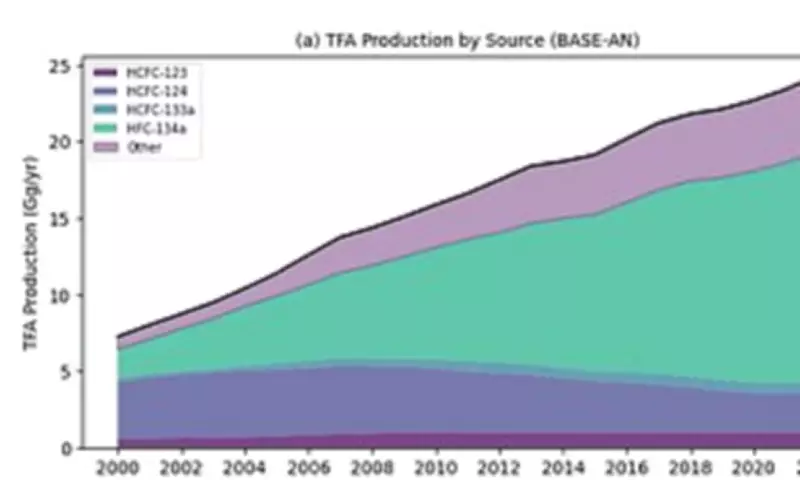
The research pinpointed hydrochlorofluorocarbons (HCFCs) and hydrofluorocarbons (HFCs) – now common in refrigeration and some inhalation anaesthetics – as key sources. Alarmingly, TFA production from these sources increased 3.5-fold between 2000 and 2022. Even more concerning is the modelling which shows that almost all TFA found in the remote Arctic, far from emission sources, originates from these CFC replacement chemicals.
Human Health and Environmental Risks
The scientific community is raising urgent alarms about TFA. Studies have already detected this persistent chemical in human blood and urine. Experts have recently proposed classifying it as potentially toxic to human reproduction. Animal studies have linked TFA exposure to birth defects, and similar short-chain PFAS are known to be toxic to freshwater organisms.
Although some regulatory agencies consider current environmental levels below immediate harm thresholds, the irreversible, accumulating nature of TFA has led to calls for it to be designated a 'planetary boundary threat'.
The New Generation of Chemicals and Future Uncertainty
The problem is set to evolve further. The researchers identified HFO-1234yf, used in modern car air conditioning systems and marketed as a climate-friendly alternative, as an important and likely growing source of atmospheric TFA.
'A number of HFOs are known to be TFA-forming,' explained co-author Professor Ryan Hossaini. 'The growing use of these chemicals for car air conditioning in Europe and elsewhere adds uncertainty to future levels of TFA in our environment.'
Professor Hossaini emphasised the long-term challenge: 'Although HFC use is gradually being phased down, this TFA source will remain with us for decades. There's an urgent need to understand other TFA sources and to assess TFA's environmental impacts.'
A Widespread Contamination Problem
The contamination is already pervasive. Separate research last year detected TFA in 31 out of 32 major rivers tested across the United Kingdom. Professor Alistair Boxall of the University of York warned that people are likely drinking water containing TFA every day, leading to a lifetime of low-level exposure – a scenario of significant concern for public health.

This study serves as a stark warning about the complex, unintended consequences of environmental policymaking. While the Montreal Protocol of 1987 successfully curbed ozone depletion, its chemical legacy now presents a new, persistent, and global pollution crisis that demands a concerted international effort to monitor, understand, and ultimately mitigate.