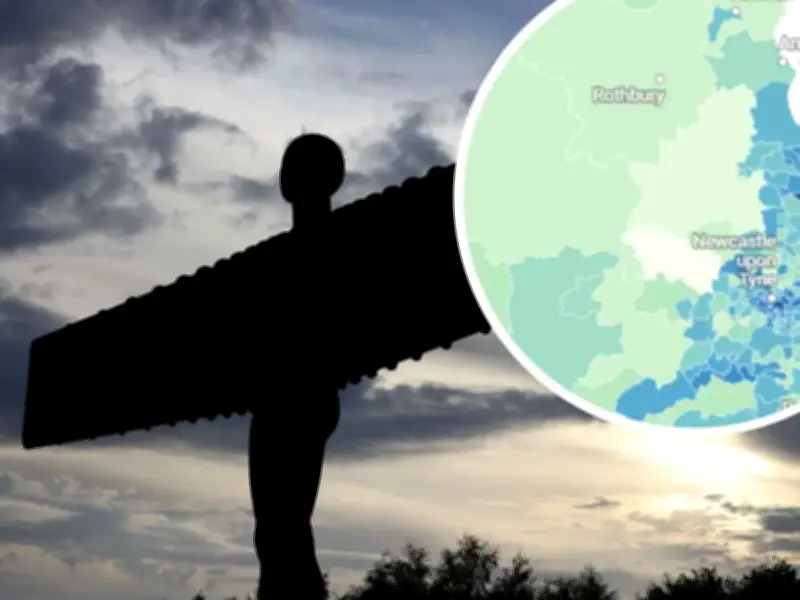
A stark new report shows that in some areas of the North East, life expectancy can be as much as 18 years lower than elsewhere in the country. The new analysis, shared by Health Equals as part of its “Shelf Life” campaign, also reveals huge disparities within the North East itself.
For example, in Newcastle, someone born today in Byker South and St Peter’s can expect to live to 72 – thirteen years less than counterparts in South Gosforth, where people are likely to reach 85 on average. The data is based on small areas where the population is between 5,000 and 15,000.
Regional disparities laid bare
The issues are repeated across local areas – there is a fifteen-year disparity between areas of Northumberland, an eleven-year gap in County Durham, and a thirteen-year difference between areas of Sunderland. Health Equals is calling on the Government to ensure tackling health inequality is central to decision-making across departments.

Overall, the data shows a clear North-South divide. Of the 100 areas with the lowest life expectancy in England, 81 are in the North East, North West or Yorkshire and the Humber. Of the remaining 19, 14 are in the Midlands. Blyth Cowpen, Byker South and St Peter’s, Newton Aycliffe West and Grangetown in Sunderland are all among the bottom 100.
By comparison, of the 100 places with the highest life expectancy, 70 are in London, the South East or the South West. In the region, only Darras Hall, Stamfordham and Heddon is in the top 100.
Healthy life expectancy figures
When the Office for National Statistics examines how much of our lives we can expect to live in good health, the results are also alarming. Looking simply at how long women should expect to be healthy, in Blyth Cowpen the most recent answer is just 52.5 years.
In the Hendon and Docks area of Sunderland, it is 52.6, while Newton Aycliffe West, Elswick South, Stanley South, Horden, Murton North and Parkside and Byker South and St Peter’s are all seeing women live less than 54 years in good health.
By comparison, women living in Knightsbridge, Belgravia and Hyde Park in London can expect to be healthy for 81.2 years – just short of a 30-year chasm.
Campaign for change
This is why Health Equals is campaigning for change. Paul McDonald, director of Health Equals, said: “Your postcode shouldn’t determine your shelf life. But in the UK, it does. Let’s not forget that behind these figures are real people with families, loved ones, jobs, hobbies – and their lives are being cut short because of things out of their control. This should be considered a national crisis.”
“This isn’t just bad luck or down to individual choices—it's because too many people don’t have access to the basics that help us stay healthy. And these inequalities don’t just affect individuals—they hold back families, jobs and our economy, and put pressure on services like the NHS.”
“Our health should be a national priority, and change is possible. Health Equals is calling for a change in the law to make improving health and tackling inequalities a legal duty for this and future governments. If Andy Burnham is serious about creating good growth in every British postcode, this will be one of his first priorities in Number 10.”
Local authority breakdown
Here is how the seven local authority areas in the region fare:
Newcastle: Byker South and St Peter’s has the 16th lowest life expectancy in the country, while Coxlodge and West Gosforth and South Gosforth are both in the top 500. The difference between those areas is a stark 13 years.
Gateshead: Gateshead Town has one of the lowest life expectancies on average in the country. Just 17 local areas in England see people expected to live less than the 72 years likely there. But there is a large spread – with areas such as Rowlands Gill and Lockhaugh and Whickham (both 84 years) seeing a much healthier outlook.

Northumberland: In a county as huge as Northumberland, there is significant variation. Broadly, the towns of the south-east are among the lower reaches of the life expectancy table. Blyth Cowpen (with an average life expectancy of 71 years) is the lowest, but all of Blyth Town, Ashington Hirst, Newbiggin, Ashington East, Bedlington Station, Blyth Isabella, Cramlington Town and Berwick-upon-Tweed have an average of less than 80 years. In the traditionally more affluent areas – such as Darras Hall, Stamfordham and Heddon – life expectancy hits 87, just three years below the highest figure seen nationally.
North Tyneside: North Tyneside sees a ten-year disparity of life expectancy if you travel inland from Whitley Bay North to Chirton in North Shields. The former has an average life expectancy of 85, while the latter falls to just 75 years. That is also the case for Percy Main.
South Tyneside: South of the river Tyne, there is an 11-year gap between life expectancy in Cleadon and East Boldon (86 years) and in South Shields West (75). Tina Roche, 69, lives in Whiteleas and is backing the campaign. She said: “I think it's a vital campaign and it is something I am so interested in. It's about how do we help people to keep being well. It's so important and shows we need to look at building blocks and how can we change things and make it better for the people living here.”
Sunderland: In Sunderland, the Hendon and Docks area is among the lowest for both life expectancy and healthy life expectancy. Life expectancy is just 72 years – 13 years fewer than along the road in Fulwell, or a few miles south at Herrington and Doxford Park, where people can on average expect to live until they are 85.
County Durham: Tudhoe Grange on the outskirts of Spennymoor is the place in County Durham with the highest average life expectancy at 84, just five years off the London maximum. However, there are 39 areas in the county where people can expect to live on average a decade less than in the leafiest parts of the country, and in some places such as Newton Aycliffe West, the gap hits 16 years – there life expectancy is just 73.
Next steps
Health Equals is calling for the Government to embed working to reduce health inequality across departments. The campaign also has a postcode checker tool on the Health Equals website which can help people find out how they are affected and to contact their MP.