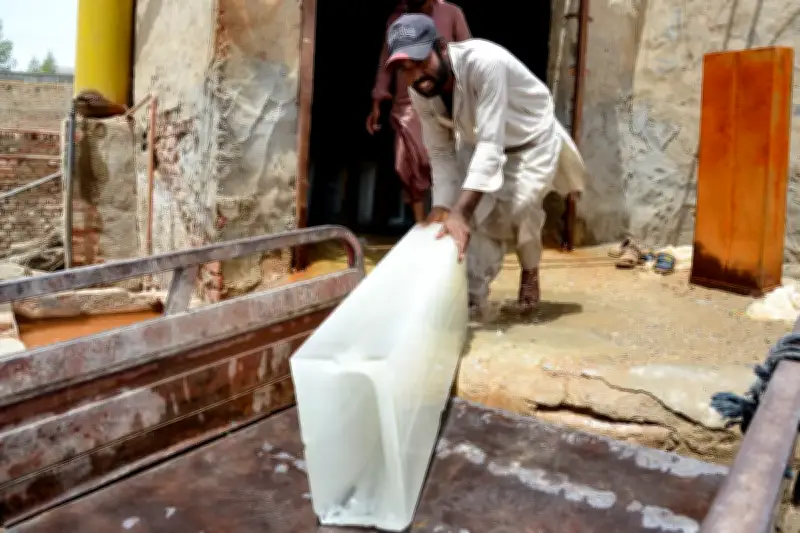
In Nasirabad, a town in Pakistan's Balochistan province, families with limited electricity and poor ventilation rely on daily ice collections to endure temperatures that can reach up to 50C. As the first light reaches the town, a queue of men, women and children forms outside the ice factory, carrying buckets, sacks and plastic containers.
Among them is 12-year-old Taimoor, in his school uniform, who says buying ice is his most important task of the day. “If I do not bring the ice, how will we endure the heat at home?” he asks. “And how will we drink water that feels as though it is boiling?” After collecting his share, he hurries home to drop it off before setting out for school, keeping a small portion in a plastic container to cool him on the journey. By 8am, the sun is hot and he wets his face with the meltwater.
A town without reliable electricity
Nasirabad is a small town about 25 miles (40km) from Turbat in Kech district, surrounded by mountains and date-palm orchards. Most residents live in mud-built houses. Electricity is available for about three hours a day, and the voltage is often too weak to operate a fridge reliably. Those who can afford solar panels use them to power fans and, in some cases, fridges during daylight hours. For everyone else, the only defence is the ice collected each morning.

Taimoor's mother is pregnant with her second child. Having experienced two miscarriages, she fears that walking to the factory herself and carrying ice through the heat could endanger her pregnancy.
Heatwaves and rising temperatures
The intensity of heat in Nasirabad places the town near the frontline of a wider warming trend. In a heatwave warning in May 2026, the Pakistan Meteorological Department included Turbat in the regions expected to face temperatures reaching between 46C and 50C. Extreme heat has become a defining feature in Asia, with the World Meteorological Organisation (WMO) suggesting the continent is warming nearly twice as fast as the global average. Globally, the 11 years up to 2025 were the 11 hottest ever recorded, according to the WMO.
In Nasirabad, these planetary trends are experienced through the temperature of a glass of water, the length of a queue and whether a family can afford to keep a fan running.
The ice factory as a cooling centre
Mohammad Haider owns Nasirabad's ice factory, which he says was established by his late father in 1992. Every morning at about 7am, workers raise the metal shutter and within two hours, all 400 blocks produced overnight are usually sold. Haider's factory has effectively become Nasirabad's cooling centre, although its limited production cannot meet the needs of everyone who depends on it. He says almost all the ice is bought to cool drinking water. Demand is so high that some residents queue up only to leave empty-handed.
“It saddens me when people cannot get ice before it runs out,” he says. “They then have to spend the entire day drinking warm water.” In the evening, residents often gather outside, where he offers them cups of cold water without charge, while another batch freezes for the following morning. Those who miss the morning distribution sometimes buy ice from residents who bought more than they needed. A piece bought for 40 rupees (11p) may later be resold for 80 rupees, Haider says.
Adaptation and vulnerability
Pakistan ranked 147th in the 2024 Notre Dame Global Adaptation Initiative country index. Its relatively high vulnerability and low readiness scores indicate that exposure to climate hazards is compounded by limited institutional and economic capacity to respond.
Each morning, 66-year-old widow Raj Bibi fills several bottles with water and carries them to a neighbour who owns a refrigerator powered by solar panels and allows her to store them inside. Bibi cannot afford ice or a solar system of her own. She returns in the evening to collect the cooled water, hoping it will remain drinkable through the night. “The day passes in heat and suffocation,” she says. “There is no electricity to run a fan, and I cannot afford solar panels.”

Even households with solar panels remain vulnerable. Many cannot afford the expensive batteries needed to store the electricity generated during the day. Families often carry bedding outside and sleep beneath the sky. The distinction between households is determined by who can afford each layer of adaptation – panels, batteries, refrigerators, water and ice – and those who cannot.
Persistent heat and limited options
The extreme heat has persisted through the summer. In its forecast for August, the Pakistan Meteorological Department predicted very hot and dry conditions across Balochistan. In its warnings in May, it advised people to avoid unnecessary exposure to the sun, to remain hydrated and use water carefully. Farmers were urged to adjust their activities and protect livestock. But each precaution assumes a degree of choice that many people do not have.
Taimoor cannot avoid the morning sun when his family depends on him to collect ice. Bibi has to walk to her neighbour's house for water. Farmers cannot abandon the orchards that are their income. Women cannot avoid the heat of the cooking fires, as no gas is available and they must cook over burning wood.
Pakistan does have heatwave plans. The National Disaster Management Authority has issued guidelines on preparing for extreme heat, and the Provincial Disaster Management Authority of Balochistan has a district plan for Kech. But residents in Nasirabad say they see little evidence of protections on the ground. Instead they rely on their own fragmented system: solar panels without batteries, neighbours sharing refrigerators, families sleeping outside and one factory producing 400 blocks of ice each night.